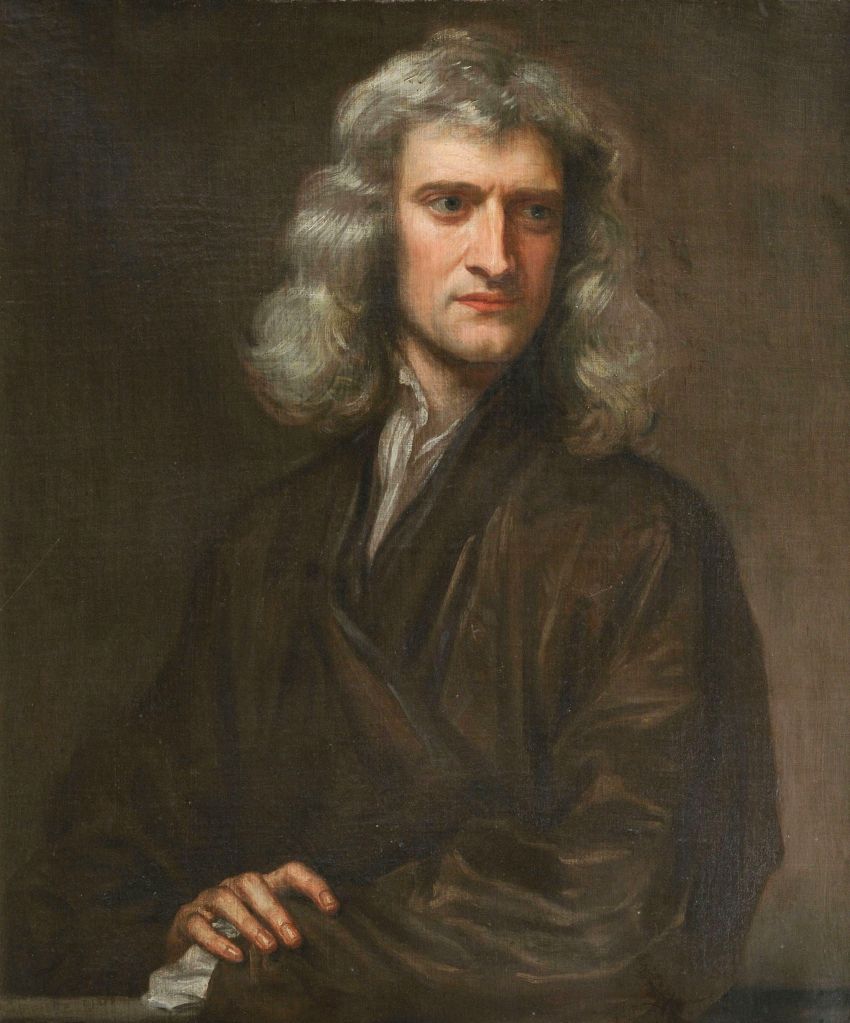
When Isaac Newton and Robert Hooke shared their thoughts in 1679 regarding Hooke’s theory on planetary motion, it reignited Newton’s curiosity in the topic. Having previously examined it in 1664, this prompted Newton to quickly demonstrate that forces decrease in proportion to the square of the distance at the two apsides of an ellipse, suggesting that the relationship applies to every point on an ellipse. Nevertheless, Newton initially kept his discoveries private, and Hooke’s visit did not lead to any immediate response.
A significant shift occurred in 1684 when Edmond Halley came to visit Newton and inquired about the path of planets assuming a force of attraction that is inversely proportional to the square of the distance from the Sun. Newton assured him that it would be an ellipse and asserted that he had performed the calculations. Although he didn’t present Halley with his earlier computations, this motivated him to write the nine-page manuscript “De motu corporum in gyrum” (On the Motion of Bodies in an Orbit), illustrating how the elliptical orbit infers an inverse-square law force, while also suggesting a larger field of dynamics.
With Halley’s support, Newton aimed to enhance his work, dedicating himself from 1684 to 1686, which eventually culminated in the 1687 release of “Philosophiæ Naturalis Principia Mathematica” (The Mathematical Principles of Natural Philosophy), a groundbreaking text that redefined the field of physics. Rather than merely expanding his previous manuscript, “Principia” represented the development of novel concepts through successive drafts.
Newton revised “De motu,” with three manuscripts still in existence: one at the Royal Society, a copy by Halley, and a noticeably different version among Newton’s documents. His introduction of the term centripetal force, in contrast to Huygens’ centrifugal force, showcased Newton’s first major contribution. His renowned three laws of motion were formed from revisions starting with the principle of inertia, transforming hypotheses into five laws, ultimately crystallizing into the three well-known laws.
As he worked on “Principia,” Newton noted gaps in his original manuscript, particularly the absence of universal gravity, and introduced the notion of mass into his dynamics. Influenced by Jean Richer’s experiments that highlighted gravitational differences between Paris and Cayenne, Newton articulated that mass remains constant while weight fluctuates with gravitational force, which can be expressed as F=ma.
Newton also sought astronomical observations from John Flamsteed related to planetary attraction and perturbation, which further bolstered his gravitational theories. Through letters, including support from Edmond Halley, Newton integrated thorough data into his research.
The expansion of “De motu corporum” resulted in Books I, II, and III of the “Principia,” employing extensive celestial mechanics and dynamics. Notably, Halley played a key role in “Principia’s” publication, even personally funding it due to the Royal Society’s financial limitations.
Ending with critiques of Cartesian ideas, Newton challenged Descartes’ mechanical vortex theory with mathematical precision. The “Principia,” while distinct from the practical approach preferred by the Baconian Royal Society, was met with mixed responses, paving the way for the continued investigation of Newton’s revolutionary influence.