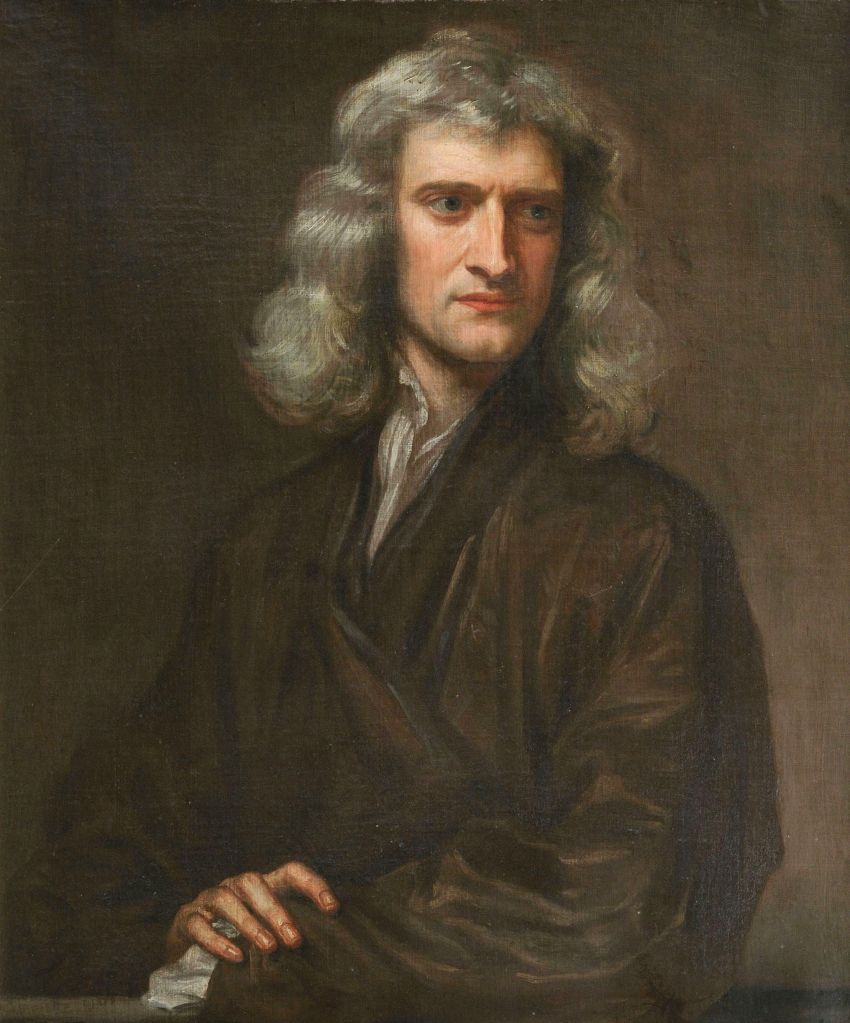
The voyage of Isaac Newton towards penning the Principia Mathematica is rife with tales and folklore. The story often begins with the concept of universal gravitation, an idea thought to have begun forming in Newton’s thoughts as early as the mid-1660s. This epoch, famously associated with the apple anecdote, frequently intertwines with the Annus mirabilis legend, during which Newton, amidst a plague year in 1665, allegedly discovered calculus, optics, and the principles of gravity. Although these assertions are mainly exaggerated, they partially arise from Newton’s own retrospective musings in his quest to establish his dominance over contemporaries like Leibniz.

In his Waste Book, Newton, influenced by Descartes, approached the subject of circular motion, where he did not yet accept the law of inertia but made crucial comparisons between the gravity of the moon and that of Earth. By building on the celestial laws of Kepler and the principles of circular motion proposed by Huygens, he noted the reliability of the inverse-square law in explaining gravitational attraction. While these inquiries were predominantly theoretical, they formed a foundation, although Newton’s active engagement with gravity waned as he explored other pursuits until provoked by Hooke years later.
The critical historical disagreement with Hooke regarding the original conception of universal gravity is significant. Hooke’s correspondence in 1679 and earlier texts proposed that planetary movement was due to gravitation, yet these ideas lacked mathematical substantiation, a deficiency that Newton would address. Hooke’s claims drove Newton to formalize his previous findings and assert his precedence. This rivalry is reflected in Alexis Clairaut’s contemplation of the divide between intuition and proven fact, highlighting Newton’s eventual victory over Hooke.
The renowned coffeehouse meeting in 1684, attended by Wren, Hooke, and Halley, where they discussed elliptical orbits governed by the inverse-square law, became a turning point. When Halley approached Newton, the latter quickly confirmed the elliptical characteristics of planetary trajectories under such influences, much to Halley’s astonishment. Although Newton initially struggled to locate his calculations, his later manuscript, De motu corporum in gyrum, not only resolved the inquiry but also transformed celestial mechanics through its foundational concepts.
Acknowledging the significance of its implications, Halley urged Newton to undertake a broader revision, leading to the detailed Principia. The Royal Society, having been informed by Halley’s accounts, recognized its revolutionary potential. As a result, Newton dedicated his energies to refining his theories, culminating in the landmark three-volume work Philosophiæ Naturalis Principia Mathematica, published in 1687. This masterpiece established the groundwork for contemporary physics, transitioning from a myth-filled history to a mathematically validated reality, solidifying Newton’s legacy in the realm of natural philosophy.
