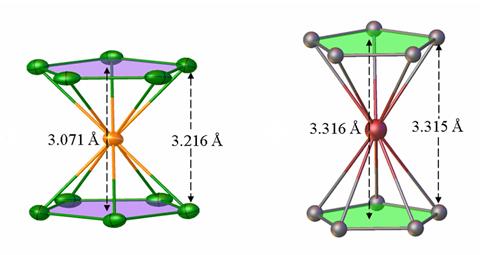
Researchers in India have developed a revolutionary osmium sandwich complex that incorporates two boron-centered rings, representing the inaugural genuine instance of a carbon-free ferrocene analogue. This pioneering compound broadens our comprehension of metal-ligand interactions. Ferrocene, in its traditional form, consists of an iron atom located between two cyclopentadienyl rings. A 2002 discovery unveiled the isolation of a titanium compound featuring phosphorus rings, yet its anionic character constrained its likeness to ferrocene.
In an innovative method, the Indian team combined a square planar osmium complex with borane dimethylsulfide, resulting in a neutral compound that contains an osmium atom flanked by two boron rings (B5H10). X-ray crystallography revealed that these boron rings are slightly twisted relative to the conventional eclipsed geometry of ferrocene, exhibiting a diminished inter-ring distance. This phenomenon is linked to the engagement between the larger boron rings and the diffuse orbitals of osmium, facilitated by bridging hydrogens that pull the rings closer together.
Furthermore, the research group discovered another osmium complex in which one boron-based ring is oriented perpendicularly to the other, alongside its ruthenium equivalent. These comparisons offer enhanced understanding of metal-ligand bonding, with possible ramifications for graphene and borophene intercalations. This investigation signifies a notable progression in the chemistry of metallocenes by broadening the horizons beyond carbon-oriented frameworks.