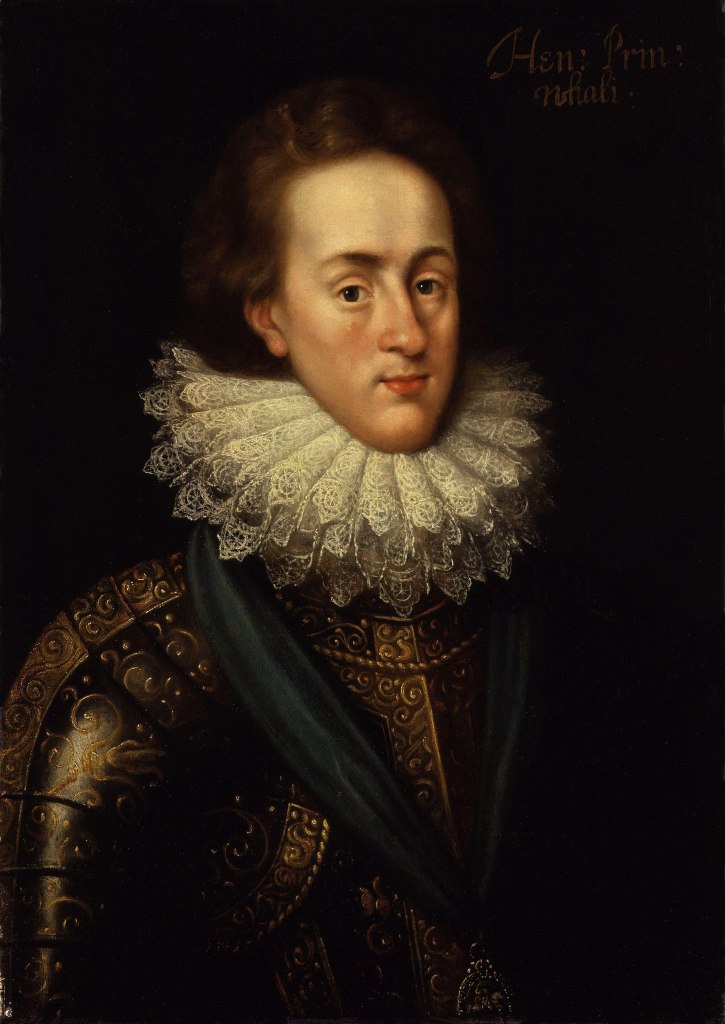
Henry Frederick Stuart, the firstborn of James VI of Scotland (1566–1625) and Anne of Denmark (1574–1619), designated heir to the Scottish throne, was born in Stirling Castle in 1594. His name was chosen in honor of his grandfathers Henry Stuart (1564–1567), the second spouse of Mary, Queen of Scots (1542–1587), and Frederick II of Denmark (1534–1588), a supporter of Tycho Brahe (1546–1601). Upon their marriage, James and Anne visited Tycho’s observatory Uraniborg located on the island of Hven in 1589.

Henry was raised apart from his mother, nurtured by foster guardians at Stirling Castle. His broad and diverse education commenced here, encompassing various sports, music, and dance. In 1603, James ascended to the English throne, becoming James I of England, and Henry soon joined him in England, where he assumed the titles Duke of Cornwall and Prince of Wales, thereby becoming the heir apparent to both the English and Scottish crowns.
His education progressed with James instructing that Henry’s household “should rather imitate a Collage than a Court.” Thomas Chaloner (1559–1615) was appointed as the governor of Prince Henry’s household, which he characterized in 1607 as “His Highness’s household [… ] was intended by the King for a courtly college or a collegiate court” (Wikipedia). As mentioned, his education spanned various subjects. During his teenage years, Henry developed a keen interest in geography, supporting the Elizabethan vision of establishing colonies and creating a British Empire, initially proposed by John Dee (1527–1609) and further advocated by Richard Hakluyt (1553–1616). Additionally, Henry showed a strong inclination towards naval and military matters, which he pursued from an early age.

In 1604, Charles Howard, Earl of Nottingham and Lord High Admiral (1536–1624), introduced Prince Henry to the shipwright Phineas Pett (1570–1647):

Pett crafted a miniature vessel for the Prince at Chatham. The keel measured 28 feet with a breadth of 12 feet and was completed “battlement-wise” like the Ark Royal. On 22 March, Pett presented the vessel to Prince Henry, who named it the Disdain and “entertained it with great joy, being purposely made to disport himself withal.” On 26 April 1604, James I of England awarded Phineas, described as a servant of Prince Henry, a daily grant of a shilling.
[…]
In 1607, Pett created and presented a ship model intended for Prince Henry to Howard. Howard considered the model suitable for the direct attention of King James and the