Every 80 minutes or so, a subtle patch of sky toward the constellation Ara flickers. A surge of radio waves, sharply polarized, lasting a few minutes, then vanishes. Occasionally it turns off completely for hours. For nearly two years, a radio telescope in remote Western Australia kept detecting the same rhythm, time and again, with the relentless consistency of a metronome.
Astronomers refer to signals like this as long-period radio transients, or LPTs. Until now, however, they have had very little understanding of what causes them.
“Long-period radio transients have baffled astronomers for years,” states Kovi Rose, a PhD student at the University of Sydney and CSIRO who led the research. There are roughly a dozen known instances, and for most, the origins have been purely speculative. Slowly rotating neutron stars were the initial favorite. The issue is, a neutron star spinning so leisurely, once every hour or two instead of once a second, shouldn’t be able to emit radio bursts at all, at least not according to the physics we believe we know.
Thus, Rose and an international team sought to unearth the source behind one of these signals. They discovered two stars.
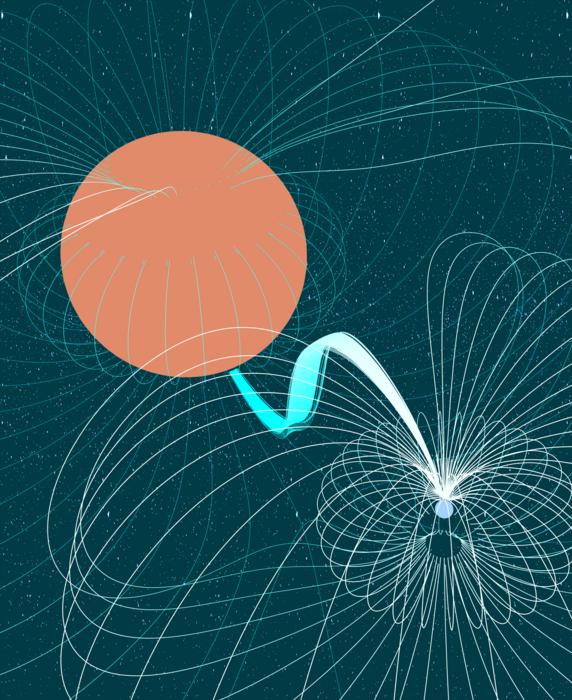
This system, cataloged with the unattractive designation ASKAP J1745-5051, is located somewhere between around 1,300 and 30,000 light years away (determining the precise distance is notably challenging, more on that later). At its core is a white dwarf: the exhausted remnant of a deceased star, about the size of Earth but carrying nearly the mass of the Sun. Orbiting around it, completing a full revolution in just over an hour, is a red dwarf weighing perhaps a tenth of the Sun’s mass. They are in close proximity—far too intimate for comfort. The white dwarf is tearing its companion apart, pulling streams of gas off the smaller star and onto itself.
This cannibalism serves as the engine. As the siphoned material spirals in, it heats up and emits X-rays, while the entangled magnetic fields of the two stars collide and produce the radio bursts. The entire process operates with the precision of the orbit, which is why the signal recurs so reliably.
Here is the clue that revealed the mystery. Although the radio pulses and the X-ray pulses maintain the same period, they do not arrive simultaneously. “Interestingly, the radio and X-ray signals don’t peak at the same moment, indicating they’re generated in different regions of the system,” explains Rose. In other words, the X-rays emerge from the region where the gas falls onto the white dwarf, and the radio waves originate from elsewhere entirely, where the two magnetic fields converge and interact. To validate this scenario, the team also captured the system’s signature in optical light using telescopes in Chile: the characteristic emission lines of hydrogen and helium that define a particular class known as magnetic cataclysmic variables, a type of accreting white dwarf binary that astronomers have studied for decades, but never as a source of an LPT.
The Jupiter Connection
One aspect genuinely astonished them. Within the radio bursts resided a fine, narrow ripple in frequency, a pattern of stripes known as modulation lanes. The only other instance in the universe where this specific phenomenon has been observed in a binary is the Jupiter-Io system, where the moon Io traverses Jupiter’s magnetic field, illuminating the gas giant in radio waves. Observing the same signature here implies the presence of plasma pockets between us and the source, distorting the signal on its journey out, akin to light refracting through frosted glass.
The system is unique in another respect. It is only the third LPT ever detected emitting X-rays, and the first for which astronomers have determined why those X-rays appear and disappear on a set schedule. “Some similar objects had been associated with binary systems before, but this is the first instance where we can clearly observe both stars and the accretion process underway,” states Tara Murphy, head of physics at Sydney and a principal investigator at the gravitational-wave research center OzGrav.
What the Two Stars Still Won’t Reveal
Not everything is straightforward. The problematic distance, varying from approximately 0.4 to 9 kiloparsecs depending on which measurement method is trusted, leaves many properties of the system loosely defined. The team is still unable to measure how rapidly the white dwarf itself spins, which is crucial for clarifying precisely what type of magnetic variable they are examining. Whether the same mechanism accounts for every LPT observed or only this one and its relatives remains an unresolved question.
Regardless, the intrigue of a system like this extends beyond solving a single enigma. These are conditions you simply cannot recreate in a laboratory, magnetic fields in the millions of gauss, matter falling at a substantial fraction of the speed of light, plasma behaving in manners unknown on Earth.