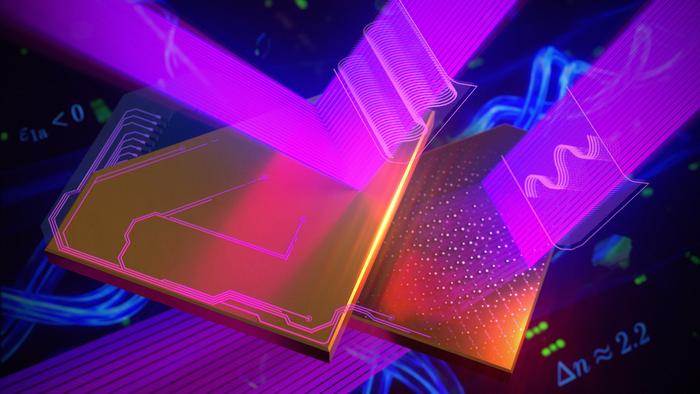
Take a shard of molybdenum oxychloride, place it on a silicon chip, and rotate it slowly under polarized light. At one specific angle, it shines back at you, vivid and yellowish, entirely metallic. Turn it ninety degrees and the gleam vanishes, replaced by the shimmering hues of a transparent film. Identical crystal, identical light, completely different response.
This phenomenon is now identified and quantified. A research team headed by scientists at XPANCEO, collaborating with colleagues from the National University of Singapore and the University of Chemistry and Technology in Prague, has exactly measured how this substance, MoOCl2, divides and directs light. The findings, published in Nano Letters, indicate that it bends light more sharply than any known natural material within the visible and near-infrared spectrum.
The explanation resides deep within the structure of the crystal. MoOCl2 is something physicists rather hesitantly refer to as a “bad metal,” interspersed with one-dimensional chains of molybdenum atoms. Electrons move swiftly along these chains in one direction but are hindered from going sideways, resulting in the material conducting roughly twelve times better in one direction compared to the other. This asymmetry, ingrained in its atomic framework, provides the crystal its dual characteristics: metallic in one orientation, dielectric (essentially a transparent insulator) in the other.
The peculiarities of MoOCl2 had been noted by physicists previously. Past research, some published in Science and Nature Communications, had observed tightly constrained light waves navigating through it in highly directional manners.
However, there existed a notable gap. Researchers could see the phenomena occurring, yet no one had precisely determined the fundamental optical constants that govern these behaviors. Without those figures, developing anything with assurance was akin to constructing a bridge while merely estimating the strength of the steel.
From observation to analysis
“Noticing a phenomenon is the initial step, but engineering demands accurate figures,” states Valentyn Volkov, founder and chief technology officer at XPANCEO and a corresponding author on the research. By assessing the complete dielectric tensor, his team asserts they have provided the field with the essential underpinnings it lacked.
So, what did the findings reveal? Utilizing spectroscopic ellipsometry, a premier method, and substantiating it with Mueller matrix and reflectance analyses, the team charted the crystal’s response from the ultraviolet through to 1700 nanometers. They recorded an in-plane birefringence, the difference in how strongly the two axes bend light, of approximately 2.2. This is a record for a natural substance, significantly surpassing common materials like calcite and rutile. It indicates that light manipulation requiring bulky optics could potentially be achieved with a flake thousands of times thinner than a human hair.
A second unexpected discovery was hidden within the green spectrum. At around 512 nanometers, one aspect of the crystal’s optical response nearly diminishes to nothing.
This is referred to as the epsilon-near-zero, or ENZ, point, and it exhibits a strange behavior: light essentially decelerates while the electric field inside the material amplifies. Many materials experience this condition, but typically in the deep ultraviolet or mid-infrared spectrum, far from where most lasers, cameras, and sensors operate. MoOCl2 achieves this right in the middle of the visible spectrum.
That visible-range ENZ is what catches the attention of photonics engineers, as it suggests chips where light can be compressed, directed, and concentrated within tiny spaces, processed more quickly while consuming less energy. The material’s extreme anisotropy qualifies it as a “hyperbolic” medium, meaning it can channel light into thin nanoscale beams without scattering, a critical requirement for miniaturizing optical circuits. The researchers outline an aspirational list of components: ultrathin broadband polarizers, waveguides that direct light through narrower gaps than traditional optics permit, and nonlinear devices to generate new colors of light. None of this has been constructed yet. However, the foundational design principles now exist.
The disappearing lens
Additionally, there’s the application that gives the entire concept a science-fiction allure. The same attributes that render MoOCl2 appealing for photonic chips are exactly what is desired for the ultra-thin optics inside augmented reality glasses, or, down the line, a smart contact lens that overlays a display onto the environment without others realizing you’re wearing it. The optics for such a device must be reinvented at the atomic level, as there is simply no place to conceal a conventional lens. A crystal that can act as either a mirror or a window depending on its orientation, while being nearly imperceptibly thin, is an enticing starting point. Whether it can withstand the harsh transition from