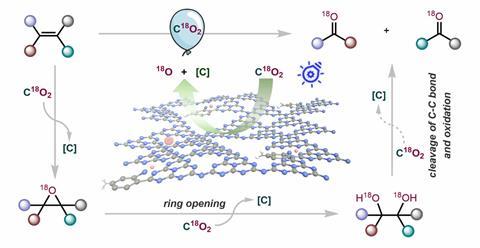
**Revolutionary Method for Green Chemistry: Employing Carbon Dioxide to Photo-Oxidise Alkenes**
Scientists in Germany and other regions have achieved a remarkable breakthrough in green chemistry by showcasing that carbon dioxide (CO2) can effectively be utilized to photo-oxidise alkenes into precious organic compounds under mild conditions. This revolutionary technique, which employs an iron-based catalyst, presents a promising substitute to current methods that frequently necessitate harsh conditions or dangerous substances.
Historically, oxidation reactions account for a considerable segment of the chemical industry’s production, with the oxidative cleavage of carbon–carbon double bonds in alkenes being especially significant. Traditional approaches such as ozonolysis, while successful, raise safety issues owing to ozone’s toxicity and explosion risk. Other alternatives often involve perilous reagents or conditions, or yield harmful byproducts, with even molecular oxygen presenting fire risks in industrial environments.
CO2 distinguishes itself as a safe and plentiful alternative; however, its stability, resulting from weak oxidising properties, presents obstacles. In 2014, a study headed by astrochemist William Jackson at the University of California, Davis demonstrated that under extreme ultraviolet light and high vacuum, CO2 could photodissociate into carbon and oxygen, elucidating abiotic oxygen generation on CO2-dominant exoplanets.
Motivated by this finding, organic chemist Shoubhik Das at the University of Bayreuth in Germany, in collaboration with Matthias Beller’s catalysis group at the University of Rostock, aimed to harness CO2’s oxygen for the oxidation of organic molecules. They formulated a process that utilizes an iron-based photocatalyst supported by modified carbon nitride, facilitating the reaction at ambient conditions using near ultraviolet or visible light in a mixed solvent of acetonitrile and trichloromethane.
The direct cleavage of CO2 remains thermodynamically complex, but the team posits that adsorption on an iron site deforms the CO2 molecule, lowering the energy required for dissociation. Combined with trichloromethane oxidation, the method promotes bond cleavage on the catalyst’s surface, resulting in the effective synthesis of various organic compounds, such as carboxylic acids, ketones, and pharmaceuticals like donepezil and fenofibrate. The team’s model was corroborated through isotopic labeling and several spectroscopic methods.
Das stated that the research team is presently collaborating with industrial partners to upscale the method, and several additional oxidation techniques based on this principle are already in progress. Although the potential applications are encouraging, obstacles persist. As remarked by Bert Weckhuysen from Utrecht University, while CO2’s utilization as an oxygen carrier is creative, the reaction’s sustainability is compromised by the toxicity of trichloromethane, underscoring the necessity for greener solvents to enhance the process’s environmental footprint.
This investigation signifies a major advancement in the application of CO2 in sustainable chemistry, with prospective implications for a broad spectrum of industrial uses, pending further refinement to bolster its practical and ecological feasibility.