It seems that Ihtesham Ali, boasting 29.5k Twitter followers, is a frequent violator. After thoroughly botching an account of al-Khwarizmi’s *al-Kitāb al-Mukhtaṣar fī Ḥisāb al-Jabr wal-Muqābalah*, he subsequently tackled Ibn al-Haytham’s *Kitāb al-Manāẓir* (Book of Optics) in 640 eager words. This piece is not quite the disaster that was his al-Khwarizmi article, yet it too harbors numerous historically inaccurate assertions that merit scrutiny and correction, as they are prevalent and uncritically embraced by those lacking the proper knowledge.
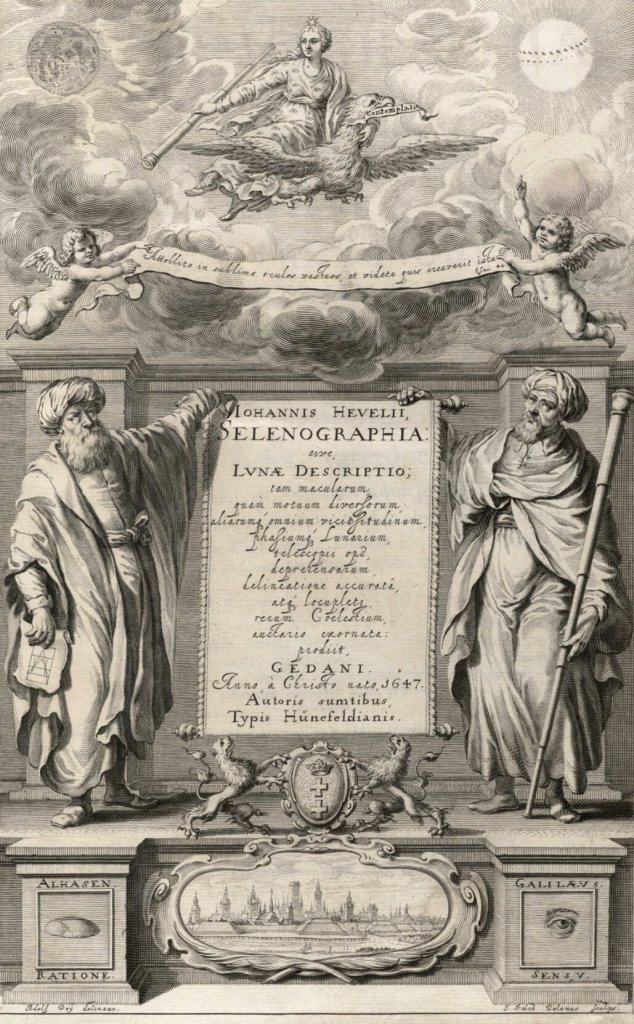
Ibn al–Haytham as envisioned by Johannes Hevelius
Ihtesham Ali: An Arab scholar in 1011 was confined to house arrest in Cairo for a decade. He utilized that time to devise the scientific method, demonstrate how vision truly functions, and author a 7-volume work that Newton assimilated 600 years afterward. I learned about him last night and couldn’t stop reflecting on it. His name was Ibn al-Haytham. The book is titled the “Book of Optics.” The typical narrative credits Bacon*, Galileo, and Descartes as the founders of modern science. Each of them came 600 years post Ibn al-Haytham. All three engaged with his research directly or via Latin translations. The individual who genuinely conceived the scientific method was laboring alone in a solitary room in Cairo while Europe remained in the Dark Ages.
Our writer kicks off with a flourish, declaring that Ibn al-Haytham invented the scientific method, elucidated vision, and authored a 7-volume book that Newton studied half a millennium later. ASTOUNDING! A genuine titan. I will address all three of these assertions separately later; for now, I will focus on the 7-volume book, which implies an enormous work. The *Book of Optics* comprises not seven volumes but rather seven books, where what were referred to as books in earlier scientific texts would now be considered sections or chapters. A suitable comparison is Kepler’s *Harmonice Mundi*, which consists of five books. The Latin manuscript of the *Book of Optics* spans 130 folios, equating to roughly 260 pages. The seven books are:
Book I explores al-Haytham’s theories regarding light, color, and vision.
Book II details al-Haytham’s theory of visual perception.
Books III and IV examine al-Haytham’s notions about errors in visual perception, with Book VI concentrating on reflection-related errors.
Books V and VI offer empirical evidence supporting al-Haytham’s hypotheses on reflection.
Book VII addresses the concept of refraction.
It’s evident that al-Haytham’s *Book of Optics* was inspired by Ptolemaeus’ *Optics* (fl.150 CE). This is crucial to remember when assessing his experimental agenda.
Moreover, it is important to note that Ibn al-Haytham was a genuine polymath, producing academic works across an extensive range of topics, which deserves acknowledgment.
*Roger Bacon read al-Haytham, but as far as I know, Francis Bacon—who is incorrectly credited as the founder of modern science—did not. I doubt that Galileo studied him either.
Ihtesham Ali: Here is a story that is seldom recounted. He was born in Basra around 965 CE. By his 40s he had garnered a reputation throughout the Arab world as one of the most innovative thinkers alive. However, he made the dangerous mistake of publicly claiming he could regulate the flooding of the Nile. The deranged caliph al-Hakim of Cairo summoned him to Egypt for this task. Upon seeing the river, Ibn al-Haytham realized that such a project was unfeasible with the technology of his time. The caliph had executed numerous scholars for far less. Thus, he pretended to be mad. The caliph accepted this ruse and placed him under house arrest in his own residence in Cairo for the ensuing ten years.
There are various accounts of Ibn al-Haytham’s unfortunate experiences with al-Hakim bi-Amr Allah (985–1021), but the most significant point is that after al-Hakim’s death in 1021, Ibn al-Haytham stayed in Cairo for another two decades until his own demise.
Ihtesham Ali: Most individuals would have completely lost their minds. He used that time to create science. Prior to his influence, knowledge operated differently. Scholars quoted authority. If Aristotle claimed it, it was true. If Galen wrote it, it was accepted as correct. The role of a scholar was to memorize