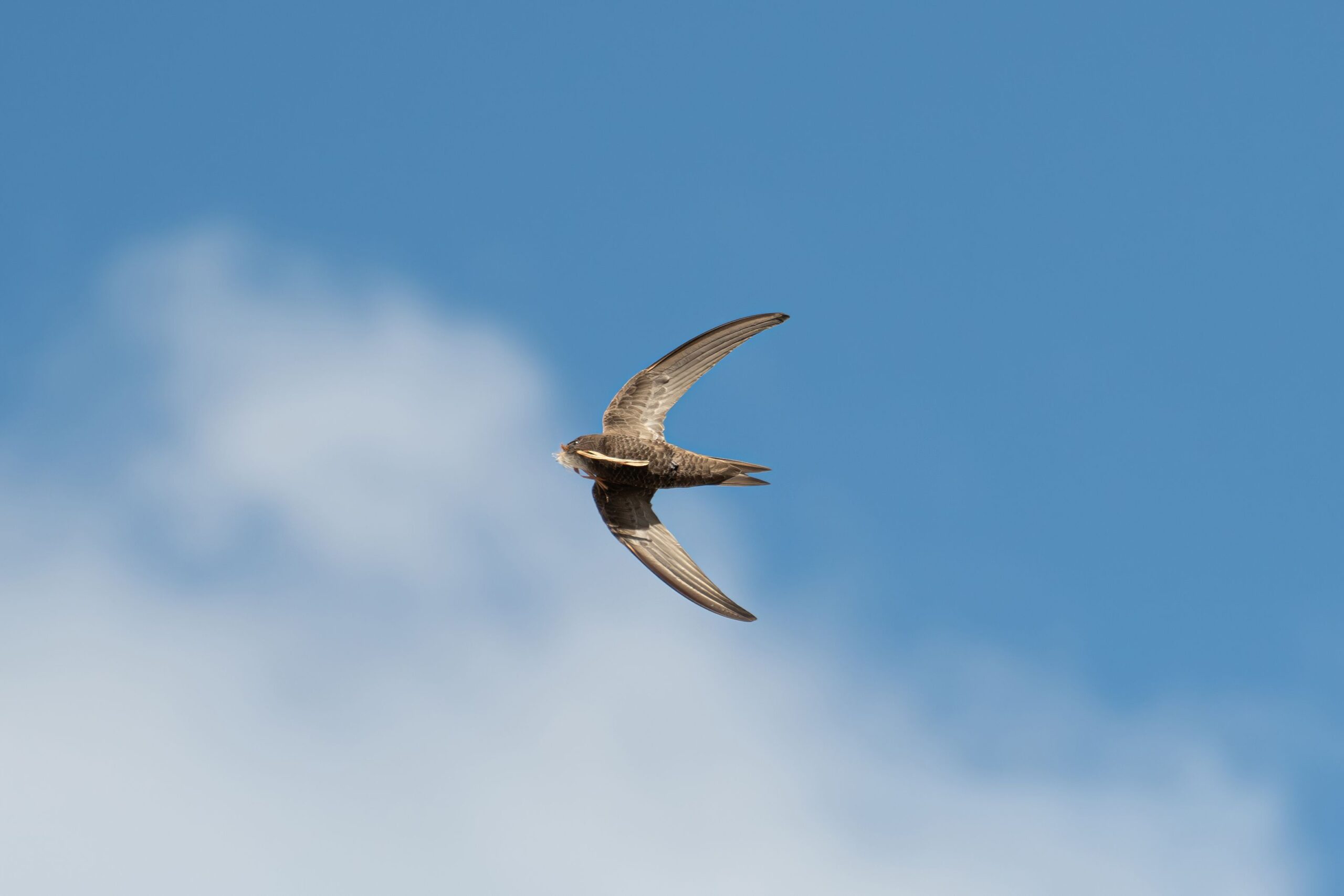
**The Incredible Aerial Existence of the Common Swift**
A common swift departing its nest in late summer doesn’t just initiate a prolonged migration; it embarks on an extraordinary journey where, for nearly ten months, it may not land on solid ground. This assertion, shared among naturalists for years, received scientific endorsement in 2016 through pioneering research that employed tiny devices to monitor the birds’ behaviors.
Researchers from Sweden outfitted adult common swifts at two breeding locations in southern Sweden with micro data loggers. These gadgets, light enough to not interfere with the bird’s natural activities, included accelerometers to log flight patterns. Some models also detected light to assist in tracking the swifts’ geographical positions during their migrations.
The findings, published in *Current Biology*, unveiled an unprecedented dimension of the swift’s existence. The data compiled from 13 recovered devices, including five birds monitored over two successive non-breeding seasons, indicated that these aerial dwellers spent over 99 percent of their time in flight during the non-breeding period. Notably, one bird accomplished an incredible 314 continuous days aloft without a registered landing.
While not every bird completely evaded land, most exhibited only brief stops. Some paused for just a few hours, with a few taking longer breaks overnight. Nevertheless, the duration off the wing remained minimal, with inactivity covering just mere fragments of the days from September to April. This information provides a more intricate understanding: continual flight is not an absolute rule but rather a flexible pattern influenced by elements such as weather, moult, and physiological state.
Crucially, swifts excel at subsisting on air. They capture their insect prey and even collect nesting materials while in flight. Their elongated, aerodynamic wings facilitate efficient high-speed travel, utilizing a flap-glide method to reduce constant wingbeats. The swifts exhibited less visible flight activity during the day, likely gliding with air currents and soaring on thermals.
Despite their remarkable flight abilities, uncertainties persist regarding how swifts fulfill fundamental needs like sleep. While accelerometers captured movements, they could not directly monitor sleep behaviors. Research on other bird species, such as great frigatebirds, has recorded phenomena like hemispheric sleep in flight, but similar observations in swifts are inferred rather than validated.
Throughout their ten-month aerial journey, swifts display intricate behaviors, including significant ascents at dawn and dusk every year. These infrared ascents may assist in navigation or prey detection.
During their stay in Africa, swifts also experience a vital feather moult. Unanticipated links between moult phases and brief inactivity suggest possible reasons some swifts occasionally land.
Drawn back to Europe each year to breed, swifts nest in crevices in buildings, a time when they reconnect with the ground to incubate eggs and nurture their young. Their association with urban environments renders them susceptible to alterations in building practices that block off traditional nesting sites.
The lifestyle of the common swift challenges traditional notions of habitats. While for humans, the ground serves as life’s base, for the swift, it represents a fleeting interlude amidst sky-bound continuity. As researchers persist in examining the physiological and neurological adaptations that enable such aerial prowess, the swift remains a symbol of the limitless marvels of avian evolution.