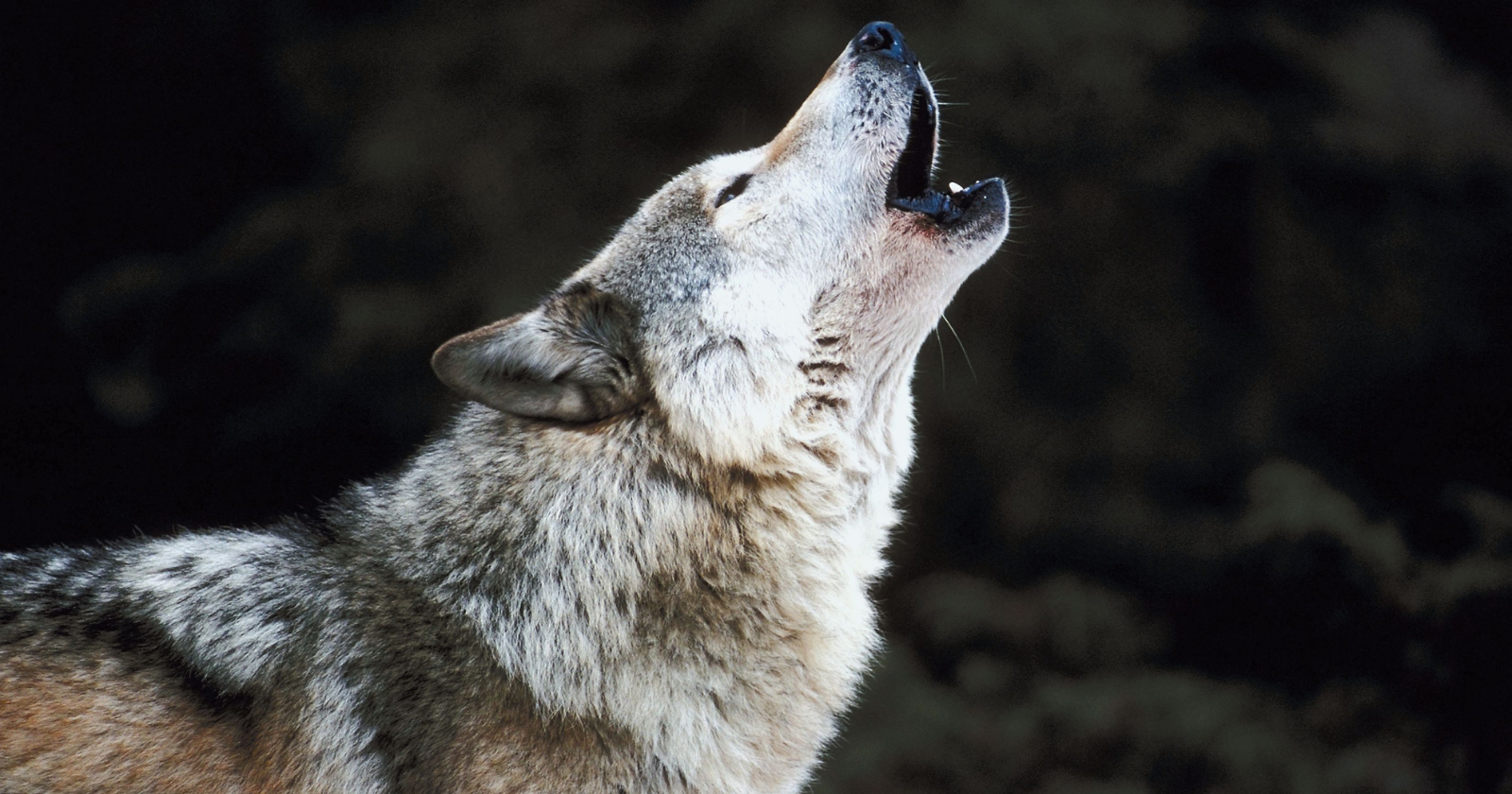
Imagine a vast expanse of open land at twilight, the air calm and cooling, devoid of trees to disrupt it. A wolf raises its head and emits a prolonged, low howl, and the sound travels across the grass and rocks, over a ridge, into a valley, and beyond. This remarkable range is not by chance. A wolf’s howl has been shaped by evolution, not intention, to reach great distances.
## Designed to transmit over open land
The science is straightforward. The [Wolf Conservation Center](https://nywolf.org/2017/02/wolves-and-howling/) states it succinctly: “A howl’s low pitch and long duration is well suited for transmission on the wild landscape.” That encapsulates the entire design in a single sentence.
The function of the howl is just as important as its reach. Holly Root-Gutteridge, who conducted significant research on identifying wolves through their vocalizations, explains the role it plays for the pack. [“Wolves use howling as a territorial defense, to assist in locating other pack members, and also as a social activity: they appear to genuinely enjoy it,”](https://theconversation.com/wolves-howl-like-humans-new-voice-recognition-study-shows-16338) she shared with The Conversation.
The territorial aspect is not merely speculative. A seminal [study by Fred Harrington and L. David Mech](https://pubs.usgs.gov/publication/5221155) in northeastern Minnesota investigated how wolves reacted to simulated howls and the role howling serves in territorial upkeep. It functions as a means of signaling presence without necessitating a meeting between animals. A sound that travels far acts as a highly effective boundary.
## The actual distance it reaches
Certain wolf conservation organizations claim a howl can be heard [up to ten miles](https://nywolf.org/2017/02/wolves-and-howling/) away in clear terrain. However, this represents a maximum rather than a distance that every howl achieves.
Other references suggest lower figures. National Geographic, commenting on Root-Gutteridge’s findings, reported that wolf responses can be heard [six miles (ten kilometers)](https://www.nationalgeographic.com/animals/article/130730-wolves-howling-science-animals-environment). A peer-reviewed study on Indian wolves indicated their howls could be detected over [more than 6 km](https://www.nature.com/articles/s41598-021-86718-w), or almost four miles.
These numbers aren’t necessarily in conflict. The audible range of a howl is influenced by various factors, including distance, weather, ambient noise, and topography. The ten-mile claim is best understood as an upper limit in ideal open terrain, not a normal range. Even the more conservative peer-reviewed statistic is sufficient to carry across numerous valleys.
## Each wolf has a unique voice
Distinct vocal traits characterize individual wolves, and researchers have successfully identified animals based on their howls.
What makes this discovery intriguing is the methodology. Previous efforts to distinguish wolves using pitch-related data achieved around [75.7 percent accuracy](https://phys.org/news/2013-07-technology-scientists-wild-wolves-howls.html). Root-Gutteridge’s group incorporated amplitude data—how the energy of a howl shifts—alongside frequency information.
This additional data proved valuable. The team identified six captive eastern gray wolves with [100 percent accuracy](https://phys.org/news/2013-07-technology-scientists-wild-wolves-howls.html). When applied to recordings of wild eastern gray wolves, primarily from Ontario’s Algonquin Provincial Park, the method again achieved 100 percent accuracy with individual howlers and reached 97.4 percent accuracy with overlapping chorus howls.
A subsequent [study on Indian wolves](https://www.nature.com/articles/s41598-021-86718-w) reached approximately 98 percent accuracy on its training data.
## But can the wolves recognize each other?
Indeed, experimental findings indicate they can. A [2015 playback experiment with captive Iberian wolves](https://brill.com/view/journals/beh/152/5/article-p593_2.xml) tested whether wolves could differentiate howls based on the identity of the caller. The wolves reacted differently to howls from known and unfamiliar individuals, providing the researchers with what they described as the initial experimental proof that wolves can distinguish individuals through the acoustic features of their howls.
The experiment was carried out with captive wolves rather than free-ranging packs howling across kilometers of wilderness, so it doesn’t precisely reflect how recognition occurs over far distances. Nevertheless, the ability to differentiate individuals by howl is more than a plausible hypothesis.
Thus, the scenario remains consistent. The howl transmits over considerable distances, with six miles supported by reports and longer distances occasionally claimed for optimal open terrain. The individual vocal signature is genuine and quantifiable. Additionally, experimental playback studies reveal that wolves can identify individual callers from the