In the Early Modern Period of England, tools for mathematics and science became essential to the sphere of practical mathematics, signifying a substantial cultural shift. Starting in the mid-16th century, the industry focused on instrument-making expanded greatly within the mathematical community, becoming crucial to scientific and mathematical progress by the 17th century. Although these tools had been around since ancient times, their variety and production thrived during this period, arguably shaping the scientific culture of the era.
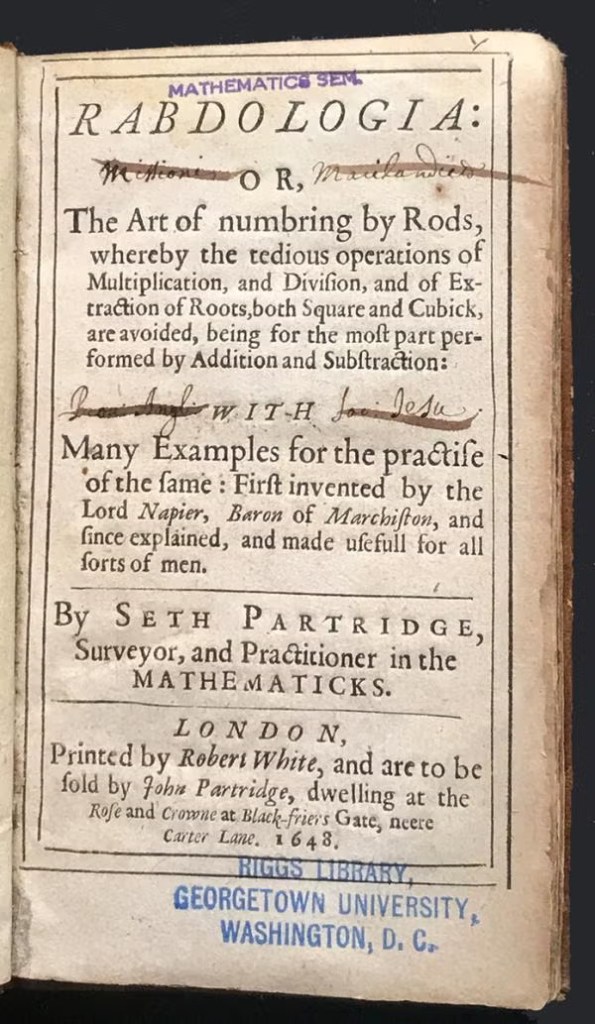
Instruments not only distinguished the era but also impacted the functions of mathematical practitioners—a term that covered multiple professions that depended on applied mathematics. These roles included surveyors, navigators, gunners, architects, shipwrights, makers of sundials, military engineers, and bookkeepers. Individuals often referred to themselves as “practitioner in the Mathematicks,” such as Henry Bond and Seth Partridge, demonstrating the extensive incorporation of mathematical instruments into various work fields.
Gauging, essential for measuring the volumes of barrels or ship holds for customs purposes, was heavily reliant on tools and calculations due to intricate shapes. This practice, along with literature on sundial construction, was common in English mathematical publications during the 16th and 17th centuries, with Johannes Kepler notably discussing gauging with early integration techniques.
Surveying, initially a basic task involving ropes and poles, experienced significant transformations during the 15th and 16th centuries, propelled by the demand for greater precision amidst changing requirements in cartography, legal land ownership, and military logistics. The revival of Ptolemaic cartography in Europe, combined with the need for accurate estate maps and military mapping, called for sophisticated surveying techniques. Gemma Frisius’s introduction of triangulation in 1533 revolutionized surveying, further popularized by his students and contemporaries such as John Dee.
Advancements in surveying tools facilitated this transition. The plane table appeared in the 16th century, creating a portable and effective surveying option. Devices for measuring angles, like the theodolite—first mentioned in Leonard Digges’s writings—and the circumferentor, changed the discipline. Theodolites began to include telescopic sights after 1608, improving the precision of triangulation. The Gunter Chain, established by Edmond Gunter, standardized linear measurements in surveying, while tools like Gunter’s sectors—hinged rules with graduated scales—simplified calculations in the field.
Triangulation required trigonometric calculations, which were revolutionized by John Napier’s logarithms, making computations easier for astronomers and surveyors and showcasing the link between mathematical developments and instrument innovation.
The spread of mathematical instruments also reached gentlemen’s education in the late 16th century, as social changes heightened the need for practical mathematics in estate management, trade, navigation, and administration. This led to a mathematical education focusing on the utilization of instruments, as seen in Edward Stone’s translation of Nicholas Bion’s work, connecting theoretical concepts to practical usage.
This educational focus enabled gentlemen to effectively collaborate with professionals on various mathematical activities, encouraging informed dialogue and computations in estate management, navigation, and bookkeeping. Consequently, mathematical instruments became a cornerstone of practical mathematics careers and education for gentlemen overseeing these initiatives.