An Innovative Shift in Fluorine Chemistry: Secure Pathway to Chiral Alkyl Fluorides
A clever modification of a well-established chemical reaction is transforming the production of chiral alkyl fluorides, presenting a safer and more effective route. This novel method, created by a research team at the University of Oxford, makes use of a safer source of fluorine directly sourced from the mineral fluorspar, greatly simplifying the direct fluorination of alcohols. By reinventing the Appel reaction, this technique avoids conventional harsh conditions and removes the necessity for troublesome reagents often linked to direct alcohol fluorination.
The intricacies and debates concerning the fluorochemicals pipeline are extensively documented. In both pharmaceuticals and polymers, the addition of fluorine functionality has traditionally relied on specialized reagents, mainly produced from hydrogen fluoride (HF). “HF serves as the pinnacle fluorochemical for generating all fluorochemicals, yet it ranks among the most hazardous substances produced on a manufacturing level,” states Véronique Gouverneur, the synthetic chemist spearheading this groundbreaking research. Her ambition is to reshape the fluorochemical industry to be safer and not dependent on HF, opting instead for alternative materials like alkali metal fluoride.
In 2023, Gouverneur’s research team introduced a simple mechanochemical method for generating potassium fluoride (KF) directly from fluorspar, providing a potential decrease in dependence on HF for reagent creation. Building upon this, the team has revisited fluorination techniques, with the goal of streamlining these reactions while replacing HF-derived reagents with KF or its harmless derivatives. Their current emphasis is the direct fluorination of alcohols.
Standard alcohol halogenations usually utilize the halophosphonium-mediated Appel reaction. Nonetheless, its fluorine variant faces a considerable challenge due to a side reaction that produces the inactive difluorophosphorane. This byproduct, which possesses robust phosphorous-fluorine bonds, obstructs the intended fluorination process. Diethylaminosulphur trifluoride (DAST), while proficient, raises serious safety issues, including the potential for explosion under heat.
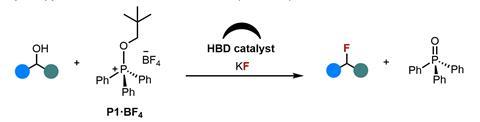
Gouverneur’s team addressed this challenge by redesigning the Appel reaction to inhibit the generation of difluorophosphorane. The breakthrough was realized through postdoc Anirban Mondal’s inventive design of the phosphorus reagent, which included a neopentoxy group to decelerate the undesirable side reaction. This modification allows sufficient time for the reagent to activate alcohol substrates for fruitful fluorination.
Combined with a urea catalyst and KF, the new reagent generates a monofluoro intermediate capable of activating alcohols via substitution with the neopentoxy group. The urea catalyst subsequently removes the fluoride from the phosphorus center, setting it up for nucleophilic attack on the activated alcohol. Investigating various urea catalysts enabled the team to perform asymmetric reactions, transforming racemic alcohols into chiral fluorides.
“This research marks a notable progress,” remarks Miriam O’Duill from the University of Nottingham. She emphasizes the potential for this technique to resolve persistent issues in enantioselective fluorination within medicinal chemistry. Furthermore, the method’s wide-ranging applicability, encompassing ketone and aldehyde functionalities that are not compatible with DAST and intricate alcohols derived from natural sources, distinguishes it as a versatile answer.
For Gouverneur, the most striking accomplishment is the elegant simplicity of the reaction. “It’s a multifaceted process, yet we provide a solution that is both aesthetically pleasing and uncomplicated,” she asserts, highlighting the importance of this progress in fluorine chemistry.