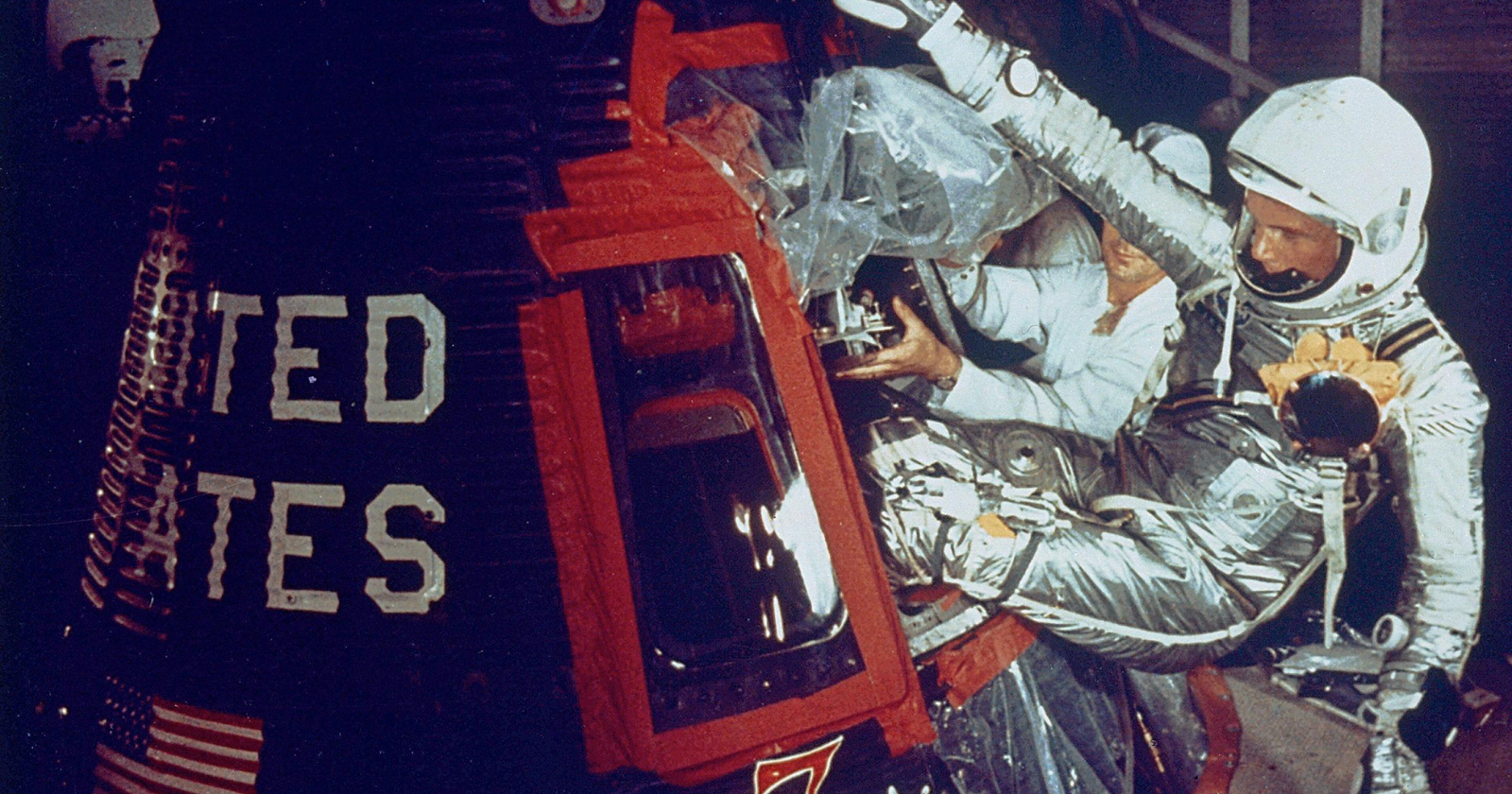
The phrase that brought Katherine Johnson fame was uttered by another individual, and it was not complimentary.
“Have the girl verify the numbers.” That was John Glenn, in the days leading up to the flight that would establish him as the first American to orbit the Earth. The girl referred to was Johnson, a 43-year-old research mathematician at NASA’s Langley Research Center in Virginia. She was requested to validate a computer’s calculations.
She performed the checks, and the figures were accurate.
What she was really verifying
Glenn’s three-orbit path had been calculated on IBM computers linked to a global network of tracking stations, a system NASA constructed from the ground up since nothing of that magnitude had ever been attempted before. As Margot Lee Shetterly reveals in NASA’s own biography of Johnson, the astronauts were hesitant to entrust their lives to calculation machines that could malfunction or crash. Therefore, Glenn sought one individual to manually rework the same equations using a mechanical calculator.
According to Shetterly, this process took a day and a half.
Why she was chosen
Johnson had not only performed such calculations before but had also contributed to authoring them. In 1960, she and engineer Ted Skopinski co-wrote a NASA technical note on determining azimuth angle at burnout, which in simpler terms is figuring out the correct orientation for a spacecraft when its engines cease. Miscalculating that angle could lead to the capsule landing in the wrong ocean. Langley’s Flight Research Division had never released a report with a woman credited as an author before. She had also conducted trajectory analysis for Freedom 7, Alan Shepard’s suborbital flight in May 1961 and the first American crewed space mission, making her a trusted colleague whose calculations had already successfully supported an astronaut.
Her journey at that site began elsewhere. She was recruited in 1953 into the all-Black West Area Computing section, a group of women who manually processed flight-test data, and within two weeks, Dorothy Vaughan transferred her into the Flight Research Division.
Uncertainty about the timing
So precisely when did Glenn make the request? The exact timing remains unclear.
In an account chronicled by Robert Pearlman for Space.com, Shetterly mentioned that she sifted through boxes of Project Mercury documents and computer printouts in search of a record, but to no avail. Johnson, reflecting on the incident more than fifty years later, estimated it occurred weeks prior to the launch, though her account varied slightly in different interviews. Shetterly concluded that it likely happened shortly before the flight, on a date she never managed to pinpoint.
Part of the confusion stems from the mission itself. Glenn’s launch was originally scheduled for the week of Christmas 1961, then shifted to 16 January, then 27 January, and again to 1 February, and twice more in mid-month, with each attempt postponed due to weather or equipment issues. During one of those delays, he lay on his back inside the capsule for almost six hours, waiting for a break in the clouds that never materialized.
What was altered in the film
Hidden Figures, the 2016 movie, condenses all this into a launch-pad crisis, featuring Johnson racing to Mission Control with a piece of paper while Glenn awaits on the rocket. Director Ted Melfi has candidly explained the rationale: extensive days of calculations do not translate well to film, so in the movie, it unfolds in just 25 seconds. In reality, Johnson was in Virginia on the day of the launch while the flight controllers were situated in Florida.
Friendship 7 ultimately launched from the pad at 9:47 am Eastern on 20 February 1962. Glenn <a href="https://www.nasa.gov/image-article/liftoff-of-john-glenns-f