**Indo-Pacific Bottlenose Dolphins Display Tool-Using Behavior in Hervey Bay**
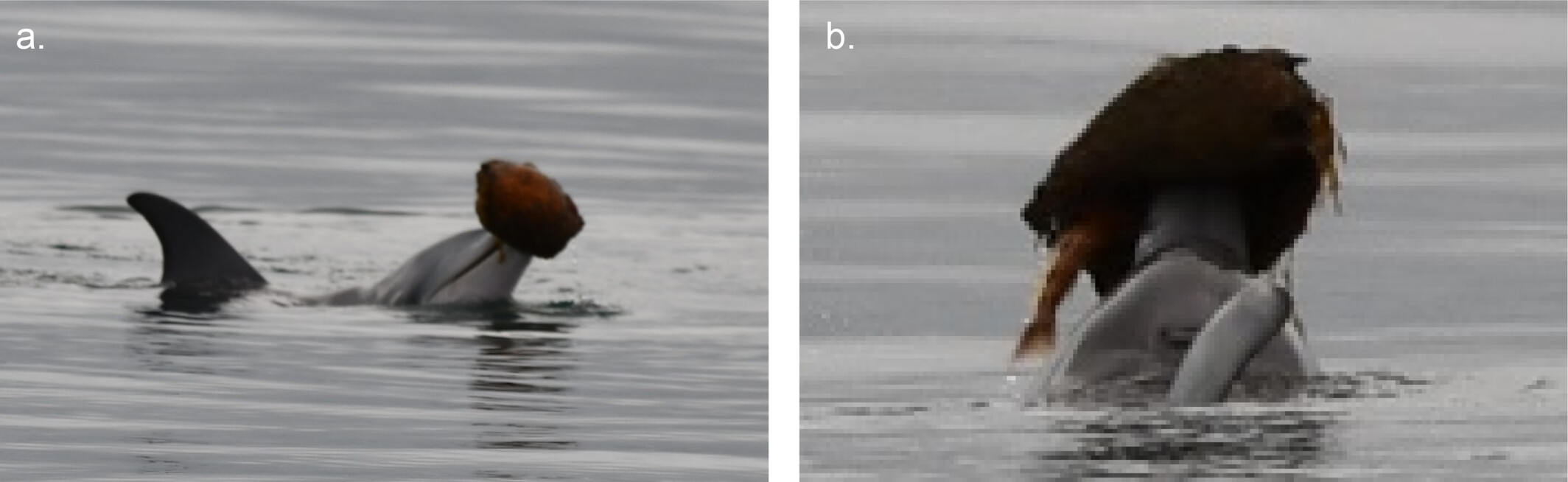
On 1 October 2025, an Indo-Pacific bottlenose dolphin named Maserati was seen demonstrating an intriguing behavior that may suggest tool use is being transmitted from mother to calf among dolphins. This incident took place at 9:01 AM in the tranquil waters to the north of Urangan, Queensland. Maserati emerged with her snout in a large bailer shell, and a research drone recorded footage of a fish escaping the shell.
Shortly thereafter, Maserati’s calf, Bentley, appeared with the same shell, manipulating it in a similar fashion by slapping it against the water. This moment, though fleeting, was noted in a 2026 publication in *Marine Mammal Science* by Alexis Levengood and colleagues as possible evidence of a tool-use method being transferred from mother to offspring.
**The Encounter in Detail**
The dolphins were spotted approximately 4.15 kilometers north of Urangan in Hervey Bay, part of the Great Sandy Marine Park. Maserati had been foraging when she surfaced with the shell, from which a fish later escaped. After she dropped the shell and pursued the fish, she failed to retrieve it. Bentley then came to the surface and interacted with the shell, indicating possible imitation.
This event showcases a mother using a tool followed by the calf emulating the action, suggesting potential social learning. However, it does not definitively establish that Maserati instructed Bentley in this behavior.
**Significance of Shells as Tools**
Shelling, as it is referred to, involves a dolphin employing a large gastropod shell to capture fish. The shell is not part of the dolphin’s anatomy and functions as a tool because it assists in food acquisition. This behavior was initially recorded in Shark Bay, where dolphins were noted using shells in a comparable way.
Shelling necessitates skill; a dolphin has to locate an appropriate shell, have prey willing to conceal itself in it, and manage to lift and empty the shell without losing the catch inside. The sighting in Hervey Bay demonstrates how shelling may represent a specialized foraging skill.
**Historical Context in Hervey Bay**
The sequence involving Maserati and Bentley is not the first documented instance of shelling behavior. In July 2025, another female dolphin named Stevie Nicks was observed manipulating a bailer shell, although the observation was interrupted by rain. Earlier photographs from 2013 and 2019 imply that tool-using behavior may have existed for some time.
The data from Hervey Bay, despite its limited scope, marks the first published evidence of dolphin shelling beyond the Shark Bay area in Western Australia. The significant distance between these two locations makes direct imitation unlikely and hints at possible independent innovation.
**Learning and Social Transmission**
Studies in Shark Bay suggest that shelling is uncommon but may be disseminated through social networks rather than purely through maternal lines. A 2020 study indicated that dolphins were more inclined to learn shelling through acquaintances, highlighting a complex interaction of social learning.
While the Hervey Bay occurrence aligns with the hypothesis of maternal transmission, the larger dynamics of how this tool use propagates still require investigation.
**Future Research Directions**
To gain a clearer understanding, long-term studies monitoring dolphins and their social dynamics are essential. Investigating whether calves with shelling mothers adopt the technique more frequently or skillfully compared to others could illuminate transmission pathways.
Ecological elements will also be pertinent, such as the presence of shells and appropriate prey. Observations across different populations will assist in determining if various learning methods coexist.
For the time being, the brief occurrence on 1 October 2025 offers fascinating insights but serves as an initial step towards unraveling the intricacies of dolphin tool use and social learning within Hervey Bay.