The Noisiest Aspect of an Iceberg’s Formation
The long-awaited instant of an iceberg detaching from a glacier is quite theatrical, yet the most thunderous occurrence in its “formation” might happen soon thereafter. Once a freshly shed iceberg is liberated, if it is tall and slender, it can become precarious and tip onto its side. As this enormous chunk of ice pivots, it generates considerable turbulence. Although slower than common tectonic movements, the forces involved in an iceberg’s rollover can produce vibrations through the Earth that can be perceived hundreds of kilometers away.
These occurrences are labeled glacial earthquakes. In contrast to traditional earthquakes, which are caused by the sudden slipping of rocks along a fault, glacial earthquakes result from the motion of icebergs as they roll over after calving. Remarkably, new studies indicate an unexpectedly frequent occurrence of these events, especially in the West Antarctic region, challenging prior seismological data.
In a recent investigation published in the Geophysical Research Letters, seismologist Thanh-Son Phạm meticulously examined seismic records from Antarctica, covering the years 2010 to 2023. This research produced a catalog of 362 previously unrecognized minor seismic events around the Amundsen Sea Embayment. Among these, a substantial portion—245 events—transpired close to Thwaites Glacier’s edge.
Glacial Earthquakes: An Alternative Phenomenon
To grasp these glacial earthquakes, one must contrast them with conventional tectonic quakes. Traditional earthquakes result from the swift release of elastic strain in rocks, generating familiar compressional and shear waves. On the other hand, an iceberg’s overturn is a more gradual mechanical occurrence where the contact and resultant force on neighboring ice are largely horizontal. This event extends over several seconds, producing distinctive waves, which, while shorter and subtler than those from Greenland’s more significant glacial earthquakes, convey important information.
The seismic data indicated that most new events had magnitudes ranging from 2 to 3, with force histories persisting around 15 seconds. Conversely, larger Greenland glacial earthquakes can achieve magnitudes of 5, with forces lasting nearly 50 seconds. This difference partly elucidates why these Antarctic incidents had gone unnoticed for so long; prior investigations lacked the sensitivity to detect such events.
Uncovering Concealed Signals
Phạm’s study employed a novel approach using both permanent and temporary seismic stations throughout West Antarctica. By focusing on Rayleigh surface waves with specific periods and applying a technique called delay and stack, the research managed to identify coherent wave patterns. This approach crosses noise thresholds by aligning and stacking signals in a way that enhances the wave of interest while negating random noise.
The analysis concentrated on shorter wave periods than earlier studies and implemented a tailored wave speed relevant to the local area. These modifications were essential in identifying events that would otherwise slip past broader, global seismological networks. After meticulous screening and validation, Phạm’s review confirmed a large number of previously unreported occurrences.
Significance of Iceberg Overturning at Thwaites
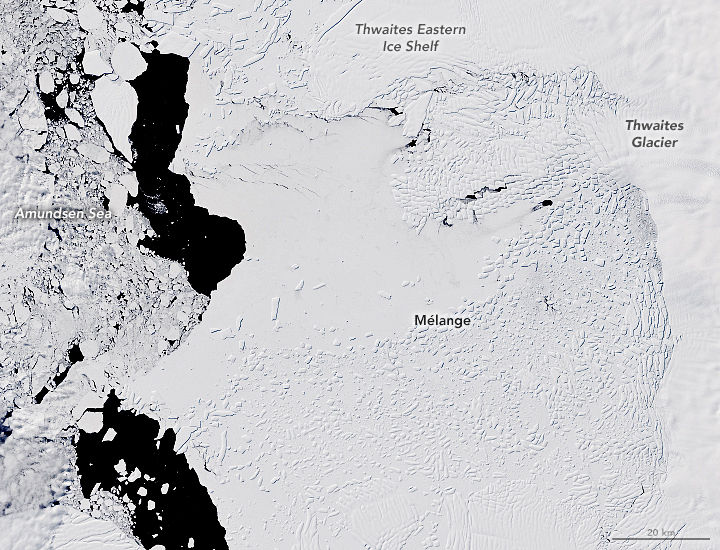
The concentration of “earthquakes” around Thwaites Glacier offers compelling geographical proof linking these incidents to iceberg overturns. The configuration of the glacier, including its central ice tongue and mélange regions where newly calved ice enters the ocean, supports this theory. Thwaites has been particularly flagged by the research as a site with elevated iceberg rollover activity, corroborated by the geographical alignment of inferred force directions with the glacier’s ice flow. Nevertheless, while models indicate capsizing events, the lack of supporting imagery for each seismic detection constrains definitive identification.
Remarkably, satellite observations on multiple occasions confirmed some seismic findings. On November 5, 2016, for instance, satellites recorded new bergs coinciding with a seismic detection, validating the methodology’s capacity to identify actual capsizing incidents.
A Mechanism Influenced by Interacting Forces
The dynamics at Thwaites Glacier, particularly during times of accelerated ice movement, reveal insights into the mechanisms that trigger iceberg capsizing. External influences such as pressure from sea ice and ice mélange may initially stabilize top-heavy icebergs. However, during periods of quicker glacial movement, the reduction in mechanical resistance facilitates their rollover, thus prompting seismic activity. Such instances at Thwaites were notably documented between 2018 and 2020, a period characterized by heightened glacial movement and fragmentation.
What Seismic Records Fail to Disclose
While the detection of seismic magnitudes provides an indication of glacial calving processes, they yield limited quantitative insights into the iceberg masses involved or the precise seismic impact on ice dynamics. Crucially, Thwaites Glacier continues to be closely monitored, as alterations in its floating ice tongue could indirectly contribute to sea-level rise by affecting the flow of land-based ice into the ocean.
Interestingly, the seismic methodology unveiled an unresolved enigma at Pine Island Glacier. Events recorded near the grounding line, distanced from calving fronts, indicated inexplicable glacial dynamics.