# Innovations in Optical Fibres: Improved Brillouin Scattering and Its Possible Applications
Light moving through a glass fibre does not pass through without interacting with the surrounding material. A portion of the light is scattered by sound waves traveling through the fibre, resulting in a slight drop in frequency as some of its energy is given to the sound. This effect, termed stimulated Brillouin scattering, is frequently seen as an inconvenience in telecommunications since it weakens the intended signal power.
Nevertheless, when utilized effectively, stimulated Brillouin scattering becomes a potent nonlinear phenomenon within an optical fibre. Optical fibres with notable scattering can enhance signals, filter microwave frequencies, produce narrow laser lines, or act as temporary light storage by converting light into sound and later retrieving it. The performance of Brillouin scattering in a fibre is measured by its Brillouin gain, quantified in inverse watts per metre, where conventional telecommunications fibres exhibit low readings.
In a pioneering research article published in Optica on 19 July 2026, Simon Seiderer and his team attained a Brillouin gain of 434 per watt per metre, achieved by solidifying the liquid inside the fibre’s core. This figure considerably exceeds that of typical silica fibres by over three orders of magnitude.
## A Fibre with a Liquid Core
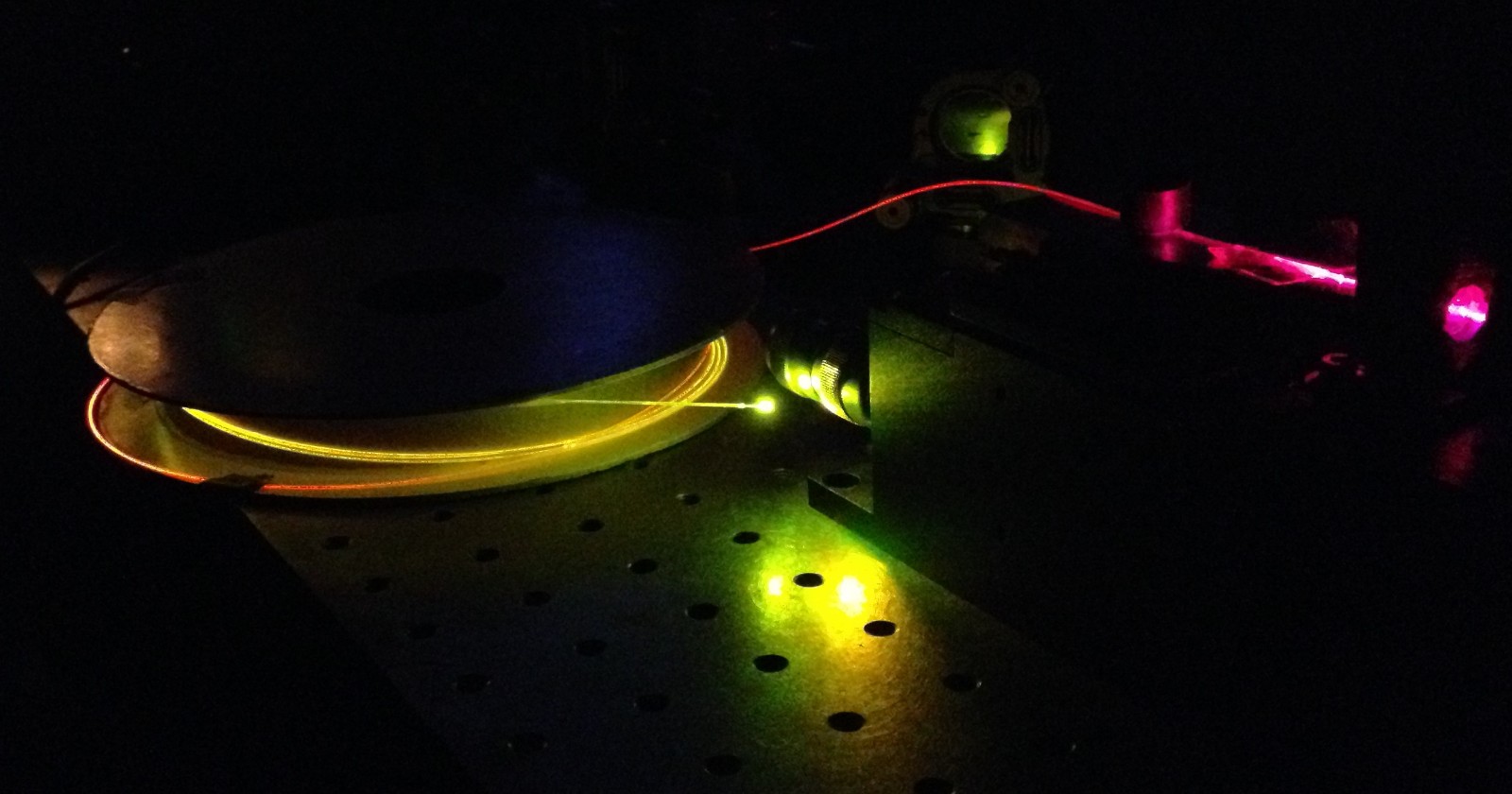
The apparatus utilized is a simple design — a sealed silica capillary five metres long with a nominal diameter of 1.37 micrometre, filled with carbon disulfide. Both ends are fusion-spliced to standard single mode fibre pigtails employing ultrahigh numerical aperture bridge fibres. Liquid core fibres with carbon disulfide fillings are acknowledged as a suitable framework for nonlinear optics.
The capillary is securely sealed and completely filled, preventing the liquid within from unrestrained expansion or contraction. Any temperature rise increases pressure throughout the fibre, while cooling lowers it, allowing the liquid column to maintain a state of tension. The researchers upheld positive pressure inside the fibre to avoid cavitation, crucial for the stability required for accurate measurement.
Carbon disulfide solidifies at 162 kelvin, achievable by employing liquid nitrogen that operates at 77 kelvin. The experimental setup involved immersing 27.5 centimetres of the fibre in liquid nitrogen. A distinct four-metre section was heated to as high as 343 kelvin to regulate internal pressure before freezing, thereby refining the results.
An assumption underpins their calculations: the internal pump power is derived from the input power to the pigtails, presuming an equal loss distribution of 5.6 decibels at each end, serving as the basis for all power-related calculations.
## The Role of Freezing
Freezing is vital because the Brillouin gain coefficient scales with the eighth power of the optical mode’s effective refractive index. This strong correlation indicates that even slight increases in index produce substantial gain improvements.
Solid carbon disulfide possesses a higher refractive index than its liquid state, expected to be above 1.5885 at a 1550 nanometre wavelength. Through time domain measurements, researchers assessed the fundamental optical mode’s effective refractive index in the frozen fibre at 1.94. Simulations propose a core index of 2.07, reducing optical and acoustic overlap, which further enhances the gain.
Findings reveal a Brillouin gain of 434 per watt per metre (with an uncertainty of 22) contrasted with 47 (uncertainty of 3) in its liquid state, signifying a tenfold increase. The peak frequency also transitions: from 2.46 gigahertz in liquid to 4.81 gigahertz in solid form, while resonance narrows from 71 to 24 megahertz.
Although the gain varies across cycles, consistent outcomes are reported, with gains predominantly exceeding 390 per watt per metre.
## Light Storage via Sound
Given such substantial gain, minimal pump power results in noteworthy effects, such as 6.94 decibels of optical gain utilizing 13.4 milliwatts of pump power across the frozen segment.
The configuration facilitates light storage by converting information from a data pulse into an acoustic wave within the fibre, subsequently reverting it back to light. This method was validated in 2007, and the innovation lies in the reduced energy necessary for optimal storage efficiency.
The research illustrates that by using a small data pulse (0.030 nanojoules) with a 1.7 nanosecond pulse duration, readout surpasses noise with a negligible control pulse (0.205 nanojoules). In total, the energy per stored bit is lowered to 205 picojoules.
In comparison, a nonlinear fibre inside a cryostat would require 150 times more pump power for similar efficiency, exemplifying the significance of this advancement.
Despite these successes, complex multi-mode dynamics within the fibre may affect results, which could be alleviated by fine-tuning pulse timing.
## Prospects Ahead