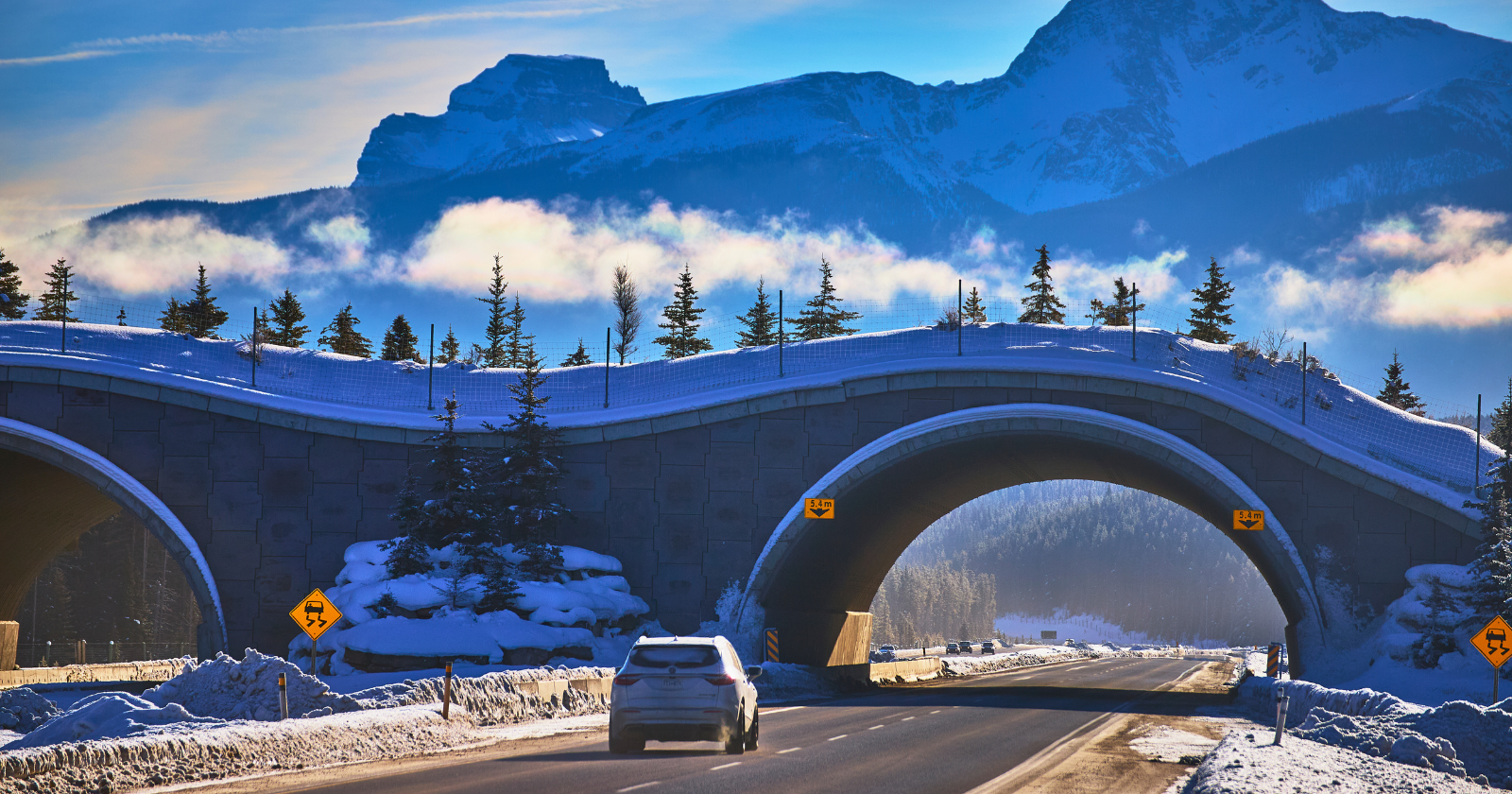
The Trans-Canada Highway traverses Banff National Park directly — 82 kilometers of a four-lane road winding through the Canadian Rockies, facilitating a vehicle passage every few seconds across some of the richest wildlife territories on the continent.
For many years, the consequences of this situation were evident in carcasses. The highway claimed elk, deer, bears, and wolves at a relentless pace, and it caused something subtler and more detrimental: it divided the park’s animal populations in half, creating a barrier of traffic that no sensible animal would attempt to cross, thereby splitting gene pools on either side of the road.
Canada’s solution, developed over a span of thirty years, was to create infrastructure for the animals — and it has emerged as the most-researched, most-replicated instance of wildlife engineering worldwide.
## Six bridges, thirty-eight tunnels
Along that section of highway, Parks Canada constructed [44 crossing structures — six overpasses and 38 underpasses](https://wildlife.org/highway-crossings-benefit-banff-wildlife/) — starting with the initial two overpasses in 1996 at approximately $1.5 million each.
The overpasses are the renowned features: to an onlooker, they appear to be regular concrete bridges, until you catch a glimpse from above and witness the unbroken forest extending across — trees, shrubs, and grass spread fifty meters wide, a slice of the Rockies carried above four lanes of traffic. The underpasses perform the bulk of work below: culverts and tunnels designed to accommodate everything from cougars to moose.
The third element is what enables the functionality of the other two: fencing along both sides of the entire highway stretch. The fence prevents animals from accessing the road; the crossings provide a path for the fence to guide them. Both are necessary. Collectively, they transformed the highway from a lethal barrier into a permeable corridor.
## The numbers
The outcomes are the standard reference that every road ecologist now cites. Wildlife-vehicle collisions along the fenced and bridged section have [decreased by over 80 percent](https://y2y.net/blog/how-wildlife-crossings-revolutionized-conservation/) — and by 96 percent for elk and deer, the species that previously faced the highest mortality rates there.
Cameras positioned at the crossings have recorded [more than 250,000 animal crossings](https://y2y.net/blog/how-wildlife-crossings-revolutionized-conservation/) since monitoring commenced — the longest-running research program focused on wildlife crossings worldwide — involving more than a dozen large species: grizzly and black bears, wolves, cougars, lynx, wolverines, moose, elk, deer, coyotes.
And the adoption pattern turned out to be a measure of personality. Elk, bold and unfazed, [utilized the overpasses even before construction crews completed them](https://discoverapega.ca/stories/wildlife-crossings-key-to-highway-safety-in-banff/). The more cautious species — wolves, grizzlies — required up to five years of exploration, sniffing, approaching, and retreating before they adapted. Yet once a crossing is included in a grizzly’s mental layout, it remains: monitoring has documented female grizzlies guiding their cubs across the structures, the route being passed from mother to cub as learned family geography — a path the next generation will regard as always existing.
## The mating question, answered in hair
The deeper concern was never solely roadkill. It was about genetics — whether the fenced highway, despite crossings, would still divide bears into two slowly inbreeding populations.
A team from Montana State University addressed this by stringing barbed wire at the crossings, capturing hair from bears that passed for DNA analysis. The genetic study revealed [bears not only crossing but also breeding across the highway](https://arc-solutions.org/article/banff-bears-use-trans-canada-wildlife-crossings-to-find-mates-wildlife-crossings-can-cost-up-to-4m-each-but-benefit-bear-populations/) — among crossing bears, 47 percent of black bears and 27 percent of grizzlies successfully bred, including one resourceful black bear male who fathered at least 11 cubs with five females while moving between both sides. Gene flow, the aspect the highway had disrupted, was measurably reinstated — for both wolverines and grizzlies, the fragmentation concern vanished.
## The export
Banff’s structures now range from $2 million to $4 million per overpass, and for years, the expense was the primary argument against them. The park’s thirty years of data put an end to that debate: collisions with large animals also incur significant costs — in vehicle damage, injuries, and fatalities — and an 80-plus percent reduction justifies the investment.
Thus, the model is being disseminated. Banff’s discoveries are influencing highway projects across Canada, the United States — including the expansive Wallis Annenberg crossing over ten lanes of the Los Angeles freeway — and initiatives from Costa Rica to Asia. The park that began with two trial bridges in 1996 has evolved into