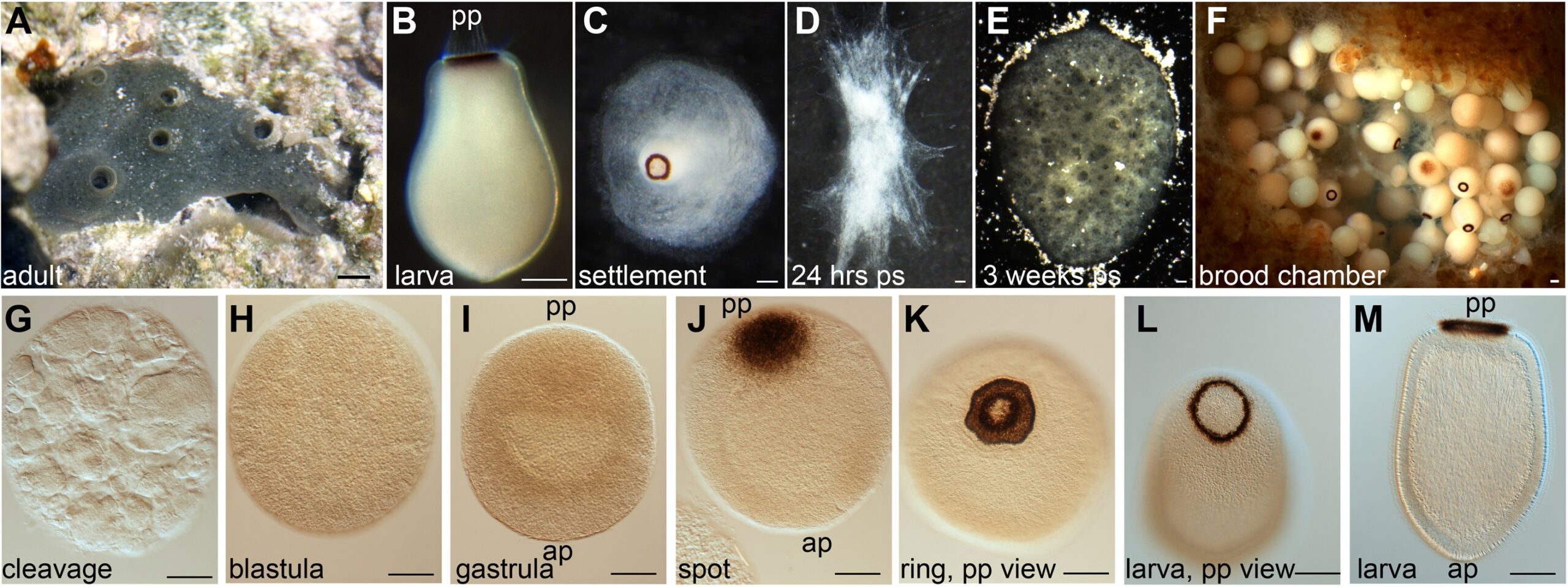
On the southern Great Barrier Reef, a larva, roughly the dimensions of a chia seed, drifts away from an adult sponge in the early afternoon. It swims for five or six hours and then, as the light above Heron Island Reef recedes towards dusk, it begins to reorganize the physical structure of its genome in preparation for a decision it has yet to make. A [reviewed preprint in eLife](https://doi.org/10.7554/elife.111060.1) by Yuan, Blard, Pujic, Bernard M. Degnan, and Sandie M. Degnan reveals that waning sunset light prompts significant chromatin remodeling in the swimming larvae of the demosponge *Amphimedon queenslandica*, gearing up settlement- and metamorphosis-related genome regions before the genes there activate. Once darkness descends and the larva contacts the correct coralline alga, the team’s [summation of Olivia Hewitt’s work](https://phys.org/news/2026-09-brainless-sea-sponges-sunset-metamorphosis.html) illustrates a firm attachment and the initiation of body disassembly within approximately 30 minutes. This animal possesses no brain, no nerves, and no neurons, and it belongs to a lineage that diverged from other animals around 700 million years ago.
## A day in the water column, a night on the reef floor
*Amphimedon queenslandica* experiences a dual-phase existence typical of many benthic marine invertebrates: a brief dispersive stage, followed by a permanent adult phase. Adults collected from Shark Bay on Heron Island Reef and housed at the Heron Island Research Station, affiliated with the University of Queensland’s Centre for Marine Science, release larvae in the early afternoon. These larvae swim — but they are not ready to settle yet. Competence, or the ability to respond to a settlement cue, occurs about five to six hours post-release, soon after sunset.
This timing is closely linked to light conditions. Previous research by the same team, [Say and Degnan in 2020](https://doi.org/10.1111/mec.15318), indicated that larvae deprived of a sunset — kept under constant light — fail to settle, even in the presence of suitable substrate. The cue they require is not merely the alga; it is the alga *combined with* the day’s conclusion.
When the two factors converge, the process unfolds swiftly. The larva encounters *Amphiroa fragilissima*, a branching coralline alga, and the chemical properties of that surface compel it. In the new research, contact triggers a quick, transient surge of activity from conserved transcription factors, including AP-1 and various bZIP family members — the same rapid-response regulators employed by animals throughout the evolutionary tree when a cell must transition quickly. The larval swimming body begins to disassemble as the organism secures itself; the eLife team recorded settlement at 30-minute intervals and noted that the initial hour of metamorphosis featured a significant transcriptional shift, while the Conversation-side framing indicated firm attachment occurs at roughly half an hour. This is not a slow capitulation to gravity; it is a commitment, executed within a time frame.
## Unlocking the genome prior to gene activation
The study’s key finding pertains to what occurs *before* any of this transpires. Chromatin represents the protein-and-DNA structure that dictates which areas of a genome regulatory mechanisms can access; it is best understood not as an instruction manual but as a building’s entrances, with some latched and others open. Assessments of accessibility in swimming larvae demonstrated that decreasing evening light correlates with extensive restructuring of these latches — many areas open up, while others close — throughout the settlement and metamorphosis toolkit.
What makes this result intriguing is the discrepancy. At that same pre-settlement juncture, gene expression alters only slightly. The larva is not yet activating its metamorphosis program. Instead, it is rendering that program accessible, so that when the algal cue arrives, the response need not commence with the tedious task of opening the genome. Anticipation is embedded within the architecture, rather than in behavior, which is advantageous for an organism lacking a nervous system to maintain a plan.
Larvae exposed to constant light beyond sunset take a different path altogether. Instead of merely stalling in the pre-competent condition, they transition into an alternate chromatin and transcriptional profile, noted for significant loss of accessibility and repression of the transcription factors linked to competence — including CLOCK and other bHLH-PAS family members. CLOCK is upregulated in typically competent larvae; uninterrupted light suppresses it. Hewitt’s summary emphasizes that this is a gene family broadly shared among animals, presenting a comparative point rather than inferring what the sponge variant does in any other organism.
## Half an hour on an exposed floor, and a very long