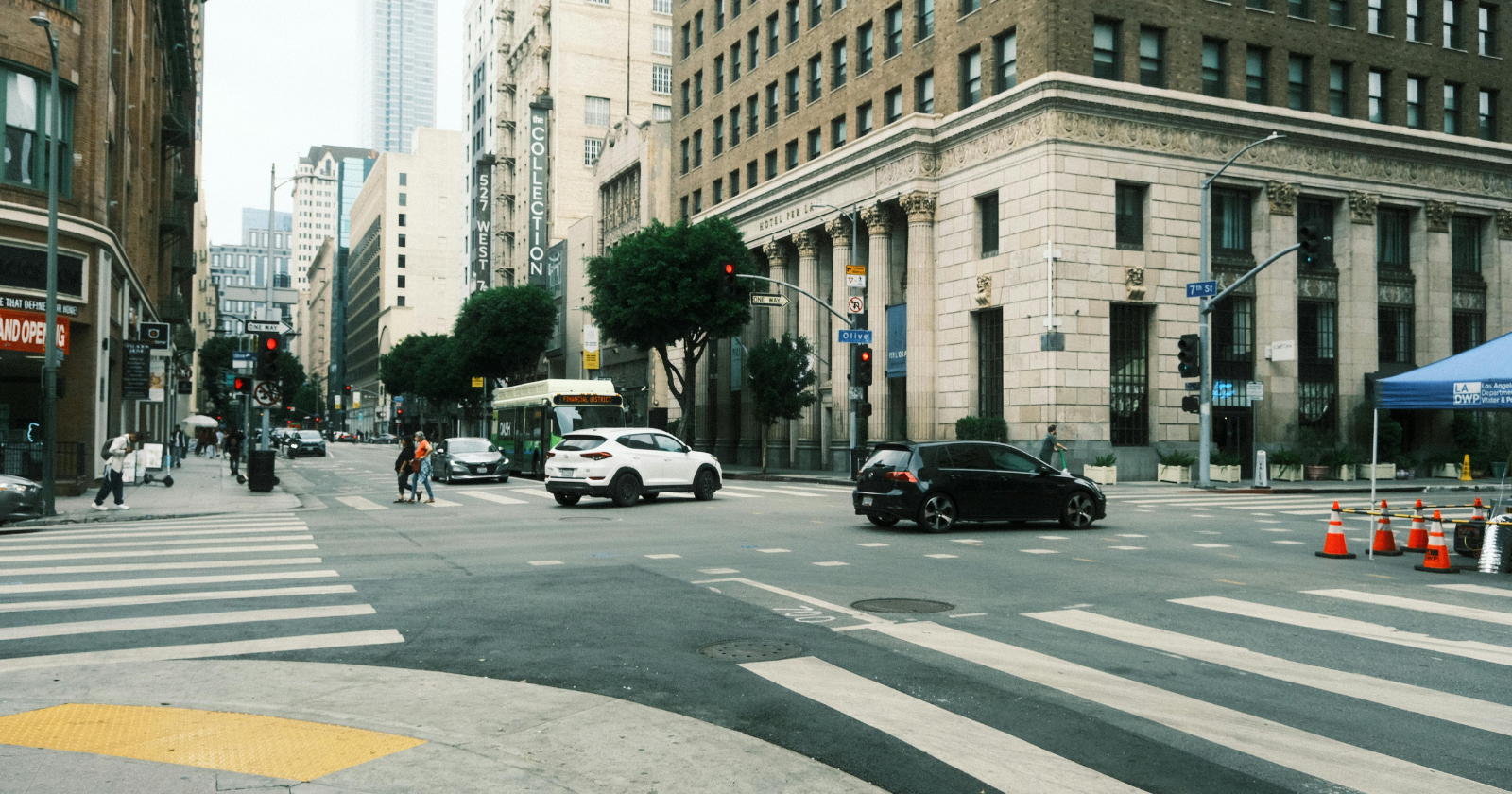
The reasoning appeared unassailable. Dark asphalt absorbs sunlight and reflects it throughout the evening, warming urban areas from underneath; this is a major reason why summer nights in Los Angeles remain warm well after dusk. Thus, lightening the streets is essential. Instead of soaking up the sun, they should bounce it back.
Commencing in 2017, Los Angeles’ street department led the way by applying a light-gray reflective coating named CoolSeal to local streets — the first initiative of its kind nationwide, later emulated from Phoenix to Tokyo.
And the coating functioned exactly as intended. During summer days, the treated roadways measured up to 11 degrees Fahrenheit cooler to the touch than the surrounding standard asphalt.
However, when researchers shifted their focus from the road to the people, they discovered an issue lurking in fundamental physics.
### The robot that mimics a human
The challenge in measurement is that “how hot is the street” and “how hot does a person feel” represent distinct inquiries. A pedestrian’s sensation is influenced predominantly by mean radiant temperature — the cumulative radiation impacting the body from all angles: sunlight from above and everything reflecting or emitting from below and around.
To assess this, Arizona State’s Ariane Middel designed MaRTy — a garden cart outfitted with sensors that gauge radiation from every direction, in addition to air temperature, wind, and humidity: a weather station that experiences heat akin to a human body. In July 2019, she and UCLA’s V. Kelly Turner took MaRTy on hourly excursions through Pacoima and Sun Valley, from late morning until well into the night, traversing coated streets, regular asphalt, and the adjacent sidewalks.
The pavement conveyed its cooler narrative. MaRTy conveyed that of the pedestrians.
### The heat that shifted
Just prior to noon, while on the reflective street, the mean radiant temperature exceeded ordinary blacktop by over 7 degrees Fahrenheit. Throughout the afternoon, this discrepancy lessened but remained above 3 degrees. On the ground intended to mitigate heat, individuals distinctly felt hotter.
The explanation lies in this article’s title, and it is a matter of accounting, not an enigma. Dark asphalt captures solar energy, retains it, and gradually re-emits it — into the atmosphere, into the night, into the urban heat island. The reflective coating prevents the accumulation. However, the energy must still move somewhere, and it ascends directly upward — approximately 130 watts per square meter of reflected sunlight, Middel estimated, akin to adding 10 percent more direct sunlight — onto the shins, torso, and face of anyone standing on it. Pedestrians were being illuminated from below, with glare reaching its peak, unfortunately, in the early evening as people returned home.
The street had indeed cooled. The individual had become the recipient of the street’s heat.
### Not a refutation — a redirection
This is where the narrative becomes more intriguing than a mere admonition, as further research provided nuance.
The reflected-heat effect is mainly concentrated on the coated surface itself; on sidewalks adjacent to the treated roads, the difference nearly disappeared — and pedestrians predominantly occupy sidewalks, not the center of the street. When L.A. coated an entire neighborhood in Pacoima — streets, playgrounds, parking lots — follow-up evaluations revealed ambient air temperatures up to 3.5 degrees cooler during a heat wave than the nearby neighborhood, with cooler nights and, in that study, no decrease in comfort. Cooler surfaces also lead to fewer burn injuries — pavement burns are a legitimate emergency-room concern in the Southwest — and reduced heat released into the night, when heat can be deadly.
Thus, the consensus in the field serves as a guideline, rather than a judgment against. Reflective coatings do cool the city — the air, the nights, the heat island. They do not cool the individual standing on them at noon, and during midday they instead impose a burden on that person. All researchers involved agree that the intervention that prevails on both levels, without exception, is shade. A tree cools both the surface and the individual simultaneously. As Turner stated, reflective pavement is merely one tool — and it cannot compete with a canopy.
### The lesson beneath the gray coating
The Los Angeles experiment claims its spot in the urban-heat discourse more for its implications than for its data: heat follows conservation laws, not intentions.
The city monitored what was straightforward to measure — surface temperature — and the surface responded by cooling. The energy, uninterested in promotional announcements, was simply redirected through the bodies of pedestrians on its journey back to the atmosphere. Nothing went awry; sunlight was merely redirected, and every heat “solution” is fundamentally a choice about where the energy subsequently travels. Absorb it, and the city remains warm all night. Reflect it, and the midday walker pays the price. Intercept it overhead — a tree, an awning, a shadow — and it never reaches the ground at all. The gray streets of Paco