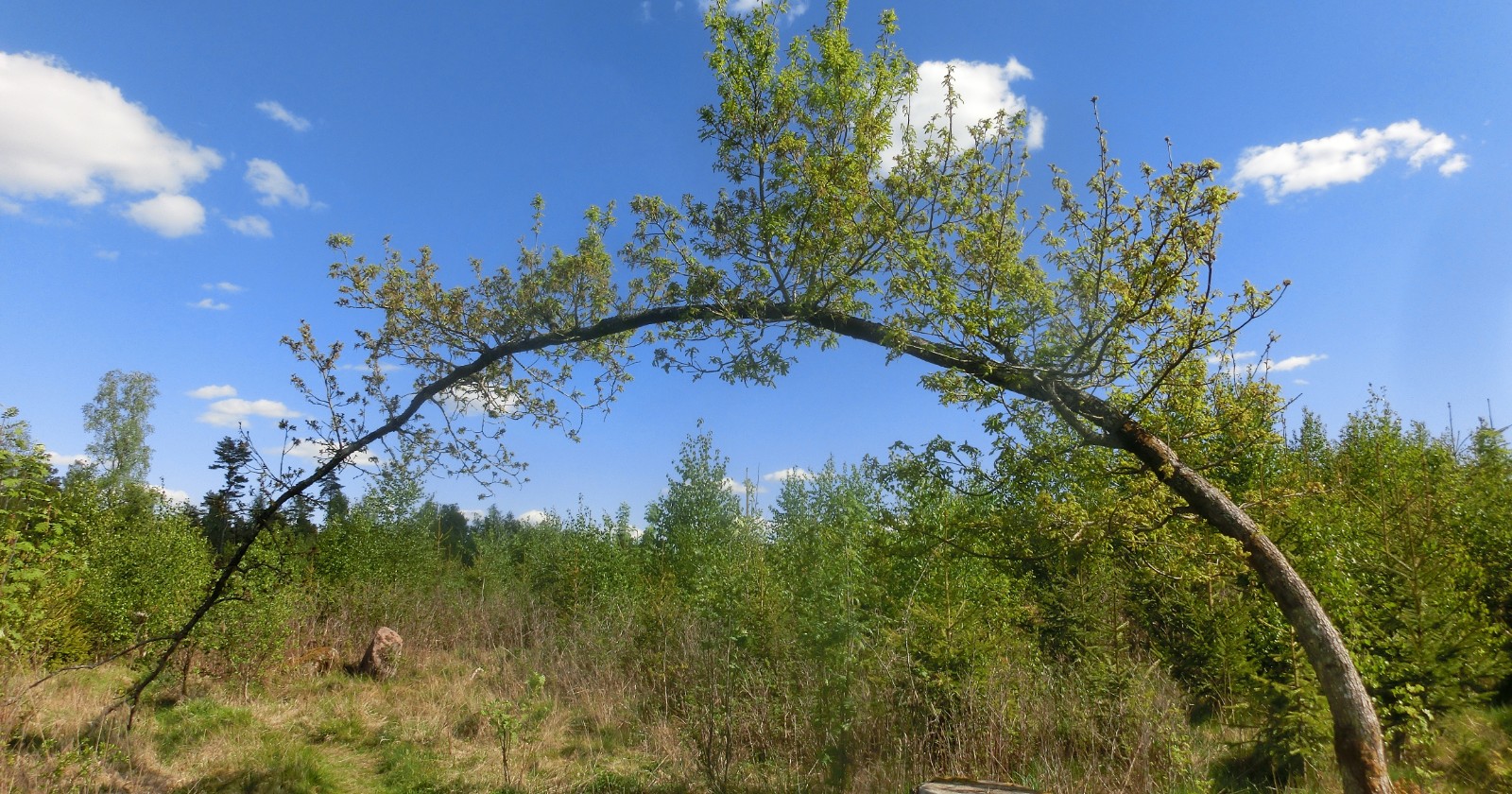
**Proprioception in Plants: Revealing a New Dimension of Tree Behavior**
Proprioception, which refers to the capacity to perceive and manage the position and movement of one’s own body parts, is typically linked to animals. Nevertheless, recent research indicates that trees may possess a similar skill to perceive their own structure and alignment, fundamentally reshaping our comprehension of plant behavior.
A pioneering study featured in New Phytologist examined this phenomenon in trees. Researchers investigated how juvenile hybrid poplar trees, namely Populus tremula × Populus alba, respond when lacking gravitational signals. Ten poplar trees were positioned on their sides, and a distinctive experiment was carried out to see how they would rectify their orientation without gravity as a guide.
**Experimental Design and Results:**
The study required tilting these poplar trees to 90 degrees within a specialized growth chamber that offered uniform light distribution. This arrangement prevented the plants from identifying a directional signal from the light. Some plants underwent a continuous rotation via a clinostat, effectively removing their capacity to utilize gravity as a navigation system. Consequently, the trees were compelled to depend exclusively on their proprioceptive senses—the awareness of their own shape and any changes therein—to realign their position.
At first, the trees simply drooped under their own weight, but after several days, they commenced actively bending upward in an effort to correct their stance. Notably, once the clinostat was activated, the trees slowly straightened out, showcasing an intriguing ability to modify their growth based on the internal recognition of their position.
**Function of Tension Wood:**
The crux of this proprioceptive ability resides in the formation of tension wood. This altered tissue develops on specific sides of the stem based on the required directional growth. Throughout the experimental phase, the trees produced tension wood on both the upper side during the initial period and later on the lower side when further adjustments were necessary while on the clinostat.
These findings challenge the conventional perception of tension wood being only on the upper side of a tilted stem. Instead, the research shows that trees can generate tension wood wherever it is required to adjust posture, presenting a new perspective on plant mechanics.
**Significance and Future Prospects:**
The findings of this study imply a wider application of proprioceptive mechanisms in plants, potentially affecting various species and growth regions. Although the research focused on the woody trunk, scientists theorize that analogous mechanisms might function in the softer, growing tips of plants as well.
The ramifications of this investigation are profound, exposing a complex self-monitoring and correcting system in plants that mirrors animal proprioception. Comprehending this capability could transform our understanding of plant growth and behavior, paving the way for advancements in ecological and agricultural fields.
In summary, this inquiry into tree proprioception underscores a captivating and previously overlooked facet of plant biology, demonstrating their extraordinary ability to perceive and adapt to environmental shifts absent traditional sensory inputs like light or gravity. This discovery represents a considerable advancement in the exploration of plant mechanics and adaptation strategies.