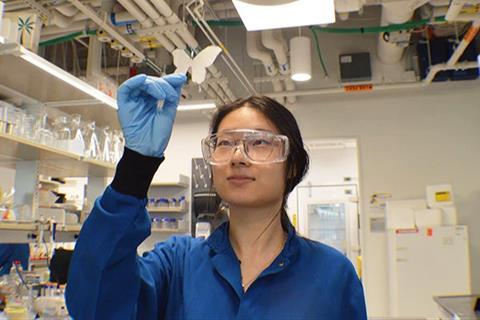
Chemists at Northeastern University in Boston are crafting new colorants that rely on structural color instead of pigments, making them more durable, vivid, and safer. The research, which is yet to be published, was conducted in Leila Deravi’s lab and presented by her graduate student Clara Wen Dou during the American Chemical Society meeting on 26 August in Chicago.
Structural color is derived from the material’s physical arrangement, where intricate nanostructures play a key role in light reflection. In contrast, traditional pigments and dyes achieve color through chemicals that absorb specific visible light wavelengths while reflecting or scattering others.
‘Structural color is solely physical – it results from light interacting with microscopic or nanoscopic features whose size corresponds to the wavelength of visible light,’ Dou clarifies. ‘For structural color to emerge, there must be an ordered or semi-ordered surface arrangement with microstructures or nanoparticles that feature repeated units enabling optimal light interference.’
This research was motivated by the vivid colors present in nature, notably the wings of butterflies in the Pieridae family, which contain light scatterers referred to as pterins. In these butterflies, pterin derivatives such as pterine and ixosanthopterin are found as dense microscopic granules on their wings.
In comparison to typical pigments and dyes, structural color remains more stable over time. ‘Pigmentary colors depend on light absorption, leading to molecular instability over the long term, resulting in photobleaching, radical formation … and eventual color loss,’ Dou explains. ‘Conversely, structural colors derive from the arrangement of the molecules – the particles themselves contribute to the color, allowing them to evade photobleaching since they absorb less light.’
To investigate structural colors from pterins, Dou and her team created and altered pterin crystals in Deravi’s lab. This involved synthesizing pterin granules that imitate the structures found on butterfly wings. The researchers discovered that color intensity could be manipulated by adjusting the size and arrangement of the pterin crystals, negating the need for multiple pigments. ‘This work demonstrated that I can produce either highly reflective white materials using ixosanthopterin or structurally colored blue, with the same material, merely by tuning conditions like pH,’ Dou informs Chemistry World.
Traditionally, forming microscopic crystals from pterins necessitated organic solvents like dimethyl sulfoxide (DMSO), which raise safety concerns for human health and the environment. However, the Northeastern team utilized water, salt, and acidity to precipitate the crystals. Additionally, crystallization with DMSO could take weeks, but the new technique allowed Dou to induce crystallization within minutes by modifying the pH.
‘In the long run, we aim to replace many synthetic pigments known for their limitations – some being highly toxic – with these natural, bio-inspired materials,’ Dou states.
This research currently produces only milligram-scale amounts of structural colors, but the Northeastern team is actively working on scaling up production.
The researchers are focused on developing new and safer food colorants. This initiative comes after the US Food and Drug Administration (FDA) revoked several food dyes for specific uses. Beyond new food dyes, the team also envisions creating new and safer cosmetics that, for instance, mitigate some of the toxicity issues related to metal oxides commonly used in cosmetic glitter.
Vinothan Manoharan, a chemical engineer and physicist at Harvard University, is excited about the research and its implications. ‘I appreciate the concept and believe it’s worth pursuing,’ says Manoharan, who did not participate in the work. However, he emphasizes the challenge of discovering and developing sustainable, non-toxic materials that can also be produced at large scales and processed via environmentally friendly methods.