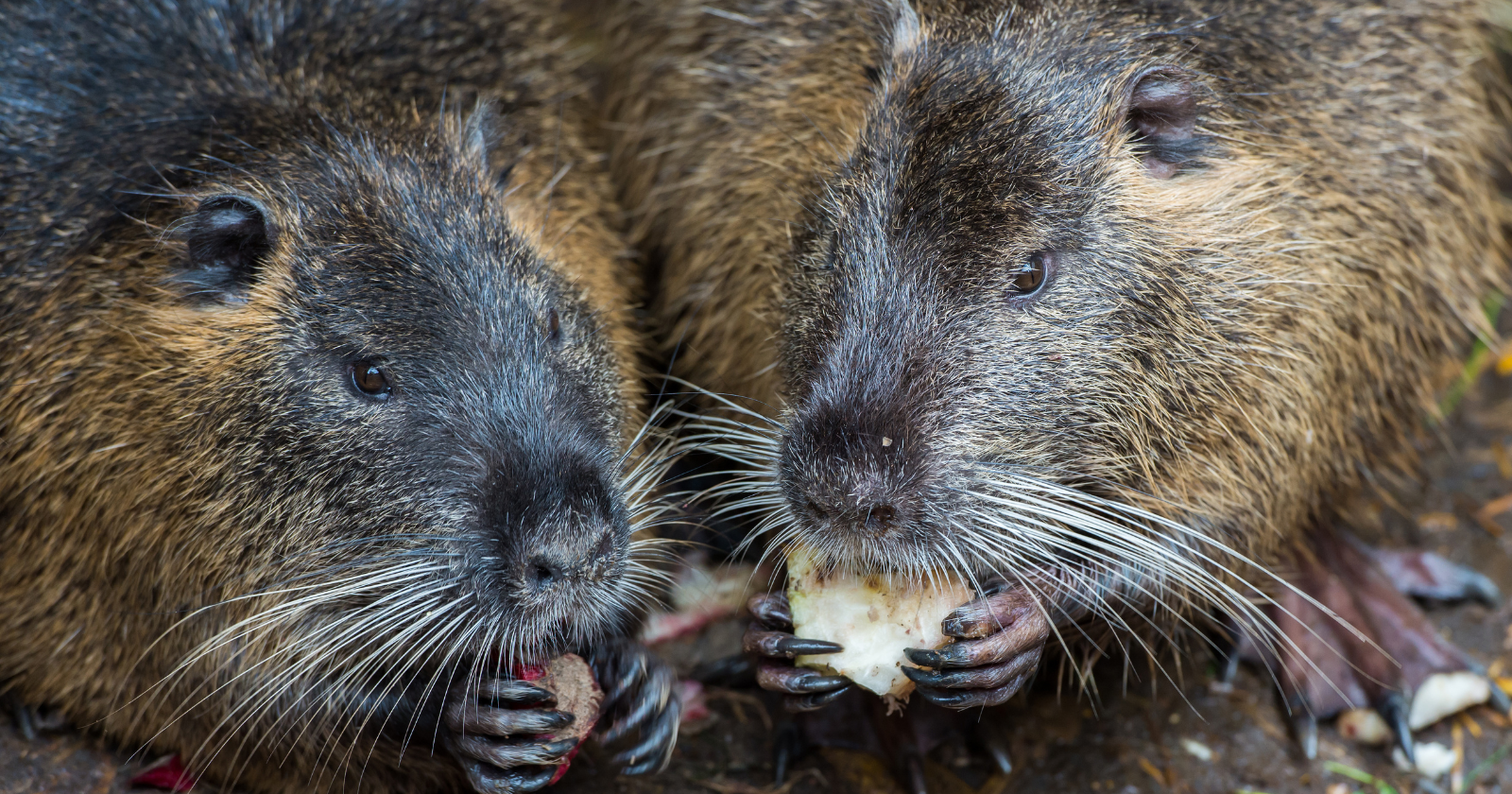
In the spring of 1943, a group of five nutria escaped from a research enclosure located at a federal fur-animal station on the marshes of Blackwater in Dorchester County, Maryland, and were subsequently discovered deceased in a nearby boathouse. This seemingly minor event, recorded by the Smithsonian’s Chesapeake Bay invasive-species database, signifies the initiation of one of the most prolonged wildlife-removal initiatives ever undertaken in the United States. Nearly eight decades would pass, involving a coordinated federal-state program lasting over 20 years, the removal of more than 14,000 animals, collaboration from upwards of 700 private landowners, and the deployment of specially trained dogs before officials could declare the marshlands of the Delmarva Peninsula free from nutria.
How a Fur Experiment Became an Invasion
Nutria, scientifically known as Myocastor coypus, are sizable semi-aquatic rodents indigenous to South America, valued in the early 1900s for their soft underfur. The federal government introduced the first nutria to a fur research facility, now part of the Blackwater National Wildlife Refuge, in 1939, aiming to create an alternative to the declining muskrat industry in the region. As per the Smithsonian Environmental Research Center’s Chesapeake Bay invasion database, the escape from the boathouse in 1943 was succeeded by further releases, some accidental and others intentional, as local trappers and landowners experimented with raising these animals for their fur.
Nutria reproduce rapidly and have a large appetite, with no natural predators on the Eastern Shore. Unlike muskrats, which trim marsh vegetation without damaging the root system, nutria uproot roots and rhizomes, turning healthy marshland into barren mudflats and shallow waters. The Maryland Department of Natural Resources describes the consequent destruction as the loss of thousands of acres of wetland habitat, with refuge managers at Blackwater stating that the refuge itself suffered a loss of over 5,000 acres of marsh due to a combination of nutria feeding, sea-level rise, and land subsidence in the ensuing decades. By the 1990s, biologists estimated a population of approximately 100,000 nutria scattered throughout the tidal marshes of Delmarva.
Building a Program to Remove Every Last One
Initial informal efforts to manage nutria date back as far as the 1950s, but were largely ineffective in curbing their proliferation. A pivotal moment occurred in the late 1990s, when the U.S. Fish and Wildlife Service, in collaboration with the Maryland DNR and roughly a dozen partner agencies, determined that complete eradication, rather than merely controlling the population, was technically possible if the marshes were diligently surveyed. A pilot project explored trapping and marsh-recovery strategies, and in April 2002, the Chesapeake Bay Nutria Eradication Project officially commenced, spearheaded by the Fish and Wildlife Service, with most fieldwork conducted by USDA’s Animal and Plant Health Inspection Service, Wildlife Services, alongside Maryland DNR and university researchers.
The success of the project hinged on access to private land, since nutria did not adhere to refuge boundaries. Eventually, field crews collaborated with over 700 landowners throughout the Delmarva Peninsula, trapping and extracting animals from public refuges, farms, and private wetlands. Throughout the program’s duration, crews captured more than 14,000 nutria, with about half sourced from private properties. Researchers also utilized radio-collared, sterilized “Judas” nutria, released to locate surviving groups of their kind, a technique incorporated around 2009 that enabled crews to locate animals in dense marsh environments where trapping alone proved challenging.
The Hardest Part Was Proving a Negative
Eliminating the majority of a large, rapidly reproducing population proved less complex than confirming that none remained. By the early 2010s, trapping success had dwindled to such an extent that crews required a more delicate method to detect the last few animals scattered across an area exceeding 250,000 acres. Beginning in 2014, the project enlisted specially trained detector dogs, collaborating with handlers to search for nutria scat rather than the animals themselves, as scat is significantly easier to detect among dense marsh vegetation than a cautious, primarily nocturnal rodent. The U.S. Geological Survey published an evaluation related to the project’s ground-based detection techniques, noting that hair snares performed comparably to trail cameras and significantly outperformed scat surveys by themselves; detector dogs were integrated into the project’s toolkit around this time but were not included in this specific USGS assessment.
That verification endeavor proved fruitful. The last nutria confirmed in the wild on the Delmarva Peninsula was captured in May 2015. However, program leaders did not declare success at that moment. Claims of eradication require demonstrating absence, which is a higher standard than simply not capturing any new individuals, so field teams invested several additional years conducting systematic surveys across the entire treated area before agencies felt assured that no breeding population remained. The Fish and Wildlife Service, together with USDA and Maryland DNR, formally proclaimed the Delmarva Peninsula devoid of nutria.