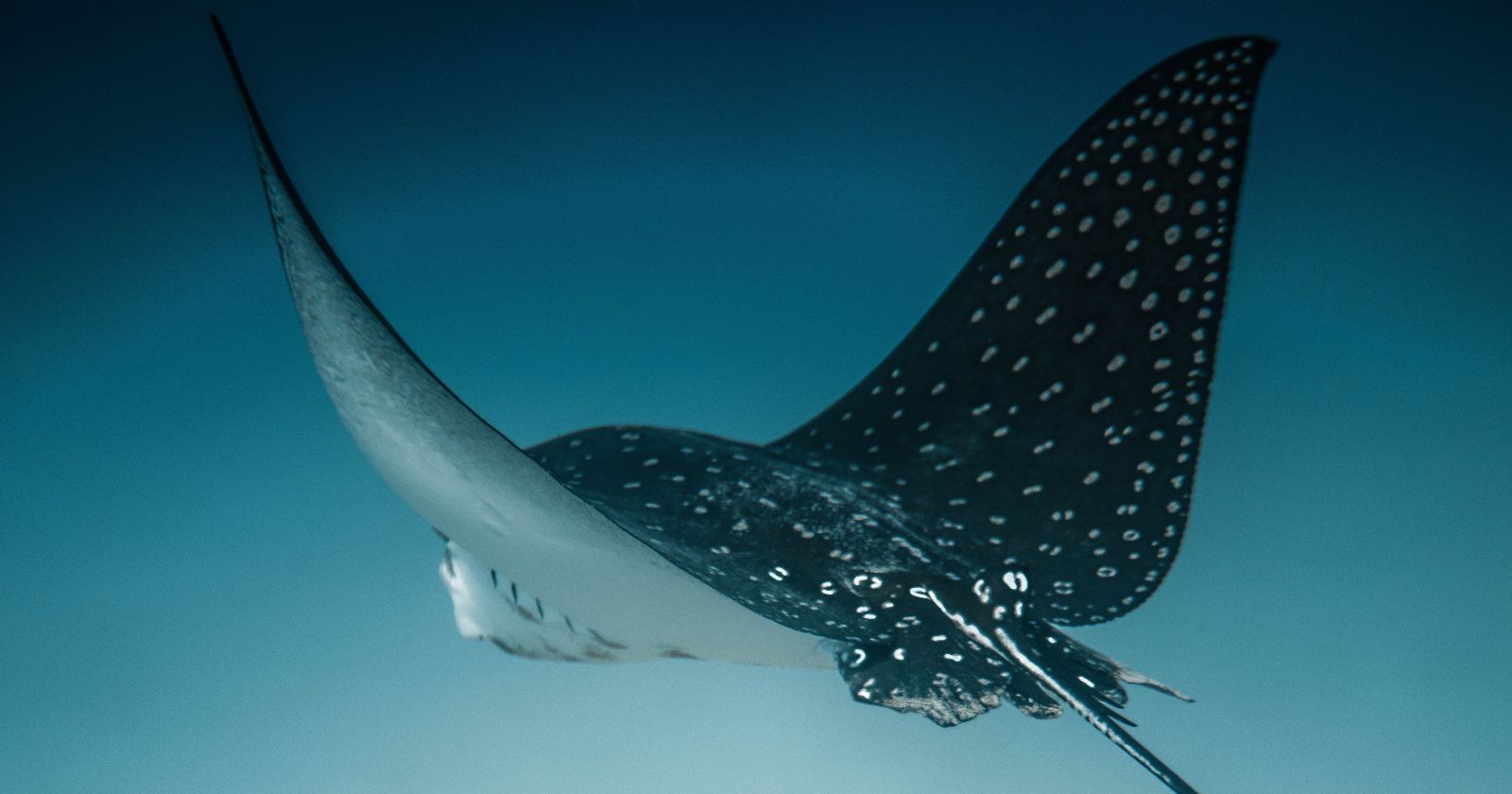
At approximately 50 meters down, in the shade of floating pens containing bluefin tuna off Malta’s northeastern coastline, a remotely operated vehicle glided over a shifting seabed. In October 2024, researchers controlling that ROV recorded an estimated 100 to 150 common eagle rays, Myliobatis aquila, clustered on and just above the bottom underneath a tuna farm — a figure the authors call in Marine Biodiversity the largest known gathering of this species documented so far, and one seemingly attracted there by uneaten baitfish descending from the cages above.
The study, titled “Large Myliobatis aquila aggregations associated with tuna ranches in the Maltese Islands,” relies on video footage instead of nets or tags. This distinction is significant for what can and cannot be inferred about the rays. There were no captures, measurements, or examinations of their stomach contents. What remains is footage of a dense congregation of a species typically seen alone or in small groups, hovering in a location where food appears on a schedule dictated by aquaculture activities.
What the ROV observed beneath the cages
The survey navigated through part of a large facility — according to a Times of India report on the research, eight out of 24 cages were inspected, along with four reference locations away from the pens for comparison purposes. The ROV operated at around 50 to 55 meters depth. That same report indicates fresh food fish resting on the seabed under three of the eight surveyed cages, with the largest ray gathering positioned beneath one of those three. Other rays, including common stingrays, were present in fewer numbers.
The key figure is explicitly an estimate. The rays were in motion — swimming across the frame, settling, lifting off, overlapping — and the authors clarify that this made an exact count unattainable. “Over 100 individuals” is how the abstract phrases it; 100 to 150 is the working range. It is a considered interpretation of moving video, not a census, and it should be viewed that way. A single animal looping back through the field of view could be counted twice; an animal resting outside the light area might be entirely missed. Both mistakes are in opposite directions, and neither can be clarified from the footage alone.
What the video establishes is co-occurrence: numerous eagle rays, in one location, at the same time, at a site where uneaten baitfish accumulate on the bottom. The abstract suggests opportunistic feeding as the main reason for the aggregation. It also does not rule out other possibilities — mating or other reproductive behaviors are not definitively dismissed. This caution is the authors’ own, and reflects an honest approach when the evidence is based on camera footage rather than an extensive observational study.
Why this species is so infrequently observed in groups
Common eagle rays have a broad distribution across the eastern Atlantic and the Mediterranean, and they aren’t elusive creatures: with wide pectoral wings, a pointed snout designed for unearthing buried bivalves and crustaceans, and a long tail. However, they are also mid-water travelers over soft substrates in a depth range that recreational divers seldom explore and that survey trawls sample roughly. Observations tend to be incidental — a fisher’s bycatch, a diver’s snapshot, or an isolated record in a database.
Reports of the species in aggregations have occurred only a few times, and the authors remark on the scarcity of such observations. This rarity is why a single ROV transect can credibly claim a record. It is important to clarify what “largest known” signifies in this context: it reflects the authors’ interpretation based on the published literature they reviewed, not an independently confirmed maximum. The absence of larger reported gatherings does not prove that larger groups do not exist — it may equally indicate that very few have examined conditions at 50 meters, beneath aquaculture structures, with a camera.
This factor contributes to the significance of the observation. The ROV was present to inspect a functioning site. The rays were simply a result of that inspection, not the focus.
What a food subsidy beneath a tuna pen might imply
Tuna ranching operates by catching wild bluefin and fattening them in sea pens using baitfish — like mackerel, sardines, and similar oily species — supplied in bulk. Not all of it is consumed. What descends becomes a predictable, concentrated food source on a seabed that otherwise contains scattered clams and worms. The pattern observed in the Maltese footage, with the largest ray aggregation under a cage that had fresh food fish beneath it, aligns with animals responding to that food subsidy.
Open questions arise directly, and the study does not provide answers. Does a consistent supply of baitfish influence where eagle rays spend their time, or how far they travel? Does a shift in diet away from hard-shelled benthic prey impact animals whose jaws and teeth are designed to crush shells? Does focusing a