At standard pressures, water, in its familiar state, becomes dramatically altered at 2,350°C; iron, in comparison, melts at approximately 1,538°C, while liquid water boils at just 100°C. Yet, pressure can significantly modify the phase diagram of materials. When water is exposed to more than two million atmospheres, its oxygen atoms remain crystallized even as hydrogen nuclei shift fluidly within that framework.
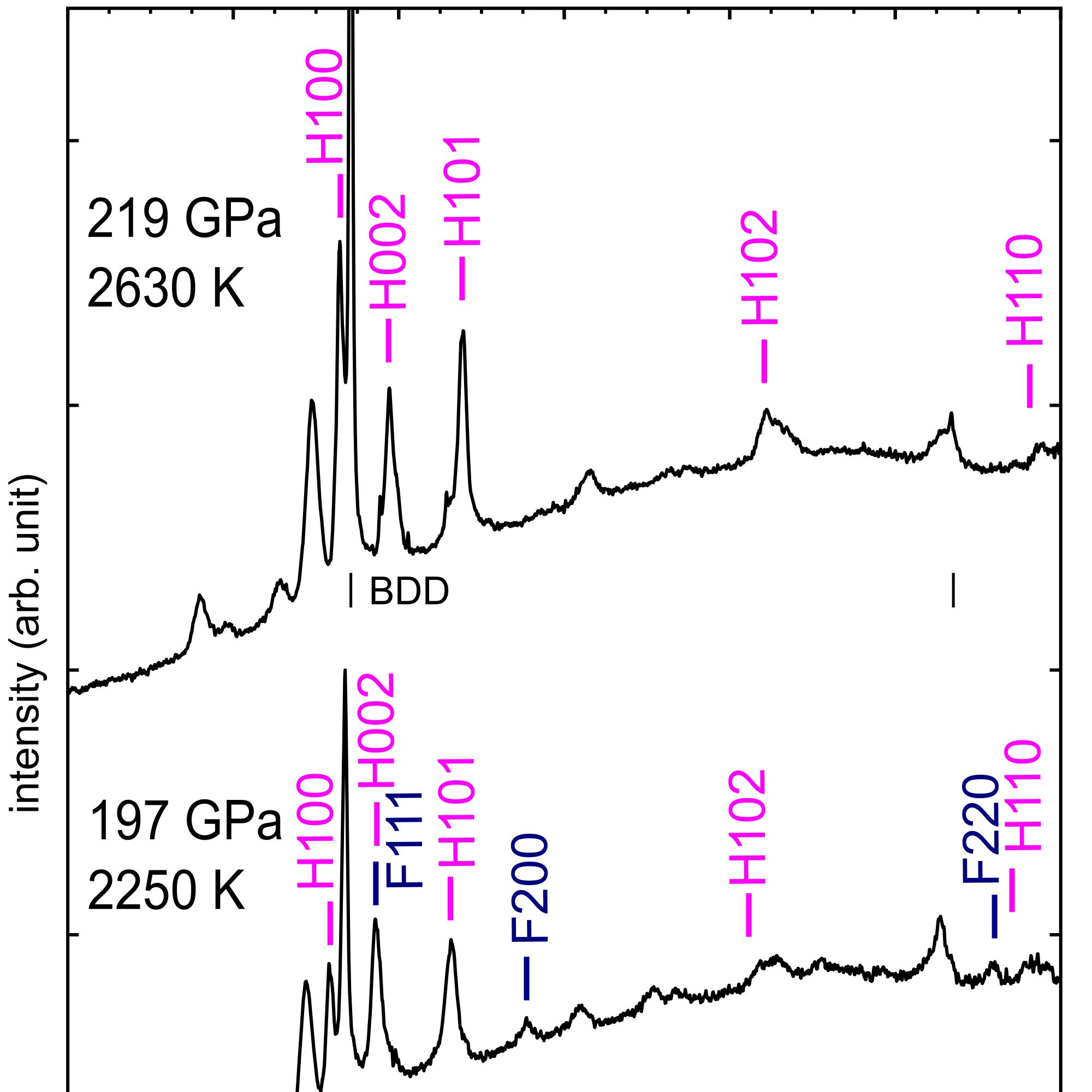
A recent experiment has demonstrated for the first time, unambiguously, a long-awaited hexagonal variant of this condition. At pressures of 219 gigapascals and 2,630 kelvin, which is roughly 2.16 million atmospheres and 2,357°C, a hexagonal close-packed oxygen lattice was dominant in the observed X-ray pattern. This finding was published in Physical Review Letters on September 9.
While this research signifies a notable advancement in science, it constitutes one instance of investigation, not a definitive scientific agreement. Regarding the term “direct,” there is an important note: the hexagonal configuration of oxygen atoms was directly confirmed through five categories of diffraction peaks; however, the behavior of hydrogen nuclei or assessments of the phase’s electrical conductivity were not directly measured. Classifying this material as superionic relies on the conditions of formation and a lattice-expansion signature associated by the authors with hydrogen diffusion.
**A Crystal That Is Only Partially Fixed**
Common ice is a molecular solid where oxygen and hydrogen atoms occupy systematic positions, creating water molecules that are hydrogen-bonded to adjacent molecules. Superionic ice deviates from this arrangement: its oxygen atoms create a firm lattice, with hydrogen nuclei becoming mobile, moving as freely as a liquid. As a result, although the material displays crystallinity, it is also significantly conductive.
The newly identified structure is referred to as hexagonal close-packed (HCP), differing from ice Ih – the hexagonal crystalline form that generates snowflakes. HCP superionic ice emerges under extreme pressure, and “hexagonal” describes the arrangement of the oxygen lattice. In a superionic context, the hydrogen portion of the lattice is disordered and dynamic.
The oxygen lattice can adopt various stacking sequences. A face-centered-cubic (FCC) stacking follows an ABCABC pattern, while HCP stacking adheres to an ABAB pattern. The lattices can appear very similar on a local scale, making differentiation from a small, hot sample challenging. Prior research definitively recognized FCC superionic ice (Ice XVIII), although theories anticipated HCP stability at higher pressures.
**How to Compress and Heat a Microscopic Sample**
The experiment conducted by Alexis Forestier and colleagues positioned water between diamond anvil tips, encased by boron-doped diamond absorbers that converted laser light into heat, with alumina serving as insulation. At pressures surpassing 200 gigapascals, the water sample measured only about 12 micrometers in diameter.
The team utilized the European Synchrotron Radiation Facility, directing an X-ray beam approximately 0.5 by 0.8 micrometers in size. As the beam traversed the compressed, laser-heated water, the crystal structure scattered X-rays, determined by atomic configuration. The resulting diffraction peaks served as structural identifiers. Complete experimental particulars are accessible in the authors’ open manuscript.
Diamond anvil cells facilitate enormous static pressure, allowing for heating and cooling of samples while researchers continuously capture structural patterns. This approach contrasts with shock-compression experiments that achieve extreme conditions for short durations. The static method enabled scientists to observe alterations within the oxygen lattice under varying pressure and temperature, providing a broader perspective on the process rather than a momentary endpoint.
**Five Peak Families Reveal the Hexagonal Lattice**
During the highest-pressure experiments, heating at 155 gigapascals and approximately 2,000 kelvin exhibited characteristics of both FCC and HCP. At 197 gigapascals and 2,250 kelvin, peaks from both structures re-emerged. When the sample reached 219 gigapascals and 2,630 kelvin, the FCC peaks diminished while five families of HCP peaks became apparent.
This progression is crucial to the outcome: an unusual diffraction spike could stem from the heater, insulation, diamond anvils, or contamination. Five consistent reflections, varying in unison with changing conditions, strongly imply a specific structural configuration. The ratio between HCP lattice dimensions was also nearly optimal for closely packed spheres.
The team discovered an alternative path to HCP stacking when cooling a lower-pressure sample. Below approximately 1,400 kelvin, new HCP reflections appeared alongside FCC and body-centered-cubic signals. This suggests that stacking faults and metastable arrangements can persist during structural transitions, indicating that the route through pressure and temperature—not merely the final readings—is essential.
**What Was Direct, and What Was Inferred**
In this experiment, X-ray diffraction is more responsive to oxygen than to hydrogen, thus the direct observation pertains to the HCP oxygen lattice. Inter