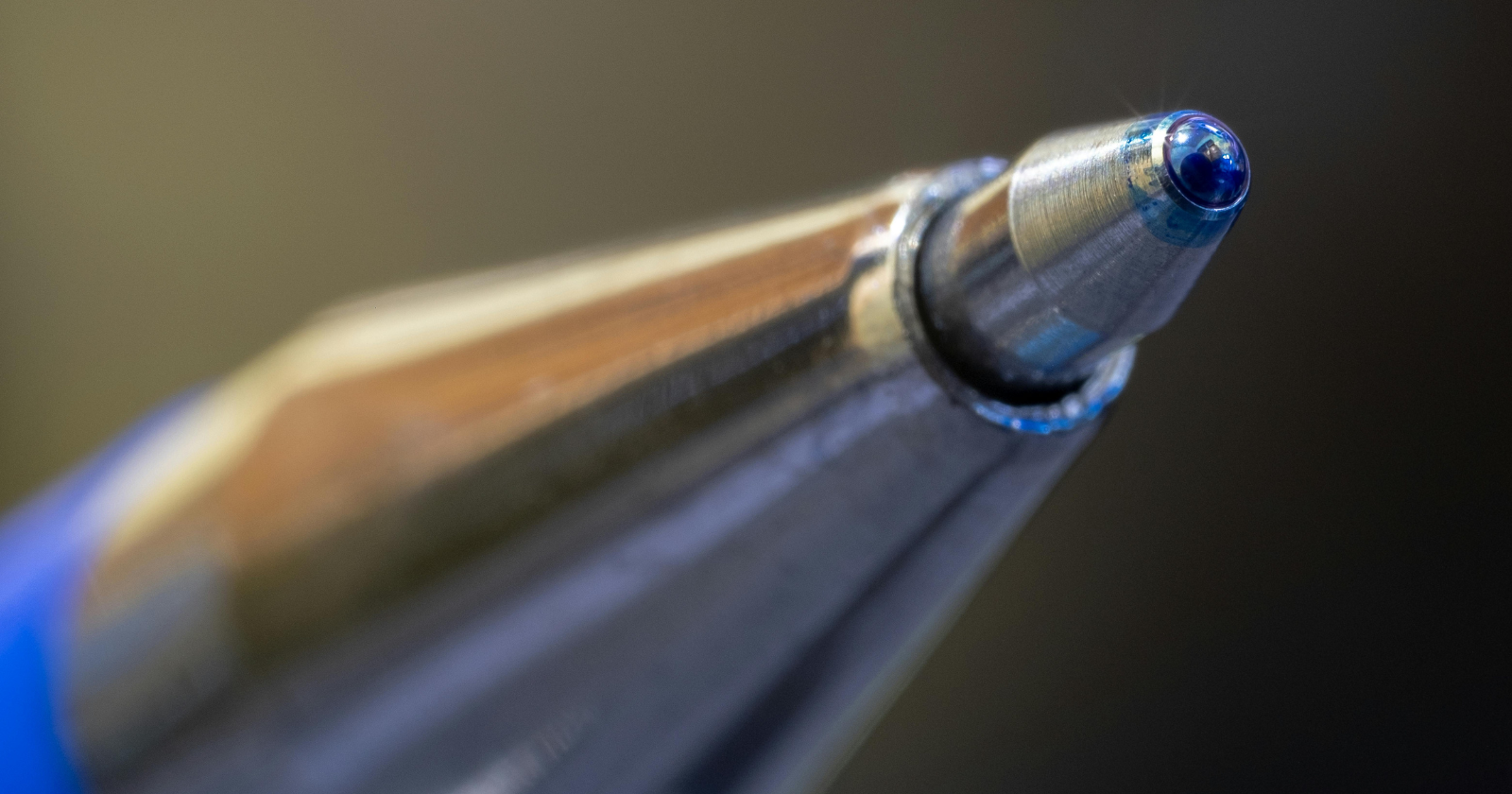
There’s a fair likelihood that the pen closest to you at this moment carries the name of a man most individuals have never heard of — and in many parts of the world, the pen isn’t just named after him; it bears his name. In Britain, Australia, Italy, and elsewhere, you don’t use a ballpoint; you use a biro.
The individual was László Bíró, and the invention arose from quite a common annoyance.
The journalist’s frustration
Bíró, born in Budapest in 1899, experimented with numerous professions — medicine, hypnotism, art, motor racing — before finding his niche in journalism during the 1930s. This role involved writing incessantly, using the only reliable tool at hand: the fountain pen.
Fountain pens were, and remain, finicky. They can leak. They smudge. Their thin ink takes ages to dry, leading to the heel of your hand dragging through a fresh line and making a mess, while the nib tears through cheap paper and requires constant refilling. For a reporter filling notebooks under tight deadlines, the fountain pen became a minor foe on a daily basis.
Then Bíró, in the newspaper office, glanced at the printing presses and observed the difference. The thick ink the printers utilized dried almost instantaneously upon contact with the newsprint — no smudging, no leaking, dry enough to stack and sell within moments. He yearned for that ink in his pen.
However, he couldn’t use it. Printer’s ink is far too thick and sticky to pass through the nib of a fountain pen; it would clog immediately. The very characteristic that allowed it to dry quickly — its heavy, syrupy consistency — rendered it impossible to deliver using the traditional method. Bíró recognized both the ink he desired and the reason it was unusable in the same glance.
The brother with the chemistry
What Bíró possessed that most frustrated writers lacked was a brother named György — trained as a dentist and inclined towards chemistry.
The brothers tackled the challenge from both angles. The delivery system was László’s innovation: instead of a nib, place a tiny ball bearing in a socket at the pen’s tip. As the ball rolls across the paper, it turns, collecting ink from a reservoir on its inner side and leaving it on the outer side — the ball serves as its own valve, dispensing the thick ink in a controlled line while sealing the reservoir against leaks and drying when at rest. Meanwhile, György focused on the ink: a formula thick enough to dry upon contact like printer’s ink, yet designed to flow smoothly to a rolling ball.
This combination resulted in the complete invention. A ballpoint is ineffective without quick-drying ink; quick-drying ink cannot be utilized without a ball to meter it. Earlier inventors had obtained patents for ball-tipped pens decades prior — the concept itself wasn’t novel — but no one had successfully harmonized the ball and ink well enough to market it. The Bírós did, filing for a patent in 1938.
The pen that surpassed its inventor
Then history stepped in, as it did for many in Europe in 1938. The brothers were Hungarian Jews, and as war drew near, they escaped, eventually arriving in Argentina, where they refiled their patent in 1943 and began manufacturing in Buenos Aires.
The pen’s first significant customer was the aviation industry. Fountain pens leak at high altitudes — falling cabin pressure causes ink to flow out of the nib — but the sealed, pressure-resistant ballpoint functioned perfectly in an unpressurized cockpit, prompting the British Royal Air Force to order thousands for its navigators, securing the design its first substantial market. From there, the ballpoint entered the typical path of successful inventions: a patent race and a price war. Others procured, borrowed, and circumvented the Bíró patents; an entrepreneur named Marcel Bich licensed and refined the design into a disposable version sold for mere cents, shortening his own name to market it — BIC, the pen that would sell in the tens of billions.
Bíró himself, as is often the case with initial inventors, saw relatively little of the wealth his idea produced. However, he gained a rarer accolade: his name became synonymous with the object. Throughout the English-speaking and much of the non-English-speaking world, the biro is simply the term for the item, an inventor’s surname so worn smooth by everyday use that most people using it are unaware they are naming a man. Argentina celebrates his birthday, September 29, as Inventors’ Day.
The entire legacy traces back to a reporter’s smudged hand and a fleeting glance — the choice to stop lamenting the fountain pen and to start envying the printing press. Bíró didn’t create fast-drying ink; the printers already had it. He didn’t invent the rolling ball; prior patents existed. What he crafted was the connection between the two, which is typically what invention is: not a novel creation from thin air, but rather two existing concepts that no one had thought to combine.