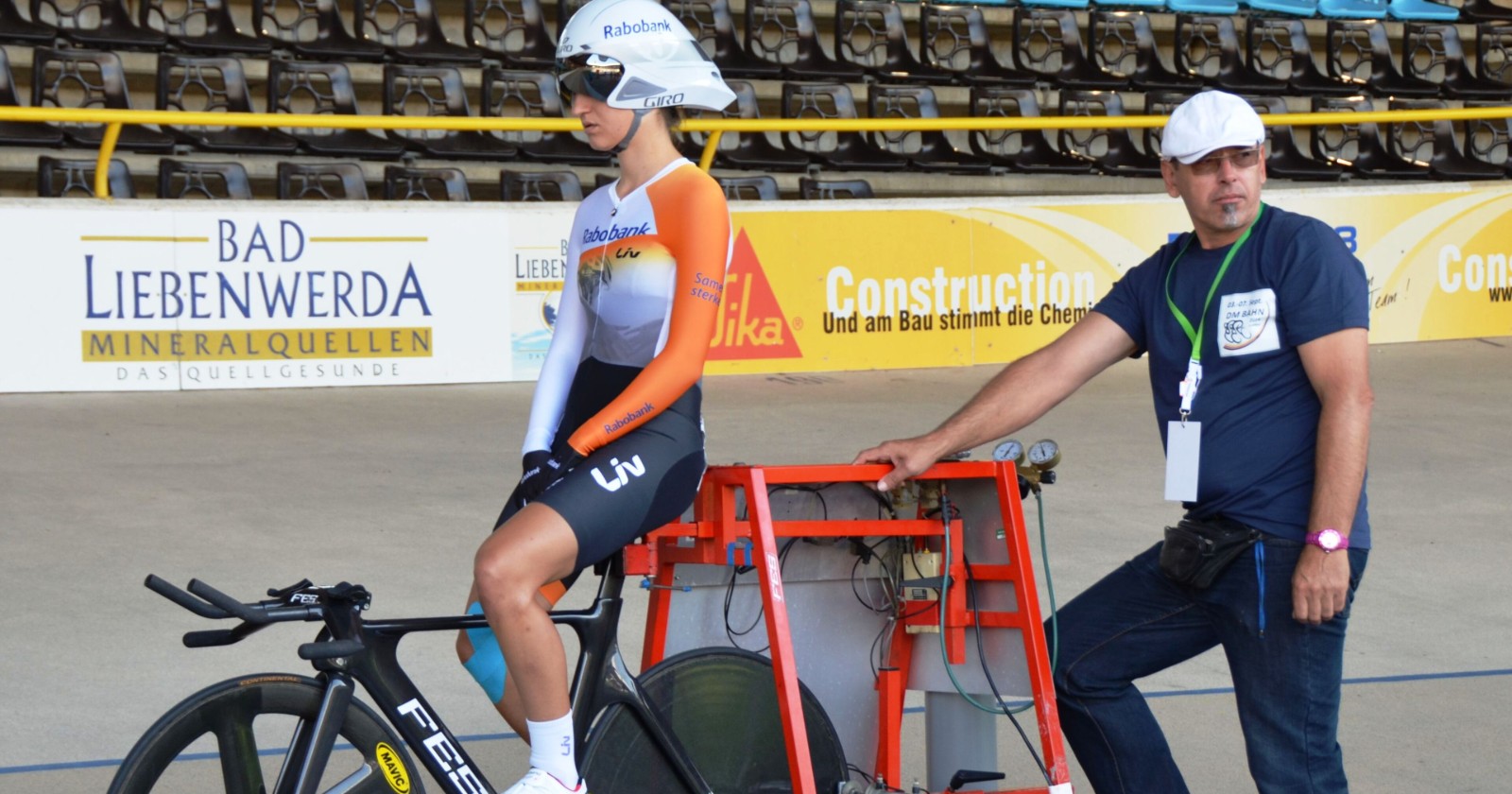
Track cycling has consistently captivated interest owing to its high-energy dynamics and precision-focused execution, especially at race starts. A recent analysis uncovers how cyclists can begin moving as the start gun fires without facing penalties for a false start. This investigation, published in the Royal Society Open Science, reveals that in the crucial initial milliseconds of the race, the cyclist’s own kinetic energy pushes them ahead, notably during the first fifth of a second.
The research evaluated the starting techniques of France’s elite team-sprint cyclists, yielding intriguing findings. The fastest among them generated approximately 1800 newtons of force by synchronizing the halting of their body’s forward momentum with the gate’s release, significantly exceeding the gate’s holding capacity of 370 newtons. This clarifies a longstanding mystery in track cycling models, which previously began at a non-zero velocity without a solid foundation—until now.
Starting with a slight distance from the start line is typical due to differences in bicycle lengths and standard gate positions. This distance permits cyclists to legally increase their speed prior to crossing the start line. The study analyzed launch postures among riders to emphasize the importance of the body’s momentum transfer, impacting their initial speed when the gate opens.
The Swiss Timing gate system, a crucial element of international track events, was examined to enhance understanding. This system incorporates pneumatic actuators that apply a clamping force bolstered by regulator pressure, yet upon the gate’s release, the resistance force diminishes almost immediately.
The interaction between the gate mechanics and the rider’s movement demonstrated that the rider’s mass repositioning predominantly influences the initial acceleration phase compared to the chain-driven force. The maximum pushing force indeed arises from the reduced velocity when the rider’s forward mass stops abruptly right after the signal, in sync with the gate release.
Moreover, the model developed in the study, which did not impose an initial speed, effectively replicated race start mechanics. This facilitated sensitivity analysis, showing how a mere tenth of a second variation in launch timing could dramatically impact speed outcomes, highlighting that precise reaction timing outweighs all other factors.
While limited in scope because it focused on three athletes, the findings underscore a vital shift towards comprehending the collaborative dynamics between human biomechanics and technical equipment in race starts.
Although the results cannot be universally applicable without additional empirical data across various bikes, gates, and track scenarios, they lay essential groundwork for refining starts in different competitive sports using stationary starting positions with dynamic release systems. The study represents progress in connecting competition results with thoroughly understood mechanical processes and athlete capabilities.