**Galileo’s Telescope: Revealing Myths and Unseen Histories**
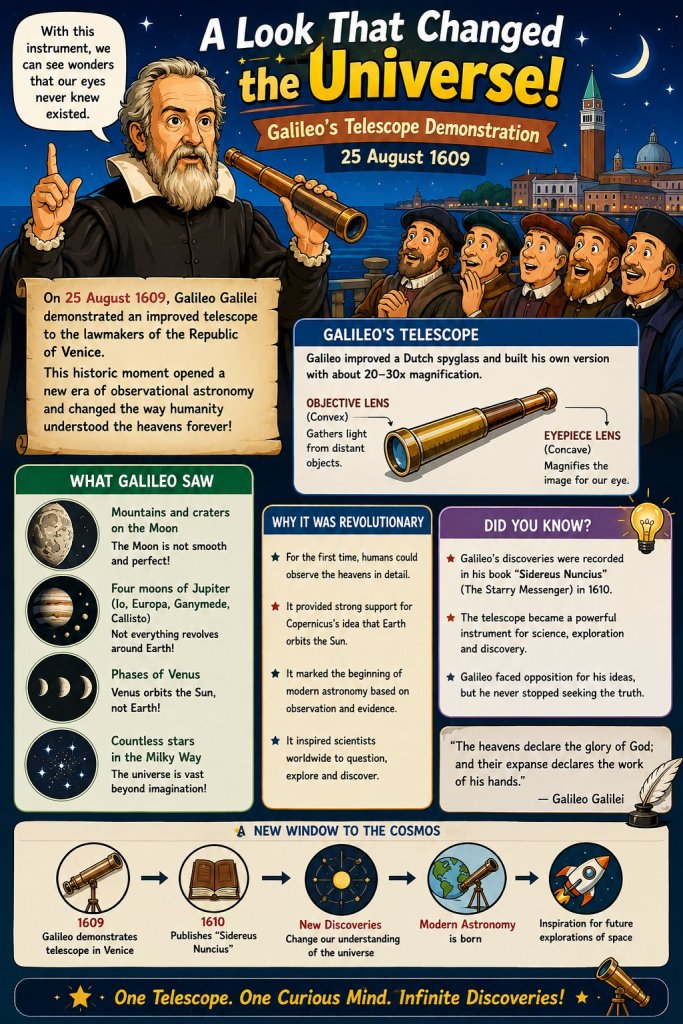
Every August, countless social media profiles and websites celebrate Galileo Galilei’s telescope demonstration to the Venetian Senate. Nevertheless, many misunderstandings exist surrounding the dates and specifics of these occasions. The dominant narrative frequently offers a simplified and exaggerated view of Galileo’s involvement, while neglecting other important figures in the early days of telescopic astronomy.
**Clarifying the Facts: Dates and Occurrences**
On 21st August 1609, Galileo showcased his telescope to Venetian nobles, followed by an official display to the Doge and Senate on 24th August. By 25th August, he obtained a lifelong position as a mathematics instructor at the University of Padua, though without future salary increases. In spite of his accomplishments, the Venetian Senate later expressed regret over their contract when they discovered the telescope could have been independently purchased at market prices.
**Beyond Galileo: A Joint Era of Discovery**
The graphic accounts often depict Galileo as the sole trailblazer of telescopic astronomy, yet this is not entirely accurate. Hans Lipperhey’s invention in 1608 sparked a wider movement. Thomas Harriot in England, Simon Marius in Germany, and the Jesuit astronomers at the Collegio Romano all engaged in concurrent astronomical observations using telescopes, largely independent of Galileo’s efforts. These astronomers made essential contributions that were critical to the advancement of the field.
**Galileo’s Enhancements and Misunderstandings**
Galileo indeed improved the Dutch spyglass into a more powerful device, achieving 20–30x magnification. However, the claim that his telescope was superior strays from historical facts. The early telescopes utilized by Galileo, Harriot, and Marius were similar to Lipperhey’s original design. The idea of Galileo being the sole innovator in telescope evolution is misleading, as these enhancements were part of collective advancements within the discipline.
**Reevaluating the Influence of Early Telescopic Efforts**
The key moment that spurred telescopic astronomy likely traces back to Hans Lipperhey’s demonstration in September 1608, which included celestial observations. The invention swiftly gained attention throughout Europe, with devices distributed to various dignitaries, including the Pope, thus igniting extensive international enthusiasm for astronomical observations.
Thomas Harriot and Simon Marius each made significant discoveries. Harriot analyzed the Moon’s surface months before Galileo, and Marius identified Jupiter’s moons concurrently with Galileo. Marius’s naming of these moons impacted astronomical terminology, although his legacy remained eclipsed due to Galileo’s quicker publication.
Galileo’s *Sidereus Nuncius* in 1610 rapidly detailed his findings for fame, playing a significant role in his renown. Despite this text’s prominence, Marius’s work, released in 1614, provided more scientific rigor. The publication emphasized that the universe was indeed more intricate than previously perceived, a realization echoed by telescopic observers across Europe.
**Enhancing the Perspective of Transformative Astronomy**
While the telescope certainly enriched observational astronomy, its initial contributions were gradual rather than revolutionary. Claims that Galileo’s endeavors alone initiated modern astronomy or solely endorsed Copernicus are exaggerated. Observational astronomy was a well-established practice, and the telescope represented a natural evolution rather than a radical transformation. Kepler’s laws, derived from pre-telescopic records, further underpinned contemporary astronomical methodologies.
**The Legacy Beyond the Idealization**
In conclusion, while Galileo’s contributions to astronomy are invaluable, the narrative that casts him as the exclusive precursor of modern astronomy is an oversimplification. Acknowledging the varied and simultaneous developments by numerous astronomers not only honors historical accuracy but enhances our comprehension of this crucial period in scientific discovery. Such a comprehensive viewpoint enriches the historical context, illustrating a collaborative quest toward understanding the cosmos.