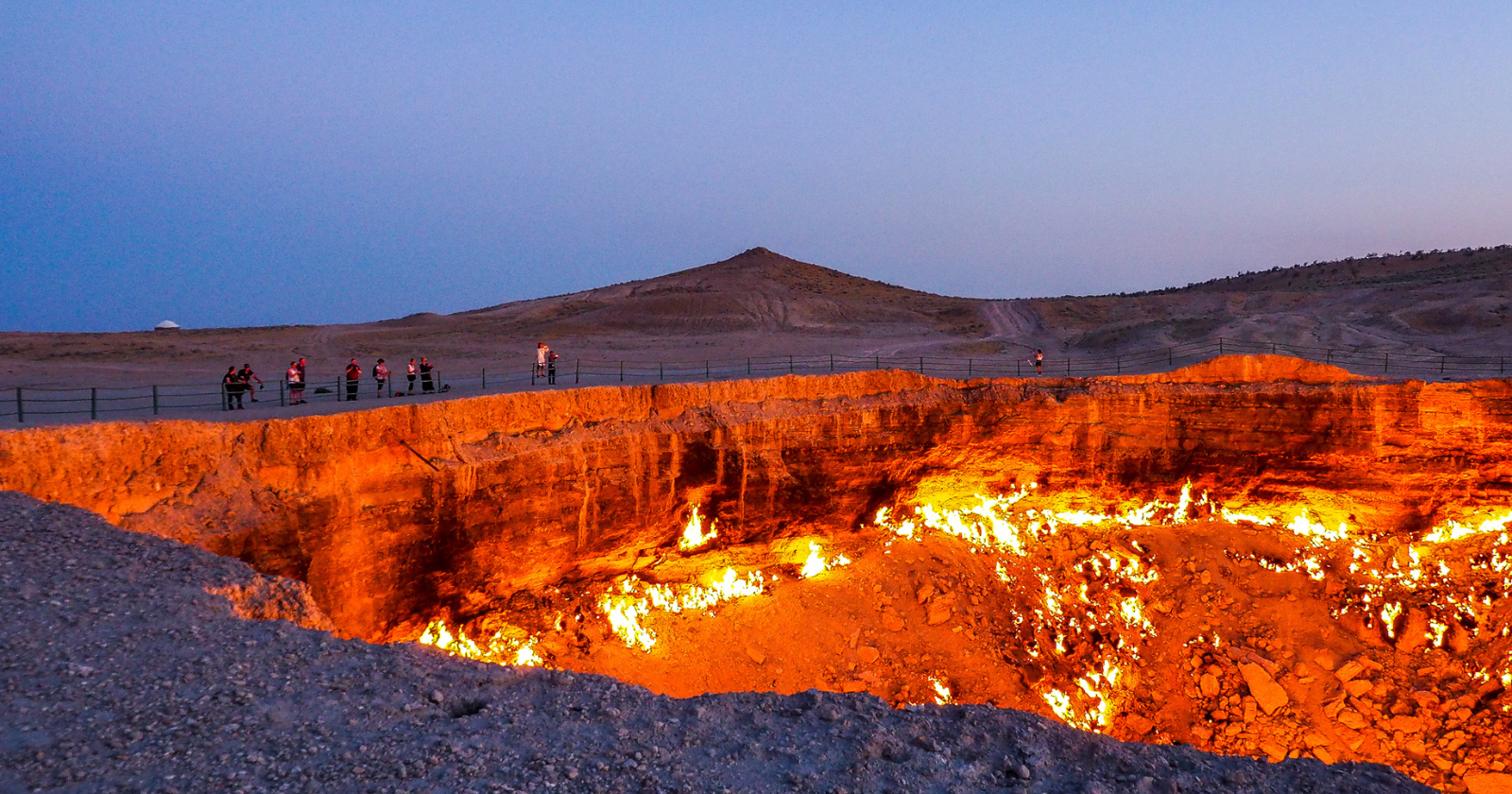
In the heart of the Karakum Desert, one of Earth’s most desolate regions, exists a gaping hole in the ground that has been ablaze for the lifetime of most individuals reading this.
This hole forms a near-perfect circle, measuring about 230 feet in diameter and around 100 feet in depth, with its base and walls adorned with hundreds of flickering flames and a few larger ones roaring at the center. During nightfall, the radiance can be seen for miles across the dark, flat expanse of the desert. The locals refer to it as the Darvaza crater, named after the nearby village, yet globally, it is known as the Door to Hell.
The tale of how this fire ignited is one that everyone shares, yet remains largely unverified.
The narrative commonly recounted
The typical account is as follows. In 1971, Soviet geologists were drilling for natural gas in the Turkmen desert, which was then part of the USSR, when the ground beneath their equipment collapsed. The drilling apparatus disappeared into a sinking cavern, causing a large crater to emerge, releasing hissing methane and other harmful gases into the atmosphere.
Fearing that the fumes could poison nearby communities, the engineers made a decision that seemed sensible at the time and has proven to be everlasting: ignite the gas and allow it to burn off. Fire consumes methane, and they anticipated the crater would run out of fuel in a few weeks.
It did not. The crater has continued to burn unabated ever since — for over fifty years — sustained by one of the largest natural gas networks on the planet, which continually seeps up through the fractured rock faster than the fire can ever eliminate it. What was intended as a brief controlled burn transformed into one of the most enduring fires humanity has ever ignited.
The aspect that remains unverifiable
This is where reality proves to be more fascinating than lore: nearly none of this origin story is substantiated.
Turkmenistan does not maintain any official records of the event, and the Soviet documentation from that era is inconsistent and seldom made public. While the 1971 date is the most frequently cited, researchers disagree — a Turkmen geologist named Anatoly Bushmakin has proposed that the collapse may have occurred and the fire may have been ignited closer to the early 1980s. Some narratives suggest that the crater fell in the 1960s and wasn’t set ablaze until many years later.
The sole individual who has physically descended to the bottom is Canadian explorer George Kourounis, who abseiled into the fiery pit in 2013 to gather soil samples. Even he has noted that there is no solid documentary evidence to support the widespread tale. Consequently, the “1971, Soviet engineers, a few weeks” narrative is best recounted in the manner locals share it — as the story that has become associated with the crater, rather than as verified historical fact. What remains undisputed is the fire itself, which anyone can observe.
What it’s genuinely like
The physical reality aligns with its moniker. Kourounis, equipped with a heat-reflective suit and harness, reported a roar audible from the rim, unbearable heat downwind, and a flame-covered floor akin to a small section of a star resting in the sand. Temperatures within have been estimated to reach around 1,000°C.
Surprisingly, it is not devoid of life. During his descent, Kourounis’s team was searching for something one wouldn’t expect in a pit of burning gas — living organisms — and researchers have since discovered bacteria in the crater’s soil that thrive in extreme heat, along with anecdotal reports of spiders attracted to or ensnared near the glow. A location named for hell surprisingly hosts its own diminutive ecosystem.
Against all odds, the crater has also transformed into a tourist destination. Turkmenistan is one of the most isolated countries on the planet, yet the Door to Hell stands as its most renowned landmark, drawing travelers who set up camp on the rim to witness the ongoing inferno throughout the night.
The door may soon be shut
The most peculiar recent development is that the eternal flame may not be everlasting after all.
For years, Turkmenistan’s government has desired to eliminate the crater — successive leaders have instructed its extinguishment, citing concerns over wasted gas, environmental damage, and health risks, although no solutions have been figured out. Now, it appears they may be achieving this, not by extinguishing the flames, but by depriving them of fuel: drilling new wells surrounding the crater to siphon off the gas before it can reach the fire. Officials announced in 2025 that the blaze had significantly lessened — by about threefold — from its previous intensity.
Thus, after more than fifty years, the Door to Hell is quietly extinguishing — not through a grand finale, but by having its fuel line gradually severed from the side. It is a suitably unremarkable conclusion for a fire that ignited, if the tale is accurate, as a short-term solution that no one contemplated extending. The engineers in 1971 expected the crater to burn for a