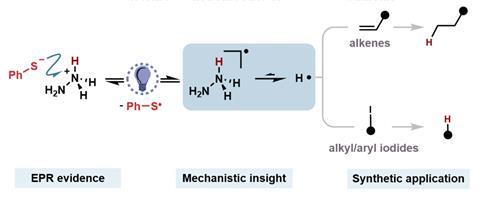
A group headed by Roopender Kumar at University College London has unveiled an innovative method for generating hydrogen radicals under mild conditions using readily available reagents. This breakthrough signifies a major shift from the traditionally severe techniques needed to produce these highly reactive species, making it feasible for any chemist to implement.
In the past, generating hydrogen radicals—a key yet elusive reactive species in the field of chemistry—necessitated complicated and harsh techniques such as utilizing incandescent filaments, electrical arcs, mercury lamps, or ionizing radiation. These methods required the breaking of exceptionally strong bonds to release a hydrogen atom from substances like water, a process Kumar refers to as brute force.
The new strategy developed by Kumar’s team significantly streamlines this procedure. Their approach requires merely a temperature of 30°C, a violet LED, an economical sulfur-based organocatalyst, and hydrazine—none of which involve precious or toxic metals, hydrogen gas, or pressurized equipment. The method operates by mixing hydrazine with the sulfur catalyst to create an intermediate that reacts under ultraviolet light. This reaction yields a distinct neutral Rydberg radical, a highly unstable species that swiftly breaks down to produce hydrogen radicals and regenerate hydrazine.
This technique offers a simple means to harness hydrogen radicals as reagents for a range of reactions, such as hydrogenation and dehalogenation, which were previously inaccessible to synthetic chemists. Maxie Roessler, a radical chemistry specialist from Imperial College London, emphasizes the promise of this development to democratize hydrogen radical reactions. By functioning under practical lab conditions with near-UV light sources, it enables a wide array of researchers to investigate novel chemical transformations.
The ability to generate hydrogen radicals in a controlled, gentle setting opens up a variety of reactions, especially alkene hydrogenation, achieving impressive yields of up to 96% across diverse substrates. This method safeguards sensitive functional groups like aryl chlorides and bromides, transcending the limitations tied to existing approaches involving palladium catalysts. Kumar’s team has also applied the technique to compounds similar to fluoxetine (Prozac), menthol, terpenoids, and amino acids, achieving notable results such as hydrogenating allyl glycine without affecting stereochemistry.
In summary, this innovation represents a significant advancement in chemical synthesis, providing greener and more accessible options for radical reactions. Kumar believes this progress can revolutionize how chemists utilize hydrogen radicals, marking the first genuine opportunity for widespread application of these reactions in a sustainable manner.