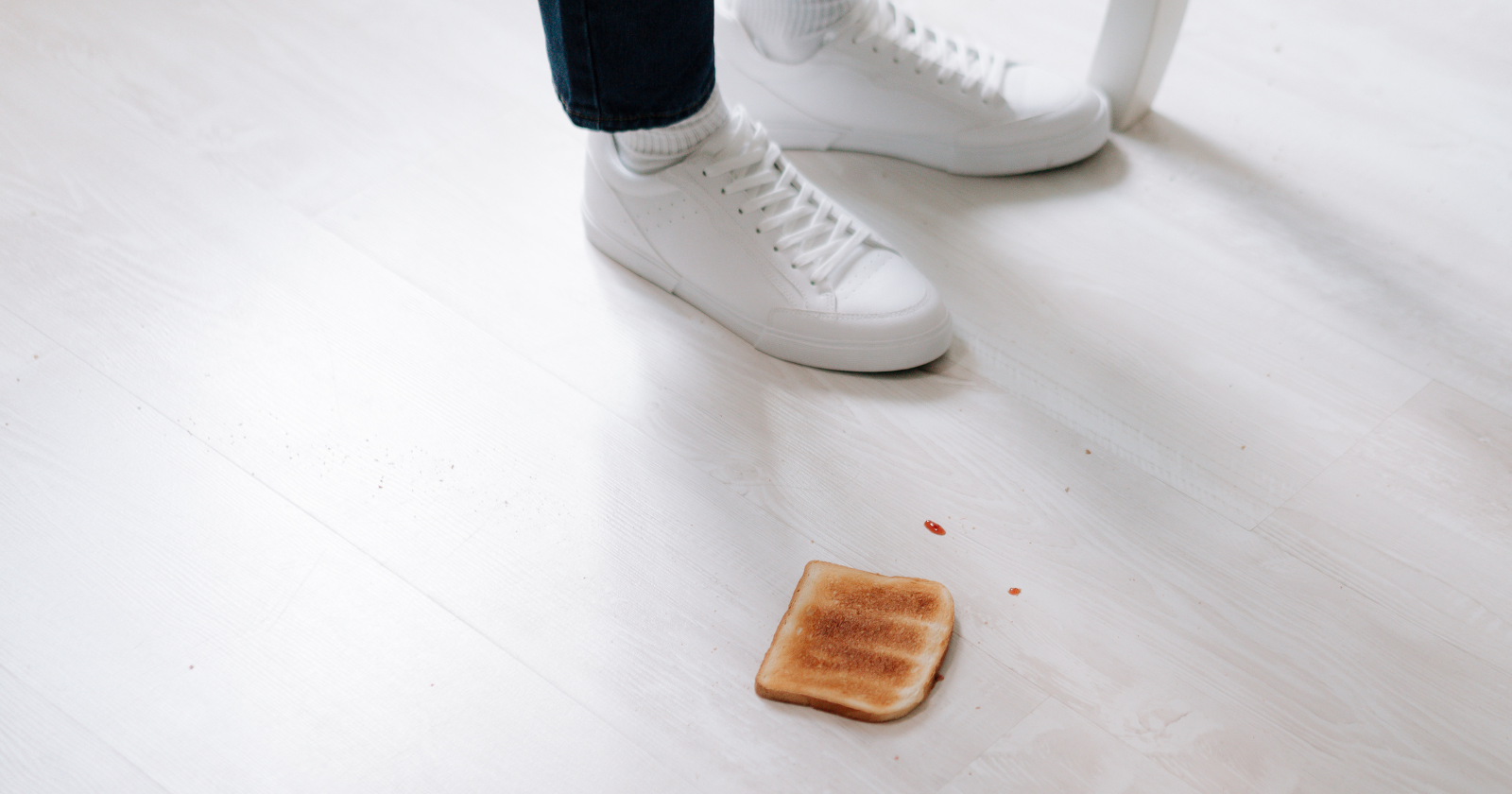
**The Fallacy of the Five-Second Rule Disproved: Findings from a Rutgers University Study**
The longstanding “Five-Second Rule,” the notion that food that has fallen on the ground is safe to eat if retrieved promptly, is challenged through thorough scientific examination. Researchers Robyn Miranda and Donald Schaffner from Rutgers University carried out a study to evaluate the legitimacy of this well-known common saying, publishing their results in the journal Applied and Environmental Microbiology in 2016.
**Overview of the Experiment**
In the carefully conducted study, food was dropped onto intentionally contaminated surfaces 2,560 times, ensuring accuracy by releasing it from a height of precisely 12.5 centimeters. None of the food was ingested; instead, every piece was bagged, ground down, and spread over a culture plate to examine bacterial transfer.
**Methodology: Evaluating Different Variables**
– **Surfaces Studied:** Stainless steel, glazed ceramic tile, maple laminate, and indoor-outdoor carpet.
– **Types of Food:** Cut watermelon, plain white bread, buttered bread, and strawberry gummy candies.
– **Duration of Contact:** Less than one second, five seconds, 30 seconds, and five minutes.
– **Bacterial Medium:** Two distinct growth media were used.
These combinations produced 128 potential scenarios, each replicated 20 times, involving the bacterium Enterobacter aerogenes, a harmless substitute for harmful bacteria like Salmonella.
**Key Discoveries: Importance of Moisture**
– **Watermelon Result:** Up to 97% of bacteria transferred in under a second. Its high moisture level (water activity of 0.99) made it very vulnerable to contamination.
– **Gummy Candies:** Showed the lowest transfer rates, approximately 62%, underscoring the protective quality of low-moisture foods.
– **Unexpected Findings with Carpet:** Contrary to expectations, carpet released the least bacteria. Fibers held onto bacteria and restricted contact with the food, while tile and stainless steel facilitated significantly higher transfer rates.
– **Inconsistent Results on Wood:** The findings for wooden surfaces were variable, falling between the extremes of carpet and steel.
**Conclusion: Reevaluating the Rule**
The belief that bacteria wait a specific time before contaminating food is disproven. Factors like moisture levels and surface type are more influential than time alone. The Rutgers study, building on prior research by Jillian Clarke and others, clarifies that prompt action and surface cleanliness have greater impact on contamination risks than a timer.
In the end, vigilance and sanitation in food handling surpass the safety claimed by the Five-Second Rule, advocating a more careful approach to items that have fallen.