A novel boron allotrope has been revealed through recent investigations as an exceptionally flexible substance exhibiting outstanding electrical conductivity, surpassing other forms of boron by several orders of magnitude. This advancement was realized via an innovative precursor-based technique, which may lead to the identification of materials with distinct characteristics.
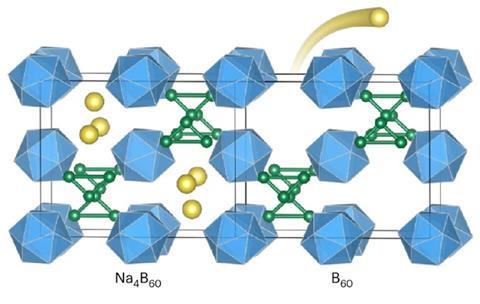
The groundbreaking material is the result of work by a team spearheaded by Xiao-Ji Weng and Xiang-Feng Zhou at Yanshan University in Qinhuangdao, China. Their approach involves the initial formation of sodium boride (Na₄B₆₀), followed by the extraction of sodium to yield a pure-boron configuration termed Imma-B₆₀. Although sodium boride was first synthesized in 1970, it has remained underexplored due to difficulties in obtaining high-quality crystals. Weng and Zhou’s team enhanced this by creating a high-pressure synthesis method to generate larger crystals, which were subsequently ground into a powder. Sodium was removed by employing a vacuum and heating the material to 900°C over a span of two days.
Imma-B₆₀ showcases a structural framework composed of icosahedral units made up of 12 boron atoms and triangular formations featuring three boron atoms, with voids left where sodium atoms previously existed. This open architecture likely contributes to the material’s exceptional plasticity, in contrast to the usual rigidity of other covalently bonded elemental materials. In addition, Imma-B₆₀ exhibits electrical conductivity six to seven orders of magnitude higher than that of other boron allotropes.
The researchers suggest that the approach of eliminating template units from precursor materials may be applicable to a wide range of compounds. They envisage this method as a pathway to uncovering unconventional framework materials, providing a promising basis for designing mechanically robust, functional inorganic substances.