**Triceratops Physiology: Disclosing the Mysteries of Its Intricate Skull Design**
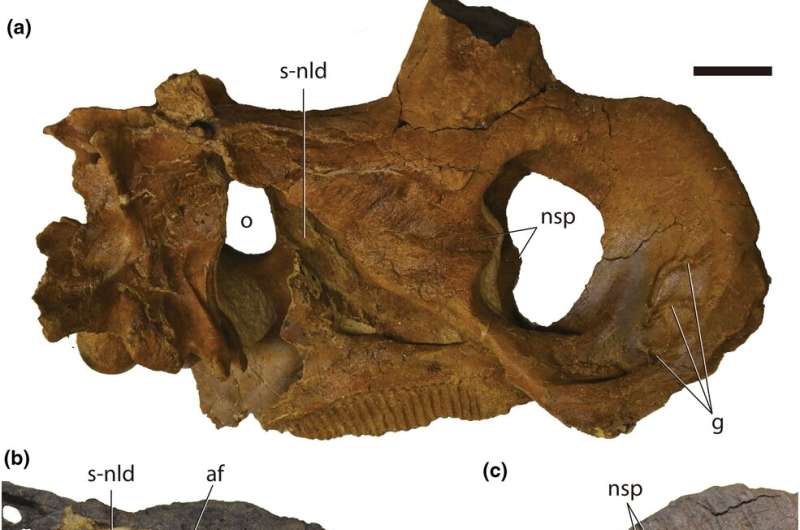
Seishiro Tada, a scientist affiliated with the University of Tokyo Museum, has initiated a scientific endeavor to unravel the enigma of a Triceratops skull. While examining 3D-printed pieces of a Triceratops snout, Tada noticed unusual internal passages that traditional reptilian anatomy could not explain.
The enigma has focused on the vast nasal cavity of Triceratops, a topic that has perplexed paleontologists for more than a hundred years. In contrast to other dinosaurs with smaller nostrils, ceratopsids such as the Triceratops developed disproportionately large openings in their sturdy skulls. By integrating high-resolution CT scans of a disassembled Triceratops premaxilla with knowledge from contemporary avian and crocodilian anatomy, Tada’s group has illustrated the soft tissues that once filled this puzzling cavity.
The results suggest that Triceratops did not depend solely on its nose for smell. Instead, these dinosaurs seemingly adapted their facial structure for an advanced cooling system. Typical reptilian anatomy directs nerves and blood vessels to the nostrils through the jaw. However, the distinctive skull design of Triceratops requires a different pathway through the nasal branch, bypassing the usual jaw route.
This evolutionary adjustment was essential for the ceratopsids, massive beings with intricate skull structures, to effectively manage heat loss. The hefty head, with its dense bone, posed a cooling dilemma, especially in the humid environment of the Late Cretaceous. Evolution offered a remedy—a specialized nasal mechanism.
Tada’s team identified a crucial bony ridge within the CT scans, comparable to the attachment point for respiratory turbinates in modern birds. Turbinates, slender, curled structures entwined with blood vessels and moist tissue, would have allowed Triceratops to regulate heat as inhaled air swept through the nostrils. The cooling of blood prior to reaching the brain and moisture retention would have been vital for survival.
The insight that Triceratops may have had respiratory turbinates is revolutionary. While prevalent in mammals and birds, such features are uncommon in dinosaurs. Tada’s measured optimism relies on evidence that some birds exhibit similar turbinate attachment ridges, mirroring those found in horned dinosaurs.
This internal nasal cooling system was essential for the large herbivore. Imagine a Triceratops maneuvering through dense foliage, its heavy head lowered while cool, moisture-filtered air rejuvenated it with every breath. This imagery transcends the well-known horns and frills of Triceratops; it reveals a biological wonder designed for peak functionality.
By utilizing the Extant Phylogenetic Bracket—a technique for inferring traits in extinct species by studying living relatives—Tada’s work exceeds speculation, achieving accurate biological reconstructions. The methodology is a careful puzzle assembly, leveraging advanced technology and a deep respect for the continuity of life.
The Triceratops’ nose is just the starting point. The complex ceratopsid skull, with its mysterious frill, entices as a possible radiator, protection, or mating display. With the nasal map finalized, Tada aims to investigate these other regions of the skull.
“I intend to delve deeper into the anatomy and functionality of their frills,” Tada states. The goal is to form a thorough, three-dimensional comprehension of these beings as active, living entities. Each revelation brings us closer to resurrecting the past—not merely confined to static fossils but as a vivid representation of prehistoric life.
The Triceratops, with its remarkable nasal structure, epitomizes evolution’s brilliance in addressing size-related challenges. Behind every legendary three-horned face lies a sophisticated network of blood vessels and tissues that maintained stability in a warming environment. As this ancient puzzle nears resolution, the extraordinary nature of these “nosy” giants becomes increasingly evident.
Study link: [https://anatomypubs.onlinelibrary.wiley.com/doi/10.1002/ar.70150](https://anatomypubs.onlinelibrary.wiley.com/doi/10.1002/ar.70150)
**Support Our Reporting**
If our findings have illuminated or motivated you, please consider making a donation. Every contribution aids our dedication to providing reliable and compelling science news. Thank you for your generosity!