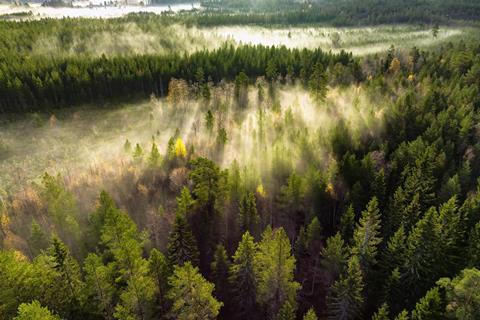
Increasing levels of carbon dioxide in the atmosphere present a complex challenge for boreal forests, as evidenced by a thorough examination of archived tree cores from Sweden. Although higher CO2 can theoretically boost photosynthesis, allowing trees to grow more rapidly, this enhancement is greatly reliant on the availability of vital nutrients such as nitrogen and phosphorus. Recent studies indicate that as CO2 concentrations rise, trees may encounter greater obstacles in obtaining nitrogen, an essential nutrient, thus impeding their growth and compromising their effectiveness as carbon sinks.
Trees primarily gain nitrogen through symbiotic relationships with soil fungi called mycorrhizae, which aid in the decomposition of organic matter. These fungi hold onto the less abundant nitrogen-15 isotope while supplying nitrogen-14 to the trees, making it possible to detect nitrogen limitation by observing declines in nitrogen-15 within tree wood. Though recognized in broader studies, the intricacies of human-induced nitrogen pollution complicate the understanding of the distinct impacts of carbon versus nitrogen pollution.
Kelley Bassett, a doctoral researcher in forest ecology at the Swedish University of Agricultural Sciences, and her team, analyzed samples from Norway spruce and Scots pine collected across Sweden from 1961 to 2018. The findings revealed that atmospheric CO2 levels significantly affected nitrogen isotope ratios in these trees, signaling increased nitrogen limitation as CO2 levels climb. This trend implies that forests globally may encounter comparable issues, with trees struggling to compete with more agile soil microorganisms for dwindling nitrogen supplies.
Ecosystem ecologist Andrew Elmore from the University of Maryland agrees, pointing out that this research effectively negates the idea that nitrogen deposition significantly influences nitrogen cycling in these scenarios. Further investigation could reveal broader ecological consequences, such as effects on caterpillar growth and bird foraging efficiency, influencing the entire ecosystem. As this study progresses, it emphasizes the crucial relationship between atmospheric changes and terrestrial nutrient cycles, prompting a reassessment of carbon sink potential in forest ecosystems.