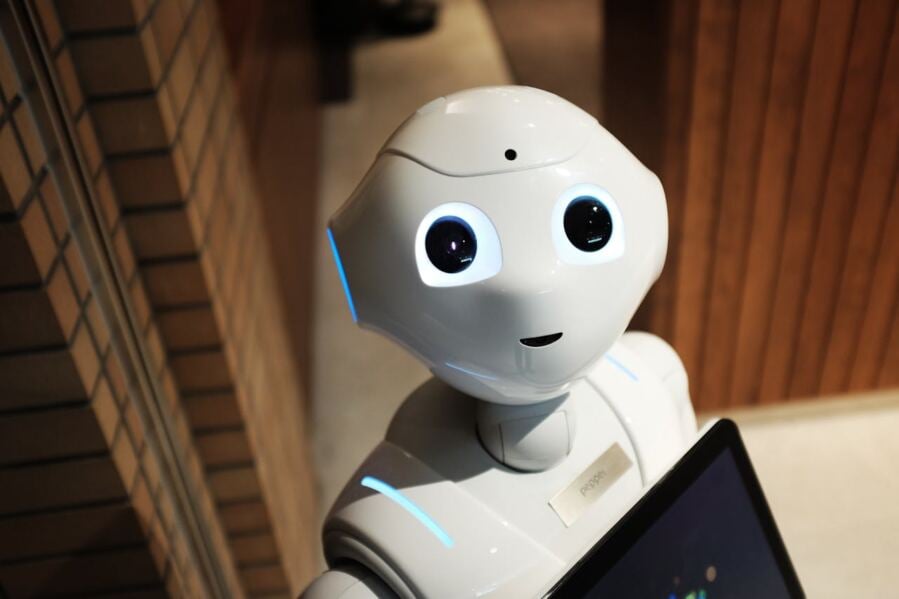
IT TAKES merely a handful of clicks in Photoshop to achieve this. You start with a realistic humanoid figure, locate the region surrounding the eye sockets, and—snip—the eyes disappear. In their stead, there is a sleek, plastic-like emptiness. This slight visual adjustment alters everything.
We have long recognized that “eyes are the windows to the soul,” a saying frequently (and possibly inaccurately) attributed to Shakespeare. However, as we increasingly coexist with machines that resemble us, this piece of folk wisdom is undergoing a thorough scientific examination. Jari Hietanen and his colleagues from Tampere University in Finland sought to investigate: if you provide a robot with eyes, do we begin to perceive it as having “someone” inside?
“This holds great significance,” Hietanen believes, “because the perception of a mind affects empathy, cooperation willingness, and even the ethical treatment of technology.”
The team employed an AI image generator to create twenty-four high-resolution robots. They varied widely—some resembled children, while others appeared as adults. Some had eyes integrated into their “skulls,” whereas others showcased them on digital facial displays. Next came the Photoshop modification to produce “eyeless” variations of those identical machines.
When 200 participants were requested to assess these robots, the findings were notably uniform. Robots with eyes were deemed to possess greater “agency”—the capacity to think, plan, and consider outcomes—and increased “experience,” which refers to the ability to feel hunger, pain, or joy.
This was not merely a conscious bias. In a follow-up experiment utilizing the Implicit Association Test (IAT), the researchers discovered that this “mind perception” activates at a subconscious level. Our brains appear to be performing the “eyes equal mind” calculation even before we fully process the image.
Why is this so? From an evolutionary standpoint, it is logical. We are instinctively programmed to monitor gaze, as it indicates where a predator is focusing or what a tribal member is contemplating. Yet, in the context of robotics, this instinct presents a complex dilemma. Some AI ethicists have already “explicitly cautioned against giving eyes” to robots. They worry it could be a form of deceit—a means to manipulate us into empathizing with a machine that, at its core, is merely a collection of wires and code.
This is a design decision with tangible implications. If a care robot possesses eyes, an elderly person may develop a stronger bond with it. If a delivery robot lacks eyes, we might be more inclined to shove it aside on a busy sidewalk.
Hietanen’s research indicates that eyes represent far more than just a cosmetic enhancement. They serve as the switch for our empathy. As we invest in more of these devices, we will have to make a choice: do we prefer to engage with our technology eye-to-eye, or do we choose to remain in ignorance?
Study link: https://www.sciencedirect.com/science/article/pii/S1053810025001564
If our reporting has informed or inspired you, please consider making a donation. Every contribution, no matter the size, empowers us to continue delivering accurate, engaging, and trustworthy science and medical news. Thank you for standing with us!