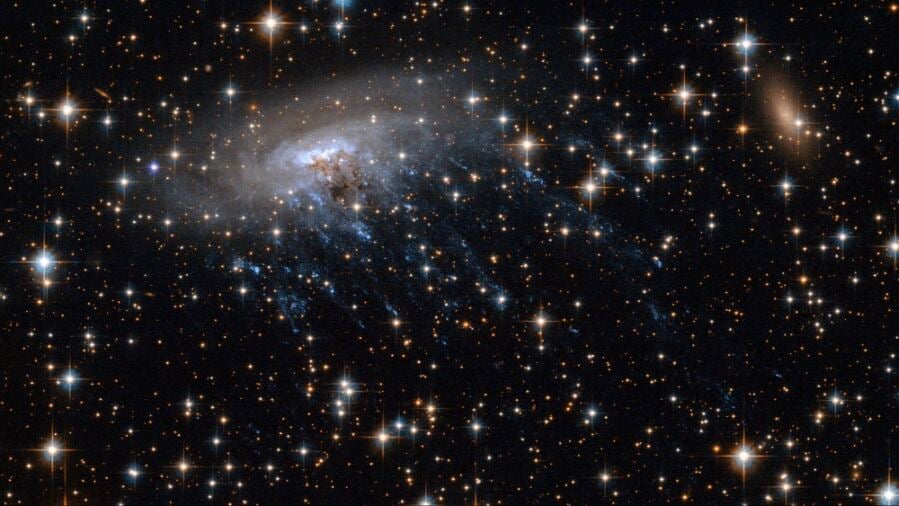
Somewhere in a dull patch of sky selected for its lack of excitement, a galaxy is undergoing disintegration. Not through collision or explosion, but by the force of wind. The gas that winds through its spiral arms is being stripped away, cast into elongated trailing streams that extend tens of thousands of light years behind it, resembling tentacles. We are witnessing this event as it occurred 8.5 billion years ago, when the universe had barely reached a third of its current age.
The galaxy, bearing the unremarkable catalogue designation COSMOS2020-635829, is the furthest jellyfish galaxy ever recorded. Its discovery, detailed by Ian Roberts from the University of Waterloo in Canada and his team, is prompting astronomers to rethink how rapidly the cosmos became a hostile environment for galaxies.
Jellyfish galaxies derive their name from the phenomenon that occurs when they dive through the hot, diffuse gas that occupies the space between galaxies in a cluster. This intergalactic medium behaves like a headwind, with ram-pressure stripping the galaxy’s gas from behind. Stars, being far denser, remain intact. However, the lighter gas is drawn into elongated tails, and occasionally, within those tails, new stars are born. This process has been well documented in the nearby universe. Observing it in action this far back in cosmic history, however, is an entirely different matter.
Roberts and his colleagues were analyzing data from the James Webb Space Telescope’s COSMOS-Web survey when they detected it. “We were examining a vast amount of data from this well-explored region in the sky in hopes of identifying jellyfish galaxies that had not yet been studied,” Roberts stated. “Early in our search of the JWST data, we came across a remote, undocumented jellyfish galaxy that immediately captured our attention.”
What JWST unveiled was impressive in its clarity. The central part of the galaxy appeared entirely normal, a symmetric disc of stars proceeding with their activities. Yet to the south, trailing behind like wreckage from a gradual car accident, were four bright blue knots of light. These were not ancient stars dislodged from the galaxy. They were newly formed stars, emerging from gas that had no reason to create stars at all.
To verify that the knots were genuinely part of the galaxy and not unrelated background objects, the team utilized the Gemini North telescope in Hawaii. Employing its integral field spectrograph, they mapped the faint glow of ionized oxygen gas in the vicinity. The gas tail extended at least 20 kiloparsecs beyond the visible boundary of the galaxy and, crucially, displayed a smooth velocity gradient connecting it to the rotation of the galaxy. This consistency was decisive; this gas belonged to the galaxy and was being torn away.
The sources of the tail proved to be surprisingly young, each containing stellar populations no older than 100 million years, with masses around a hundred million times that of our sun. Individually, they contribute roughly 1 to 2 percent of the main galaxy’s stellar mass and about half a percent of its star formation rate. Possibly modest contributions. However, the mere existence of these stars this far back in time is significant.
Prior to this discovery, the count of confirmed jellyfish galaxies beyond a redshift of 1 was, according to the paper itself, likely zero. Fewer than ten candidates were documented in the entire literature. The common assumption suggested that galaxy clusters in these early times were still coming together, their environments not yet sufficiently dense or hot enough to create the intense ram pressures needed to strip gas from a moving galaxy.
COSMOS2020-635829 indicates otherwise. “Cluster environments were already severe enough to strip galaxies, and … galaxy clusters might significantly alter galaxy properties sooner than previously believed,” Roberts stated. This carries implications for one of astronomy’s enduring puzzles: why so many galaxies in clusters today are red and dead, depleted of the gas required for star formation.
The traditional view presents a “slow-then-rapid” model. Galaxies initially lose fresh gas as they drift into a cluster. Then ram-pressure stripping delivers the final blow, sweeping away whatever fuel is left. If that stripping was already taking place around Cosmic Noon, roughly the time when star formation in the universe peaked, it could imply that the process of environmental killing commenced much earlier than we have assumed. Roberts and his team have requested additional time on JWST to investigate the galaxy further.
A question still lingers regarding the galaxy’s classification. The team cannot completely dismiss the possibility that it may be a collisional ring galaxy instead of a jellyfish. However, the distribution of its ionized gas, which peaks at the center and steadily fades into the tail rather than being concentrated along a ring, strongly suggests stripping. Regardless of the final conclusion, one thing appears certain: the nascent universe was not the gentle nursery we once envisioned. It was already capable of stripping galaxies to their cores.
Study link