## Ralph Greatorex: Instrument Maker of the Seventeenth Century and Collaborator in Early Modern Science
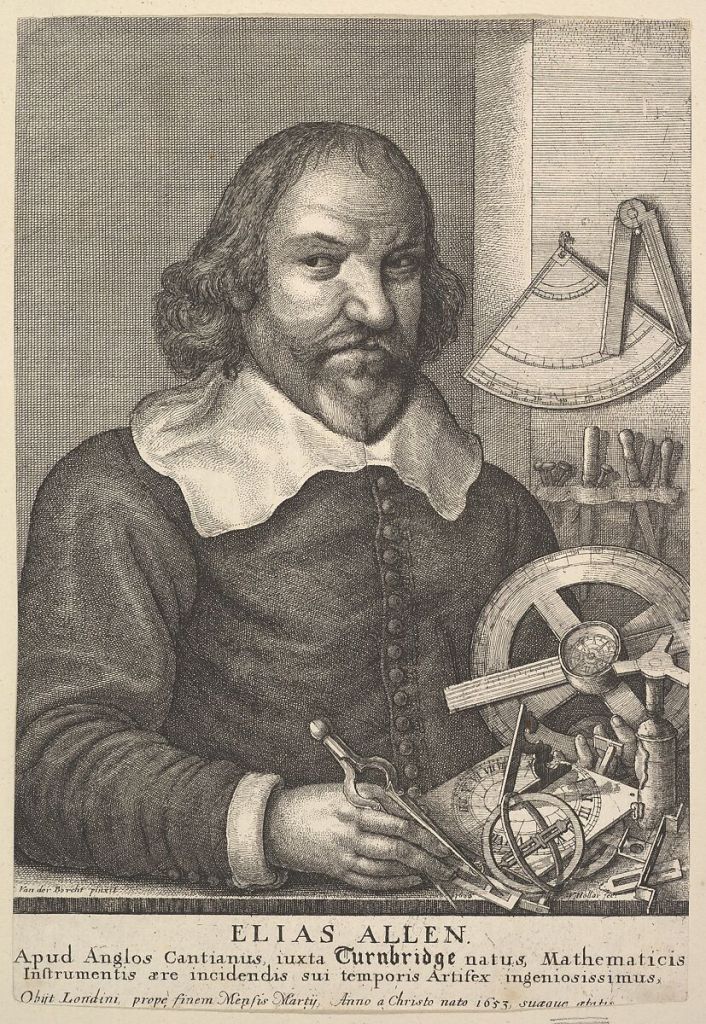
Ralph Greatorex (circa 1625–1675) was a prominent figure in the scientific field of seventeenth-century England. Hailing from Derbyshire, he began his career as an apprentice clockmaker under Thomas Dawson and subsequently under Elias Allen, a noted maker of scientific instruments. He finished his apprenticeship in 1648 and opened his own workshop known as the Sign of Adam and Eve in 1650.
Greatorex formed close relationships with key scientists, particularly William Oughtred. He exchanged letters with Oughtred and created various mathematical instruments based on his designs, including the pioneering double horizontal dial. His involvement with the scientific community included making instruments for notable individuals like Christopher Wren, a celebrated mathematician and architect, and Robert Boyle, for whom he built a vacuum pump.
Greatorex’s reputation grew throughout the scientific community, evident in his connections with notable figures such as Seth Ward, Samuel Hartlib, and Robert Hooke. Although Hooke deemed his pump design for Boyle unsatisfactory, Greatorex’s contributions were foundational for future mechanical advancements.
In addition to scientific instruments, Greatorex explored inventions related to diving gear, brewing equipment, and fire-fighting devices. He applied his expertise to surveying, demonstrated by his efforts in post-Great Fire London and the Tangier mole project in collaboration with Jonas Moore, a mathematician and engineer, highlighting the multidisciplinary scope of his work.
Greatorex’s life, enriched by collaborations and associations across the scientific landscape, exemplifies the vibrant interactions within the scientific community of his era. His contributions, while sometimes eclipsed by those of his peers, were crucial to the progress of scientific instruments and mechanical innovation in early modern England.