The Earth is essentially a sphere, or more accurately, it is an oblate spheroid, meaning it is compressed at the poles and bulges at the equator. Nevertheless, the differences from a perfect sphere are slight, so it can typically be treated as a sphere in daily life. Mathematically, it is impossible to flatten the surface of a sphere without causing some distortion. All two-dimensional representations of the Earth’s surface utilize a projection, which invariably leads to some form of distortion. The most recognized map projection, the Mercator Projection—named after Gerard Mercator (1512–1594), a Flemish cartographer—distorts areas, causing land masses to appear larger than they are as one moves further from the equator. For instance, Greenland, with an area of 2,166,086 km², seems larger than Africa, which is actually fifteen times bigger at 30,370,000 km². This has sparked numerous debates regarding the use of the Mercator Projection, with some individuals alleging incorrectly that it promotes European superiority over the global south.
The Ancient Greeks were already aware that the Earth is a sphere and recognized the issues of map projection. Ptolemaeus (fl. 150 CE), who authored the Geographike Hyphegesis (Greek: Γεωγραφικὴ Ὑφήγησις; lit. “Guide to Drawing the Earth”), penned the most significant work on cartography prior to the Early Modern Period, which featured three distinct map projections and asserted that the only precise representation of the Earth’s surface is through a globe.
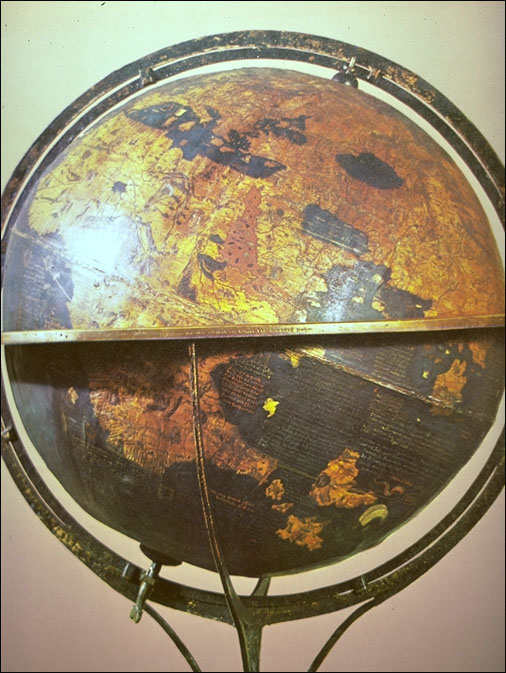
No terrestrial globes from ancient times have been preserved. While several Islamic celestial globes seem to have survived, there are no known terrestrial examples. Some records indicate earlier European terrestrial globes from the fifteenth century, with the Behaim Globe or Erdapfel, crafted in Nürnberg by Martin Behaim (1459–1507), being the earliest surviving terrestrial globe. This sphere was produced by Hans Glockengiesser (a name meaning bell founder) and Ruprecht Kolberger. The map was illustrated by Georg Glockendon (d. 1514), and the inscriptions were created by Petrus Gegenhart. Until that point, all globes were individual, handcrafted items, often termed manuscript globes. The invention of printing in the fifteenth century altered this landscape.
The earliest known printed globes were small globes produced by Martin Waldseemuller (c. 1470–1520) based on his world map from 1507, which was the first to label America. Although none of the actual globes exist today, four sets of globe gores have survived.
The mass production of printed globes commenced with the Nürnberger mathematicus, Johannes Schöner (1477–1547), who created his first printed terrestrial globe in 1515, also rooted in Waldseemüller’s world map, and a corresponding printed celestial globe in 1517. This initiated the tradition of pairing terrestrial and celestial globes. Schöner released a new set of printed globe pairs in 1533/34.
Correspondence indicates that Schöner was quite successful, selling a significant number of globes; however, only a few of his globes remain. He was not the sole Nürnberger mathematicus crafting globes. Georg Hartmann (1489–1564), who acted as Schöner’s globe dealer in Nürnberg while Schöner resided in Kirchehrenbach, also produced globes, but unfortunately, none have survived.
Both Waldseemüller, with his map, and Schöner, with his globes, published a corresponding cosmographia, a booklet containing usage instructions along with additional geographical and historical details. An enterprising printer/publisher in Louvain reprinted Schöner’s cosmographia, Lucullentissima quaedam terrae totius descriptio, and engaged Gemma Frisius (1508–1555) to create a replica of Schöner’s globe to complement it. Frisius became a globe maker, as did his former student and assistant Gerard Mercator (1512-1594), who later emerged as the most accomplished globe maker in Europe.
During this period, England lacked globe makers, and the first printed globes were brought into England in 1547 when John Dee (1527–c. 1608) returned from studying under Frisius and Mercator in Louvain, bringing with him several mathematical devices, including a pair of Mercator’s globes. It would take another forty years before someone initiated the production of printed globes in England, that individual being Emery Molyneux (d. 159 )