**Oliver Selfridge and His Impact on Contemporary Artificial Intelligence**
Oliver Selfridge emerged as a trailblazer in the realm of artificial intelligence during its early development. His seminal research in 1959 unveiled what is referred to as the ‘pandemonium architecture,’ which established the groundwork for ideas that ultimately transformed into contemporary machine learning and neural networks.
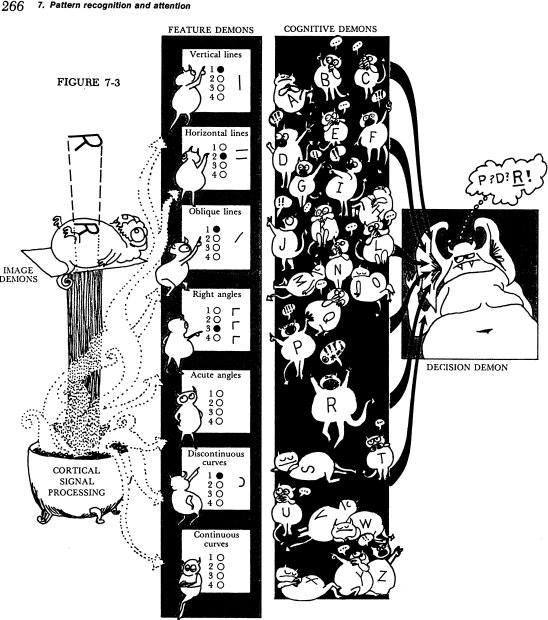
The fundamental concept of the pandemonium architecture involved a framework of simple entities, or “demons,” each assigned a particular role. These demons function within a network, working together to carry out complex cognitive tasks. At its core, this model reflects how current neural networks function, employing layers of nodes to analyze data and reach conclusions.
The pandemonium concept received broader acknowledgment through its illustration by Leanne Hinton, which appeared in the 1977 textbook ‘Human Information Processing’ authored by Lindsey and Norman. These images, celebrated for their playful and captivating demon characters, stand out for their innocent simplicity, which aided in clarifying the abstract notion of parallel processing for a wider audience.
In addition to his contributions to AI, Oliver Selfridge enjoyed a diverse career that included authoring four children’s books. He was married three times and played a role in uncovering the NSA’s secret surveillance activities related to the Echelon program. Despite the importance of the pandemonium model, the illustrator Leanne Hinton’s contribution is frequently overlooked in discussions surrounding this work. An effort to validate her role in creating these delightful illustrations remains unconfirmed.
Selfridge’s legacy is distinguished by his inventive approach to artificial intelligence, and his influence continues to permeate the principles that form the basis of modern AI technologies, reflecting his vision and creativity.