An international investigation has shown that minor differences in experimental methodologies can greatly affect flow battery efficiency, underlining replicability issues within the discipline. As renewable energy systems generate variable power, flow batteries play a vital role in energy storage, employing liquid electrolytes to retain energy for prolonged durations. Despite progress in the domain, worries remain regarding the absence of standardization and clarity in laboratory practices.
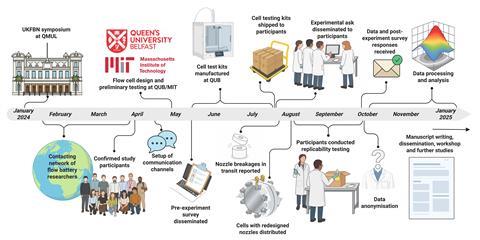
Following a conversation at the 2024 UK Flow Battery Network symposium, researchers led by Josh Bailey and Hugh O’Connor from Queen’s University Belfast, along with Fikile Brushett and Alex Quinn from MIT, initiated a study involving eight research teams in the UK, US, and Netherlands. Each group received the identical 3D-printed flow battery and was instructed to apply common electrochemical techniques to assess performance, using a ferricyanide/ferrocyanide electrolyte in a symmetric arrangement.
The collected experimental data was anonymized to avoid bias when comparing polarization, impedance, and charge–discharge cycling outcomes across laboratories. Bailey observed unanticipated discrepancies in participant-controlled variables. These encompassed different techniques for electrode cutting, preparation of electrolyte batches, and configurations for electrical connections. Such varied practices resulted in significant differences in results, with area-specific resistance standard deviations reaching around 40% of the average in certain instances, mainly due to variations in electrical connections. Electrolyte usage also exhibited notable discrepancies, with variations up to approximately 10%.
Electrochemist Anqi Wang from King Abdullah University of Science and Technology noted the study’s revelations regarding factors of test variability that are infrequently discussed in the literature. Kiana Amini from the University of British Columbia highlighted the importance of quantifying these differences, acknowledging their influence on flow cell data.
Bailey intends for the study to inform subsequent inter-laboratory comparisons, co-managing a larger investigation across 35 institutions to reduce replicability errors in the flow battery sector. The study emphasizes the vital nature of test protocol specifics in flow battery research, reinforcing the necessity for dependable, standardized techniques to ensure consistent and reliable findings.