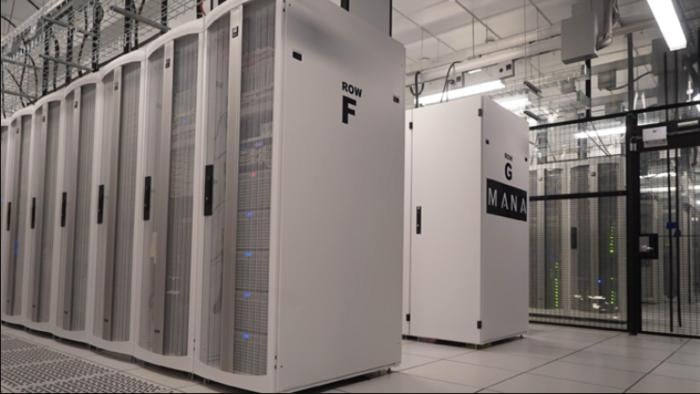
Somewhere right now, in a dim hall filled with buzzing server cabinets, a structure is exhaling. Chilly outside air is drawn in through louvered vents, flows over rows of processors running hot, and exits warmer on the other side. No chillers, no refrigerant, hardly any extra electricity. It represents one of the most economical and eco-friendly strategies in the data center handbook, known as: direct air free cooling.
The downside is that it operates effectively only when the external air is cool and dry enough. Unfortunately, that is increasingly becoming an issue.
A research team led by Christina Karamperidou, an atmospheric scientist at the University of Hawai’i at Manoa, has calculated how often the weather actually assists, both now and in the coming decades. Publishing in Scientific Reports, they combined high-resolution hourly weather data with climate model forecasts and a global map marking the locations of data centers. Then they posed a deceptively straightforward question: how many hours each year are the conditions too hot and too humid for outside air to facilitate cooling? The answer, it turns out, has been trending in the wrong direction for some time.
“We discovered that time periods with temperatures and humidity levels surpassing the recommended operating limits for direct air free cooling are growing more frequent and lasting longer in various regions,” Karamperidou states. “This will diminish the availability of air free cooling for an increasing number of data centers worldwide.”
When Outside Air Loses Its Effectiveness
Over the last 45 years, the researchers found that the number of hours characterized by the sticky, oppressive conditions that hinder air cooling has significantly increased. Not every location is affected equally, of course. The worst occurrences cluster in the tropics and, closer to many American operators, the southeastern United States, that humid area where the air often feels like a warm blanket much of the summer. A detailed examination found the number of data centers experiencing these limiting conditions for at least a quarter of the year is rising.
Humidity plays a sneaky role in the situation. We usually focus on temperature, but a server hall seeks not just cold air, but air that can also absorb heat, and humid air performs poorly in that aspect. If moisture levels rise too high, operators risk condensation forming on the very electronics they aim to protect, which is exactly what you want to avoid around several hundred million dollars’ worth of hardware. Therefore, the critical threshold is a combined one, temperature and humidity together, and the climate is altering both.
It’s the Most Challenging Days That Keep Engineers Awake
Here’s the twist that the team found most revealing. The significant changes are often not apparent in the averages. In multiple areas, the worst-day scenarios, those infrequent extreme stretches, are intensifying more rapidly than typical circumstances. The pressure, in other words, is becoming concentrated into fewer but more severe events.
That difference is not merely theoretical. “From an operational standpoint, those worst-day conditions frequently dictate contingency planning, system overrides, redundancy needs, and decisions about reliability,” explains Karamperidou. A facility might manage an average year adequately while still facing challenges during the three or four days when everything heats up simultaneously. She suggests that planners might need to take into account not just average conditions but how the most trying days are evolving.
And the timing couldn’t be more inconvenient. The artificial intelligence surge is spawning new data centers at a rapid rate, each one demanding immense power, just as the climate restricts one of the most effective methods to prevent them from overheating. When free cooling fails, the alternative is mechanical refrigeration, which consumes more electricity, or evaporative systems, which waste water. Each megawatt of AI we introduce puts more pressure on that trade-off. “Our research explored a question positioned at the crossroads of climate, computing, energy, and water resources,” says Karamperidou, and you can discern in that context how intertwined the issues have become.
None of this implies that the humming halls are on the verge of silence. Engineers are an inventive group, and the response will likely blend smarter locations (constructing where the air remains accommodating), enhanced heat-tolerant equipment, and cooling techniques that do not rely on either inexpensive cold air or scarce fresh water. The core aim of the study is less about despair and more about guidance: it highlights where the pressure is increasing, enabling the industry to prepare accordingly rather than being caught off guard. Karamperidou hopes the findings assist in identifying where innovative strategies might mitigate the trade-offs among reliability, energy consumption, and water usage. Which, given how much of contemporary life now relies on these facilities, is a challenge worth addressing sooner rather than later.
DOI / Source: [Limitations to Air Free Cooling in Data Centers under Rising Heat and Humidity](https://doi.org/10.1038/s41598-026)