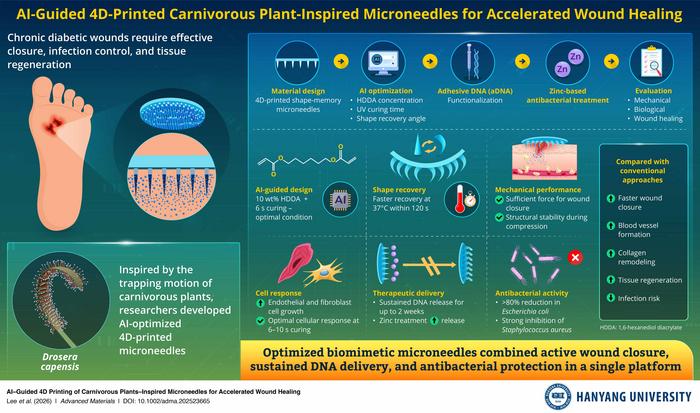
The needles initially appear straight, arranged neatly in a formation not wider than a fingertip. When you apply the patch to warm skin, they start to move. Within two minutes, they have intertwined into a coil, akin to countless tiny fingers tightening their hold, drawing the edges of a wound together from within. No one is twisting a screw or pulling a thread. The needles are merely reacting to the body’s heat, performing exactly as they were designed.
This intrinsic behavior is the result of a team spearheaded by Hyun-Do Jung, an associate professor at Hanyang University in Seoul, inspired by an unexpected source: a meat-eating plant. Drosera capensis, known as the Cape sundew, ensnares insects by curling its adhesive tentacles around them, securing them firmly, and subsequently breaking them down through a chemical process. Jung’s team integrated these three functions — coordinated movement, adhesion, and an inbuilt defense against microbes — into a singular device for wound healing.
Taking Cues from a Predator
The movement aspect is the most ingenious, utilizing what material scientists describe as a shape-memory polymer. The needles are crafted from two acrylates, mixed and hardened under ultraviolet light via a 4D-printing technique (with time being the fourth dimension, as the shape modifies afterwards). When heated to 70°C and then straightened, the polymer retains this flattened temporary shape until it is warmed again. At room temperature, it remains mostly inactive. At 37°C, the temperature associated with human tissue, it returns to its original curl, achieving full bend in approximately 120 seconds. In other words, the wound closure occurs the instant the patch contacts living skin.
Getting this timing precisely right is more challenging than it may seem. The shape recovery relies on a complex interplay of variables: the quantity of crosslinker added, the duration the resin is exposed to the lamp, and the warmth of the environment. Manually working through every combination would require an immense amount of time.
Thus, the team delegated the challenge to machine learning. They developed three distinct algorithms to forecast how the printed material would respond, and one, utilizing a technique called Gaussian process regression, significantly outperformed the rest, predicting the recovery angle with over 99 percent accuracy and, importantly, indicating its confidence level each time. This enabled the researchers to determine an optimal formulation and a printing schedule that balanced rapid shape change with the necessary structural rigidity for the needles to penetrate skin effectively.
For Jung, this fusion of biology and computation is the essence of the work. “This study transcends traditional biomimicry by employing artificial intelligence to transform nature-inspired concepts into a functional biomedical device. The crucial aspect of this research is that it’s not only inspired by nature, but AI is instrumental in converting biological inspiration into a predictable, programmable, and clinically relevant wound-healing technology,” he stated.
Sealing the Wound, Then Healing It
Merely sealing a wound would only constitute half of the treatment approach. A wound that is kept closed but remains exposed risks festering, and for individuals with diabetes — whose wounds heal at a slower pace, remain inflamed, and can become septic far too easily — infection is often what escalates a minor injury to a severe condition. This is where the sundew’s additional capabilities come into play. The needles were coated with adhesive DNA nanoparticles, crafted using a sticky chemistry derived from mussels, which are gradually released into the wound and stimulate the cells responsible for creating new blood vessels and connective tissue. They also reduce the reactive oxygen molecules that perpetuate chronic wounds in their inflamed condition. Additionally, an extraordinarily thin layer of zinc, introduced through an ion-implantation technique, provides antibacterial strength. In laboratory tests, it reduced colonies of Escherichia coli by over 80 percent and effectively targeted Staphylococcus aureus as well. The zinc also serves a secondary purpose: by densifying the polymer surface, it slows down the DNA release, prolonging it over a fortnight or longer.
When applied to a diabetic mouse’s wound, the results are evident. Wounds treated with the complete system closed more rapidly than those receiving saline, showing nearly full skin regrowth by day ten, along with denser and more organized collagen and a surge of new blood vessels. Markers of inflammation decreased. Certain characteristics of healthy skin, such as hair follicles and the small glands that maintain skin moisture, returned at rates up to six times higher than those observed in untreated wounds.
However, this does not mean a sundew patch will be ready for your bathroom cabinet next year. The work has been conducted on mice, not humans, and a