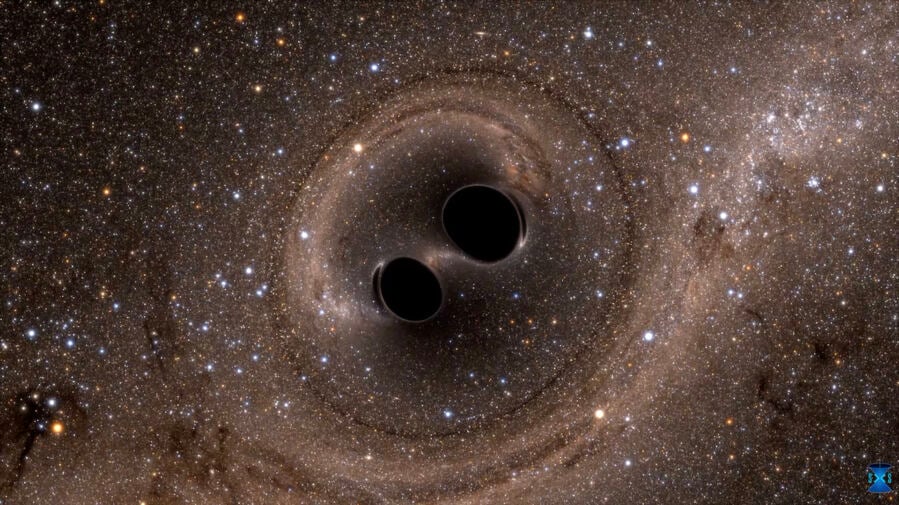
Sizheng Ma had already identified what he sought before he set out. He and his team had dedicated months to determining, on paper, how a specific distortion of spacetime would manifest as it arrived on Earth as a gravitational wave. They then focused on the most significant black hole collision recorded by LIGO, which occurred on 14 January 2025, and began scouring the signal for that particular anomaly. It was present.
What they discovered represents, in a sense, the signature of a black hole’s outer boundary: the manner in which its rapid rotation pulls spacetime into a swirling vortex. The findings, published in Nature on 24 June, provide physicists with their clearest insight yet into the region where gravity reaches its peak intensity.
To visualize “frame dragging,” set aside the black hole momentarily and imagine a spindle rotating quickly in a tub of honey. The honey close to the spindle gets entrained and pulled along with it. In proximity to a spinning black hole, the honey represents spacetime, and the dragging is so severe that nothing nearby can remain stationary; everything is compelled to rotate. When two such bodies spiral towards one another, the effect intensifies. Like ice skaters moving closer together and spinning faster, the nearer the pair approaches, the more violently the surrounding spacetime churns.
“As they come closer, the swirling strengthens, and at the final stage, the orbital motion is fundamentally influenced by this frame dragging effect,” says Ma, a postdoctoral researcher in the strong gravity group at the Perimeter Institute in Canada.
The final instant, the fleeting shift as two black holes merge into one, is where the new signal resides. The team refers to it as a “direct wave.” It oscillates at nearly double the rotation frequency of the newly formed black hole’s horizon, and it diminishes at a rate governed by another fundamental property of the horizon, its surface gravity. Both characteristics are encoded right there in the wave that traveled approximately 1.3 billion light years to reach us.
Why This Event, and Why Now
The collision itself, designated as GW250114, was not particularly unusual. The two black holes had masses around 30 to 40 times that of our sun, much like the duo responsible for LIGO’s first detection in 2016. What distinguished this event was its exceptional clarity. A decade of refinement in reducing instrument noise has made the detectors vastly more sensitive, and GW250114 emerged as the loudest binary black hole signal recorded, with a combined signal strength about four times the threshold required for most analyses. Loud enough, in other words, to probe for a feature that had never been extracted from actual data before.
Here, it’s helpful to understand what gravitational-wave astronomers typically listen for. The final echoes of a merger, referred to as the ringdown, consist of quasinormal modes: characteristic frequencies that a black hole resonates with as it stabilizes, much like a bell when struck. They are certainly valuable. However, those frequencies relate more to the light ring situated farther out, rather than the horizon itself. The direct wave differs. It is the final emission of radiation from the infalling matter as the horizon engulfs it, carrying information from significantly closer proximity.
Isolating it was meticulous work. The direct wave coexists with the louder quasinormal modes, so the team initially needed to filter out those familiar frequencies mathematically before the hidden signal could be revealed. Once they did, the remaining oscillations aligned remarkably well with their theoretical predictions.
A Theory Built First, Then Confirmed
The sequence of operations was crucial. “Before this paper, we released a theoretical paper discussing how to interpret this signal, and then, with that theoretical framework, we proceeded to look for this signal from the recent gravitational wave event,” Ma states. “We were fortunate to detect it because this event was the loudest to date.” He believes the challenging part was never the data analysis but rather the physics that preceded it: determining which aspects of the wave correspond to which features of the horizon, and understanding why it oscillates as it does.
And when theory aligned with observation, Einstein stood firm. Once more. The observed characteristics of the direct wave align perfectly with what general relativity predicts a rotating, well-behaved black hole should emit. “You can observe this gravitational wave signal and overlay it with Einstein’s prediction, and they coincide very closely,” Ma notes. “When you consider it, that is remarkable.”
There is a hint of irony in that, naturally. Many physicists would ardently wish for general relativity to…