The stall at my corner in Bangkok offers grilled pork on a bamboo skewer, and in Thai, it is *moo*. The creature it originates from is also referred to as *moo*. There is no alternative term reserved for when the creature ceases to live, no Latinate barrier obscuring the exchange. If you desire pig, you request pig, and then you consume pig.
English stands out in this context, and there is a neat explanation for this, reiterated often enough that it has solidified into accepted truth.
## Origin of the Narrative
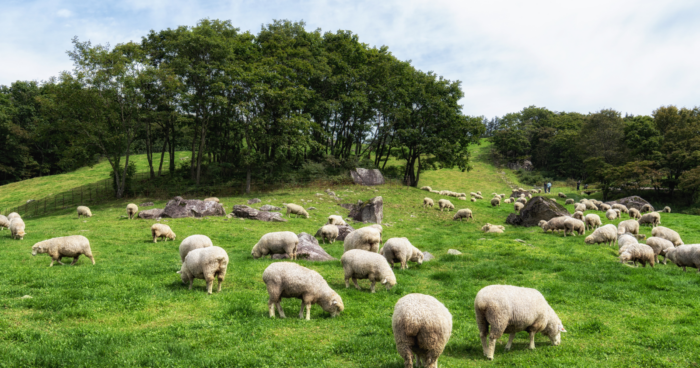
Open [Ivanhoe](https://www.gutenberg.org/ebooks/82), and you encounter Gurth, a Saxon swineherd, alongside Wamba, a jester who has made an insightful observation. Swine is fitting Saxon, Wamba elucidates, yet the sow skinned and suspended upside down transforms into pork, a term borrowed from good Norman-French. The animal retains its Saxon title while it remains under care, adopting a Norman label the instant it transitions into a delicacy.
Walter Scott published this in 1819, setting it in 1194. It encapsulates conquest, class, and desire into a jest between two men in a forest, which is why it has been recited for two hundred years as if Scott were simply relaying it.
He was not the initial one to notice the trend. In the Eger Journal of English Studies, the linguist [Tibor Őrsi](http://publikacio.uni-eszterhazy.hu/3336/1/Orsi_49-58.pdf) traces this observation back to the grammarian John Wallis, who documented the word pairs in 1653. Scott provided the antagonists.
## The Chronology Does Not Align
Beef appears in written English around 1300. Pork does as well. Mutton too. The Online Etymology Dictionary verifies that both [beef](https://www.etymonline.com/word/beef) and [mutton](https://www.etymonline.com/word/mutton) emerged around that time frame; Őrsi’s examination of the Oxford English Dictionary and the Middle English Dictionary supports this timeframe. When contrasted with the 1194 of Scott’s narrative, this reflects a roughly century-long gap, and is well over two centuries after Hastings. Őrsi cites English historian Albert Baugh, whose conclusion was that the event simply occurred about a hundred years too soon.
That is not a mere rounding mistake.
The linguist [Colin Gorrie](https://www.deadlanguagesociety.com/p/1066-french-words-in-english) contends that the entire notion of a linguistic conquest is inaccurately dated. For the initial century following 1066, French words were integrated into English at an approximate rate of one every eight years, and those that did arrive were primarily the vocabulary of nobles and clergy: war in 1116, duke in 1129, nativity as early as 1105. By around 1250, the integration accelerated nearly twentyfold, to almost three per annum. By that point, William’s heirs were speaking English at home. Very, which few recognize as an adaptation of French *vrai*, is first documented in 1384.
The influx occurred as French was relinquishing its control over England, not while it maintained authority.
## Beef Once Signified Cow
In [The Merchant of Venice](https://shakespeare.mit.edu/merchant/merchant.1.3.html), Shylock measures a pound of human flesh against “flesh of muttons, beefs, or goats.” He refers to the living animals themselves, still moving about, and Shakespeare penned this line in the 1590s, five centuries post-Conquest.
The [Anglo-Norman Dictionary](https://anglo-norman.net/eating-your-anglo-norman-words/) project at Aberystwyth University, which chronicles the French of medieval England, states the objection plainly. Throughout and beyond the Middle Ages, beef and mutton referred to the animals as well as the meat, so the clear distinction Scott presumed emerged centuries too late to reflect any authentic medieval separation.
Őrsi’s data confirms this with timelines. Mutton, denoting a live sheep, is attested as late as 1839. Beef, indicating an ox or a cow, remained in use until 1884, and collectively for cattle in America until as late as 1907. The term pork for the living pig came even later: this sense didn’t emerge until around 1425, and it had already declined by 1682. The original plural for that animal meaning was beeves.
Őrsi acknowledges lexicographer Robert Burchfield for first debunking the myth in 1985, precisely on that basis. His additional contention was that the significant surge of French culinary and gastronomic terms, the