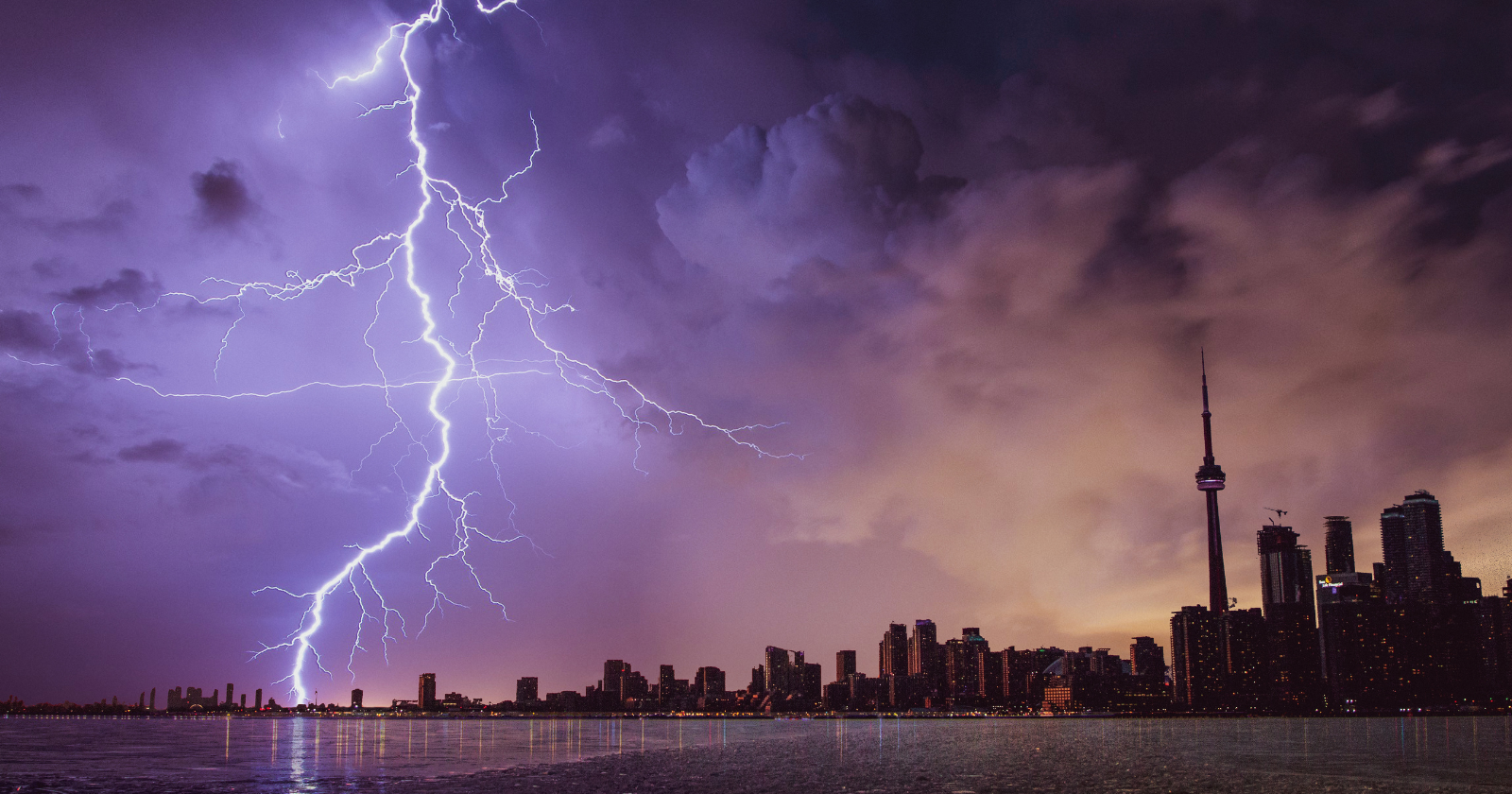
The lightning rod situated atop the Empire State Building follows a pattern. Several times annually, a stream of intensely heated air—about the size of your thumb—connects the spire to a cloud, releasing several hundred million volts through a copper strap, and disappears into the bedrock beneath Midtown. No one on the observation deck spills their coffee.
This renders the saying a bit perplexing.
The actual record states
The National Weather Service categorizes “lightning never strikes the same place twice” as a myth, alongside the notion that huddling in an open field will keep you safe. Its statistics for the Empire State Building indicate an average of 23 strikes per year, while New York City Emergency Management references the same agency for a more rounded figure of 25, adding one crucial detail that resolves the debate entirely: during a single storm, the building was hit eight times in just 24 minutes.
Eight strikes. Twenty-four minutes. The phrase fails to survive even one rough afternoon in Manhattan.
Even this underestimates the phenomenon. What we regard as a single bolt is commonly several discharges traversing the same ionised path just a few hundredths of a second apart, which is why lightning flickers rather than merely flashes. NOAA’s National Severe Storms Laboratory highlights that a negative cloud-to-ground flash might contain as many as 20 return strokes. A single strike, in the most straightforward sense, has already impacted the same location twenty times before the thunder sounds.
Toronto possesses superior instruments
New York earns the fame.
Toronto gains the data. The CN Tower is a 450-metre concrete column capped by a 100-metre steel antenna mast. Copper strips extend its entire length of 553 metres into grounding rods embedded beneath the base, and its operators claim the structure experiences about 75 strikes per year. Consider that figure with some flexibility. When researchers opted for optical counting of flashes over several seasons rather than relying on estimates, the long-term average was closer to 36 strikes a year, a statistic mentioned in a study regarding the tower’s most intense recorded lightning storm published in the Journal of Atmospheric and Solar-Terrestrial Physics. Same structure, half the lightning, based on who is tallying.
That storm is the aspect I continually revisit. On the evening of 24 August 2011, two cameras captured 52 flashes striking the tower in just over 84 minutes, approximately one every 99 seconds. In 90 minutes, the CN Tower absorbed more lightning than it typically receives in an entire year.
The tower does not linger
Most visualize a strike as something directed downward toward a passive object, much like a dart aimed at a target. Beyond about 100 metres, that perception becomes inaccurate. Tall structures can initiate their own upward leaders into the storm, a discharge that originates from the ground and ascends. Tom Warner and his team at the South Dakota School of Mines and Technology documented 81 upward flashes from ten towers in Rapid City from 2004 to 2010. In 80 out of those 81 instances, other lightning had already discharged nearby, distorting the local electric field enough to encourage the tower to strike first.
Thus, the spire functions less as a target and more as an active participant, frequently the initiator.
People are not towers
Roy Sullivan served as a ranger in Shenandoah National Park in Virginia, and between 1942 and 1977, lightning struck him seven distinct times. Guinness World Records still recognizes him as the person with the most lightning strikes on record. His hair ignited on more than one occasion. He began keeping a container of water in his truck, which can be seen as either grim practicality or the darkest humor within the National Park Service.
Sullivan is often regarded as a freak occurrence, and to some extent, he is one. He also spent four