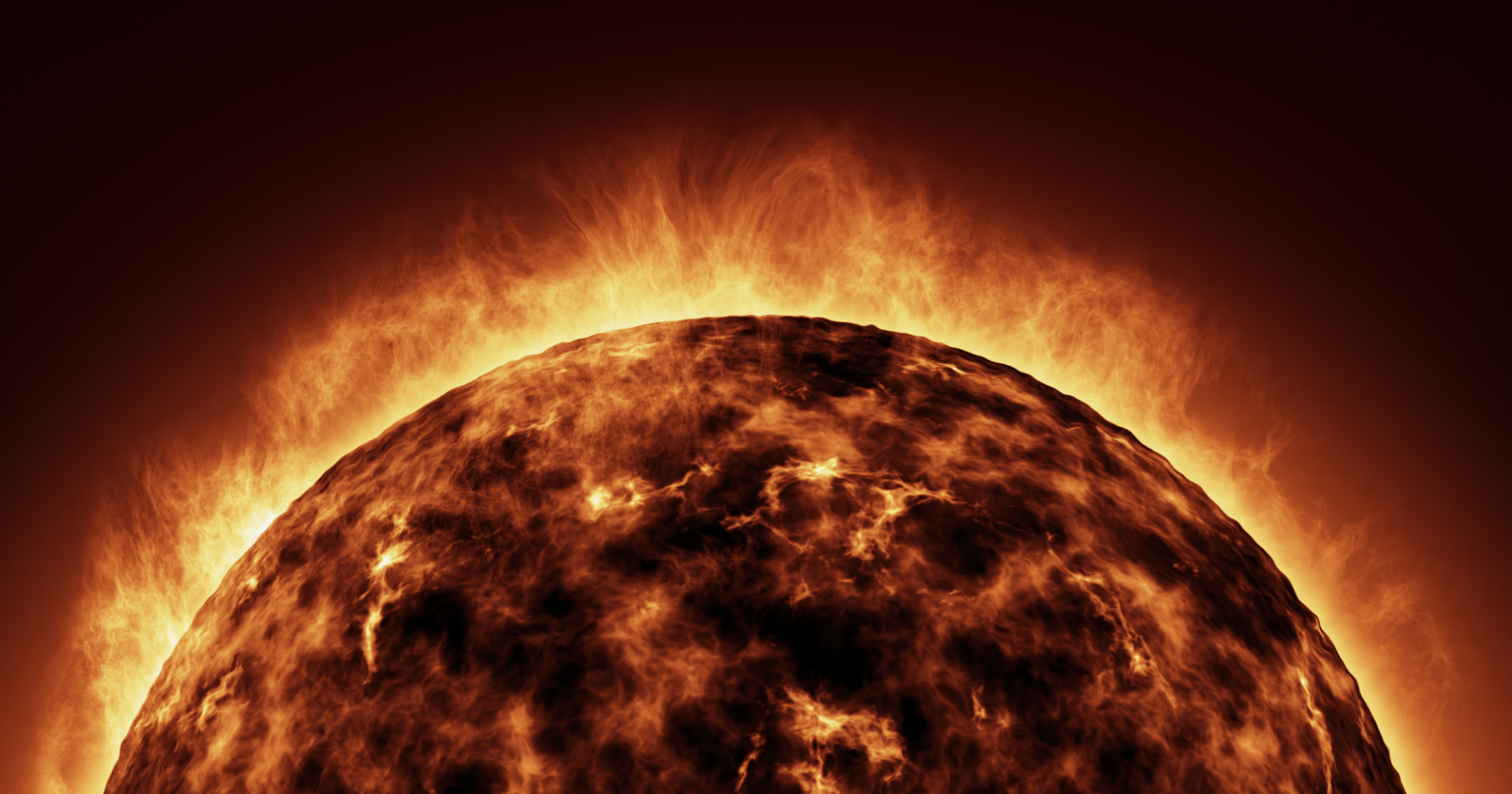
Every child receives the same little untruth packaged within a cardboard box of 24 crayons. Sketch the sun, opt for yellow. No one disputes this, partly because the object in the sky appears yellow, and partly because the yellow crayon remains the only one not reduced to a stub.
The sun is white.
Not white in any clever technical manner. Just plain white, akin to a sheet of printer paper presented in orbit.
What genuinely emits from the sun
The visible layer of our star, known as the photosphere, exists at about 5,500 degrees Celsius and is merely a few hundred kilometers thick, a delicate layer on an immense sphere of plasma, as NASA’s overview of the Sun indicates. At this temperature, it radiates across the visible spectrum, from violet to red, and the combination is such that human eyes perceive it as a single color: white.
The UCAR Center for Science Education states this clearly: sunlight reaches Earth’s atmosphere as white light. The yellow hue we perceive occurs only thereafter, while descending through the atmosphere.
This entire process happens in the last hundred kilometers of a journey that spans 150 million kilometers.
The sky takes its share
Air predominantly consists of nitrogen and oxygen. These molecules are significantly smaller than a wavelength of visible light, and when light encounters something this minute, it scatters sideways in all directions rather than reflecting off neatly.
Lord Rayleigh formulated the equations in the 1870s, and the crucial part is the exponent. Scattering is related to the inverse fourth power of wavelength, as described in Georgia State University’s HyperPhysics reference. Reduce the wavelength by half and you achieve sixteen times the scattering.
Blue light is short. Red and yellow are longer. Thus, the blue light is spread across the entire sky, while the longer wavelengths proceed more or less straight into your eye.
This means you are witnessing both sides of a singular transaction. The blue absent from the solar disk is the blue you are currently standing under. NASA’s Space Place explains the sunset variation of this phenomenon: as the sun descends, the greater distance its light has to traverse through the atmosphere means that more of the short wavelengths are filtered out before reaching you.
So, is it green?
This is where much of popular science veers off course. Solar emission peaks around 500 nanometers, situated in the green section of the spectrum, and if you interpret Wien’s displacement law literally, you might convince yourself to proclaim that our star is secretly green.
Jonathan Marr and Francis Wilkin dismantled that notion in the American Journal of Physics, available in full on arXiv. Their contention is that the blackbody curve is far too broad and too flat for any single color at the peak to be prominent. A peak on a graph is a statistical characteristic, not a visual one. Your retina processes the entire spectrum and reports back as white.
This is one study, and a teaching argument rather than a groundbreaking discovery. The underlying physics has never been contested.
Why the illusion persists
Mainly because you cannot verify it. Gazing at the sun is a poor choice, therefore very few have a clear point of reference, and the two instances when it is safe to look, sunrise and sunset, are exactly when it genuinely appears orange.
Images also do not assist. Many well-known solar photographs are taken in narrow bands of the spectrum, often outside the visible spectrum entirely, then color-coded afterward so that the features can be distinguished. Every golden and red sun you have scrolled past was an artistic decision made by a graphics team.
Additionally, your visual system operates less like a camera and more like an editor with strong preferences. It consistently performs white balance adjustments, determining what is neutral based on everything else in view. This explains why paper appears white under a kitchen bulb and again white outdoors, despite the two light sources being distinctly different.
Even the haze contributes. The sky surrounding the sun appears pale rather than blue because scattering from larger particles is not particularly selective about wavelength.