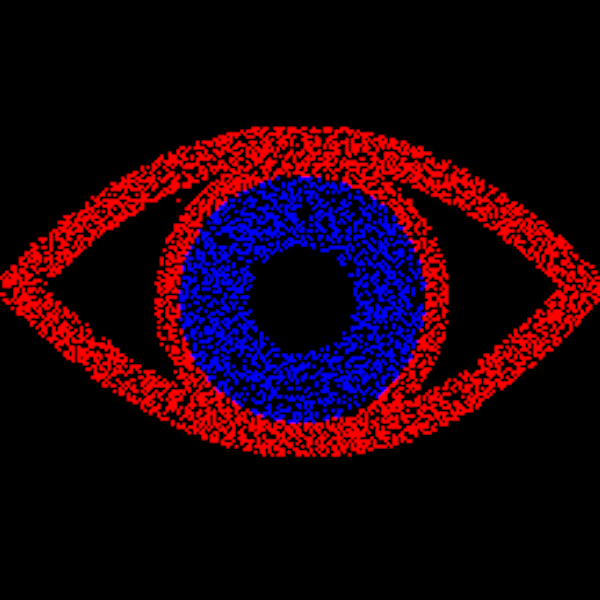
The impact differs among individuals. Take a second to observe this. Some viewers notice nothing unusual: merely a blue iris within a red eye.

For me, however, there is a remarkably strong illusion of depth – the blue and red seem to be positioned at varying distances.
I can amplify the effect by blinking quickly, increasing my screen’s brightness, and observing in a dim environment. Occasionally, it fades for a few moments before reappearing. Since the colors appear at different depths, they seem to move independently when I tilt my head side to side, which is obviously not possible for a still image.
This phenomenon is known as chromostereopsis, and it’s puzzling me for several reasons.
The first is that I believed I had encountered all optical illusions, and this one is entirely unfamiliar to me. Seriously, did all of you know about this and just kept quiet?
The second reason is that there are significant variations in how individuals perceive the effect. This is not only in terms of intensity, but as someone it strongly affects, I notice that people also vary in which color appears nearer. For the majority, red is perceived as closer, with blue appearing deeper or more distant. I belong to the minority, so if you share my view, this reversed image above should seem more natural: the iris appearing set deeper than the surrounding eye.

The third reason this effect strikes me as odd is that stereo-depth illusions typically depend on two images, separately shown to each eye. This is the principle behind 3D movies – you wear red-green or polarizing glasses, and the 3D elements of the film showcase two overlapping images, with each image being visible through only one lens, sending slightly varied images to each eye. Your visual system then merges these images and “unearths” depth information, enhancing the 3D interpretation of the displayed objects. The overlapping images cause the film to appear peculiar when the glasses are removed.

Chromostereopic illusions represent authentic stereo illusions – they necessitate the integration of information across both eyes. Numerous depth illusions are not stereo illusions, but this one qualifies. You can validate this by closing one eye and making the effect vanish. The image remains unchanged, but both eyes are crucial for the depth illusion to manifest. You can also attempt to show this illusion to someone who is “stereoblind.” A small fraction of the population does not integrate information from both eyes, relying instead on other monocular cues for depth perception. Our visual system is so proficient in this task that many individuals go their entire lives unaware of their stereoblindness (though I suspect they tend to avoid careers requiring precise depth perception, like juggling).
The exact mechanism of chromostereopsis is not fully understood. Even the esteemed Michael Bach, who contributed to the Mind Hacks book, describes…