**Oliver Selfridge and the Pandemonium Architecture: A Legacy in AI**
Oliver Selfridge, a key player in the realm of artificial intelligence, transformed cognitive science with his groundbreaking concepts. His 1959 publication introduced the idea of “Pandemonium Architecture,” a framework that established the foundation for contemporary neural networks, greatly impacting modern machine learning advancements.
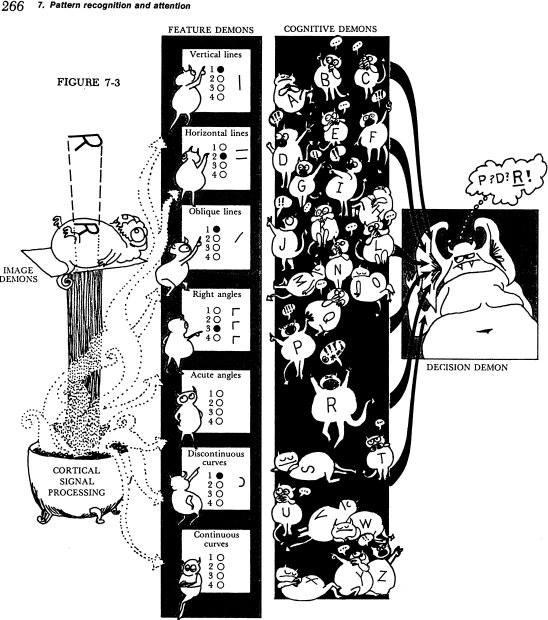
Selfridge imagined a mechanism where numerous basic units, each executing a specific function, could collaboratively address intricate cognitive tasks. Called the “Pandemonium Architecture,” this framework resonated with a broad spectrum of researchers and greatly contributed to the progress of AI. Notably, it underscored parallel processing, a principle that has become essential in the comprehension and advancement of artificial intelligence and machine learning.
The Pandemonium model received additional recognition through its feature in the 1977 psychology textbook “Human Information Processing” by Lindsey and Norman. This textbook included striking illustrations by Leanne Hinton, which depicted the model as a collection of amiable “demons” participating in cognitive tasks. These visuals, although characterized by some as reminiscent of a child’s nightmare, charmingly captivated the imagination of both students and educators, successfully conveying intricate ideas in a familiar manner. Despite their popularity, Hinton’s contribution often remains uncredited, as her involvement is frequently excluded from conversations.
Aside from his AI contributions, Selfridge’s varied career encompassed writing children’s literature and assisting in revealing the National Security Agency’s ECHELON surveillance initiative. His personal journey, defined by three marriages and his writings for the youth, showcases a versatile individual dedicated not only to scientific advancements but also to creativity and social causes.
Currently, while the principles of the Pandemonium Architecture persist in modern discourse regarding AI, there lingers a lasting intrigue about Leanne Hinton, the probable illustrator behind these legendary visuals. Efforts to validate her participation and request permission to distribute these illustrations have thus far been unacknowledged, allowing space for further investigation and recognition of her contributions.
For readers and academics fascinated by Selfridge’s endeavors and Hinton’s artwork, any extra details or corrections are greatly appreciated, fostering an ongoing conversation about these revolutionary achievements.