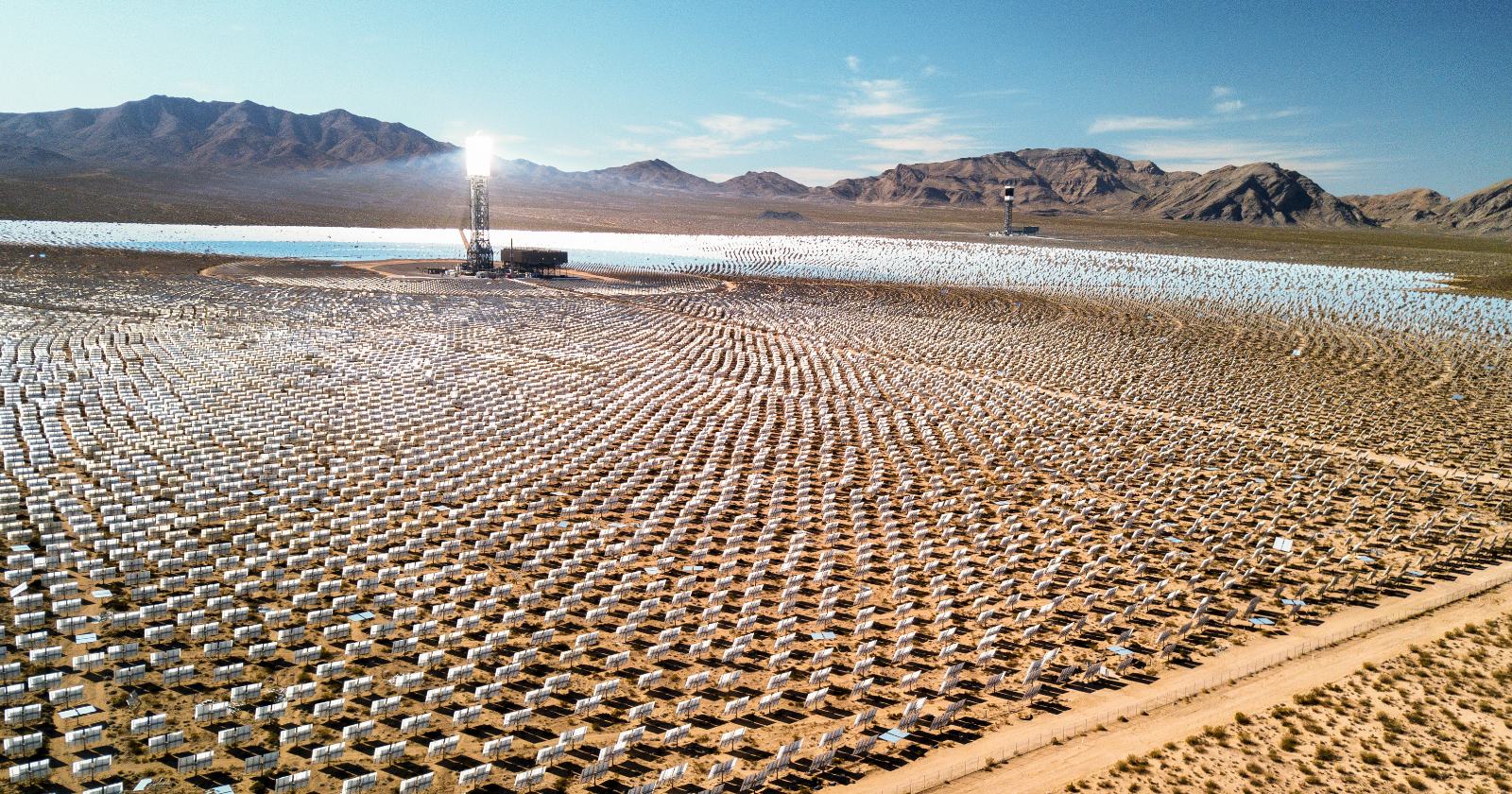
Motorists on Interstate 15, traveling between Los Angeles and Las Vegas, recognize the moment: the western desert floor suddenly twinkles, an expanse of five square miles, and three 459-foot towers majestically emerge from the glint, each topped with a block of light far too bright to gaze upon. The Ivanpah Solar Electric Generating System stands as one of America’s most extraordinary sights, envisioned to symbolize the future. It commenced operations in 2014 as the globe’s largest solar thermal facility, a $2.2 billion engineering feat supported by $1.6 billion in federal loan guarantees, with Google among its stakeholders, and it sells its energy to California’s largest utilities via contracts extending to 2039.
Fast forward eleven years, and its proprietors and primary client arranged for its partial decommissioning, and the surprising aspect is the rationale behind it. It’s not what most assume.
A facility powered by concentrated sunlight
Ivanpah does not fit the typical solar farm model; there are no silent photovoltaic panels conducting chemistry. Instead, it operates as a concentrating solar power plant, a mechanism based on the principle of a magnifying glass. Spanning the desert, 173,500 computer-controlled heliostats, each equipped with dual mirrors, follow the sun and redirect its light onto boilers atop the three towers, transforming water into steam that drives traditional turbines. Essentially, it functions like a coal plant, substituting aimed sunlight for coal, which was exactly its allure: unlike traditional panels, it could store heat in the working fluid and produce energy into the evening hours, and back in 2009, at the time of contract signing, it remained competitive in pricing against all solar technologies available.
The physics behind its operation also led to its most infamous issue. The air surrounding the receiver towers, where countless mirror-loads of sunlight converge, reaches temperatures around 1,000 degrees, resulting in a luminous glow that draws in insects, subsequently attracting birds that prey on them. A bird navigating through the flux field can ignite mid-flight, leaving a trail of smoke as it descends. Plant employees coined a term for this phenomenon, “streamers,” and the casualty figures became the project’s ominous shadow: a 2016 report by the Los Angeles Times estimated 6,000 birds annually perishing due to collisions or incineration while pursuing insects around the towers, a figure echoed as a minimum in a 2023 report by the Association of Avian Veterinarians. Estimates vary significantly, and the operators contest the higher claims, but the mechanism remains undisputed; Ivanpah is the sole facility in the U.S. with bird emissions that include flaming creatures.
Doomed by the mundane alternative
Here is the pivotal shift in the narrative that the bird-centric headlines overlook: none of this is the cause of its closure. The fate of Ivanpah was sealed by straightforward calculations, driven by the most unremarkable competitor. In the fifteen years following the signing of its contracts, conventional flat photovoltaic panels, which Ivanpah aimed to surpass, experienced price drops of approximately 90 percent, while Ivanpah failed to meet its expected output and resorted to burning natural gas each morning to heat its boilers in preparation for solar generation. By the 2020s, PG&E was purchasing electricity from Ivanpah at rates far higher than what newly established panel farms demanded, prompting the utility, under directives to reduce expenses for customers, to seek out contracts for renegotiation or termination. In January 2025, PG&E, the plant’s proprietors and the Energy Department finalized termination agreements regarding the two towers serving PG&E, with closures slated to begin in 2026, designed, in NRG’s terminology, to optimize the government’s loan recovery while benefiting ratepayers. NRG’s own acknowledgment encapsulated the sentiment: the plant was a successful display of a technology that photovoltaics had simply