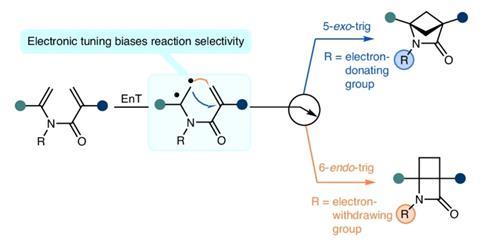
An intriguing breakthrough in organic chemistry illustrates that adjusting the substituent on a dialkene is essential for regulating the types of bicyclic rings produced during radical cyclisation reactions. This novel method contests the established ‘rule-of-five’, which typically anticipates a preference for the formation of five-membered rings in the radical cyclisations of non-conjugated dienes. According to this rule, the generation of a five-membered bridged compound is favored due to optimal orbital overlap and minimized ring strain. However, the pioneering work by Varinder Aggarwal and Robert Paton shows that substituents can steer alternative pathways, enabling the formation of ladderane structures, similar to the beta-lactam rings present in antibiotics.
Aggarwal’s research indicates that the intentional placement of electron-withdrawing groups, like acyl chains, on a nitrogen atom within an aza-1,5-diene, promotes ladderane formation over the bridged product typically produced with electron-donating substituents. The study highlights how changes in these substituents influence the stability and transition states of the involved radicals, presenting chemists with an innovative framework to control reaction results. Computational studies revealed the intricacies of ‘spectator’ radicals and the modification of radical pathway preferences through strategic electronic alterations.
The importance of these discoveries goes beyond academic curiosity; they offer practical applications in pharmaceuticals. With the capacity to generate varied bicyclic structures from readily available precursors, this research accelerates the evaluation of different molecular architectures for therapeutic potential.
Nonetheless, the findings also provoke significant inquiries regarding the wider applicability of these newly identified selectivity subtleties. In spite of these ambiguities, the discipline is progressing toward a greater acceptance of adaptable rule interpretations, marking the dawn of a new phase where molecular scaffold design moves beyond chance, becoming a intentional decision driven by well-founded scientific understanding.