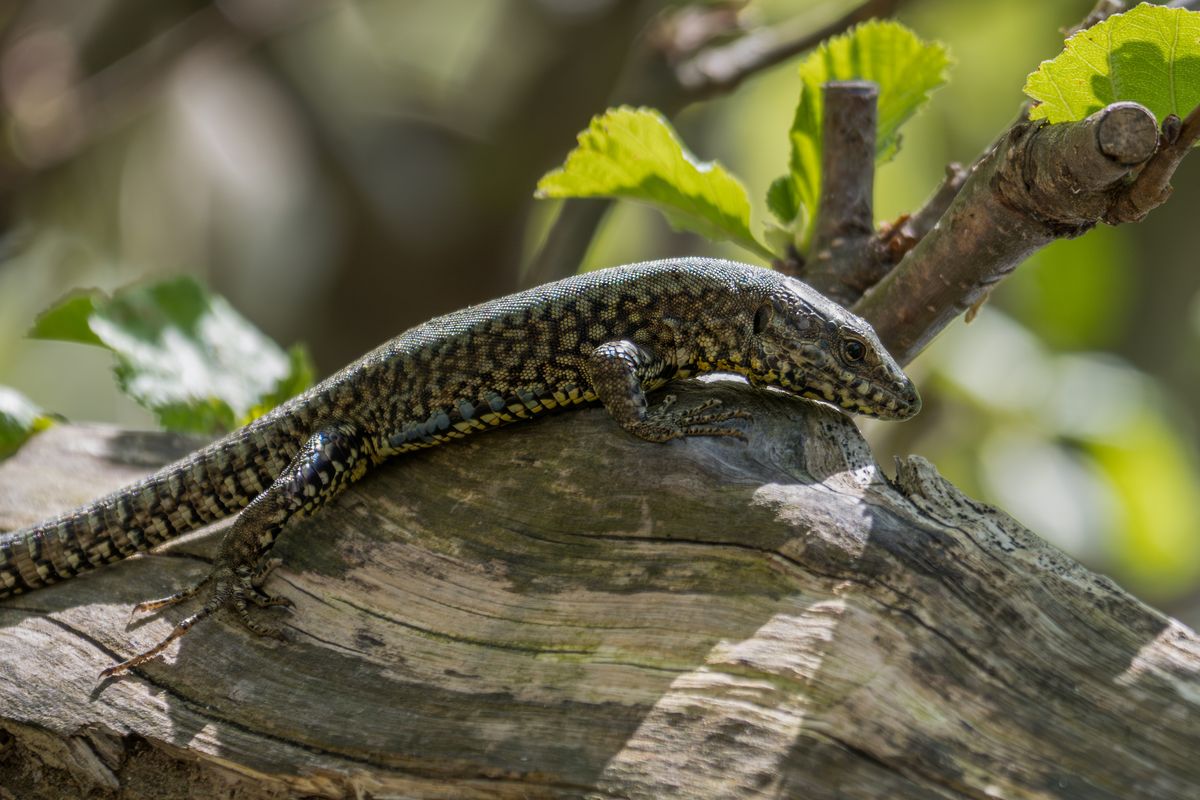
In 1971, ten lizards transported between two Adriatic islands served as the foundation for a remarkable comparative study. Their offspring not only formed a new population but also adapted their diets and evolved different feeding structures.
The transfer consisted of five male and five female Italian wall lizards, relocated from Pod Kopište to Pod Mrčaru in Croatia. A study from the University of Massachusetts Amherst highlighted changes in head shape, bite force, and digestive anatomy occurring within just 36 years. The creatures remained classified as Italian wall lizards, now generally referred to as Podarcis siculus and designated as P. sicula in the original publication.
The most remarkable aspect was the extent of change over such a brief period.
A new diet on the island
In the 2008 PNAS publication, Anthony Herrel and colleagues noted that plants made up about 34% of the stomach contents in spring and 61% in summer for the Pod Mrčaru lizards. In contrast, the figures for Pod Kopište were approximately 7% and 4%. The introduced population was consuming a varied diet featuring a significant plant component, rather than becoming strictly herbivorous.
Both males and females exhibited stronger bites. The researchers observed cecal valves in all examined specimens from Pod Mrčaru, including a hatchling and a juvenile, but these structures were absent in the source population. These intestinal features can hinder food movement and aid fermentation.
The authors interpreted the variations as rapid adaptive divergence, while explicitly recommending investigations into environmental plasticity and maternal influences. The observations alone did not reveal the genes involved.
A mechanical rationale from the jaws
A subsequent 2023 study on skull structure and function explored the relationship between head morphology and feeding efficiency in greater depth. The modeling analyzed jaw mechanics at various mouth-opening angles and skull shape combinations.
The findings indicated that the skull structure of the Pod Mrčaru lizards enhanced bite efficiency at wider gapes. This adds a mechanical aspect to the previous field data: the shape of the head influences how muscle force translates into bite force.
Relying solely on a larger head would not fully explain the changes. Key inquiries focus on the jaw arrangement, the muscles operating them, and the resultant performance. Evaluating an animal’s outline, measuring its bite, and modeling its feeding apparatus offer distinct types of evidence for comparison.
A subsequent dietary study added complexity
The gut dynamics became even more intriguing in a 2010 follow-up by Bart Vervust and colleagues. They observed longer food passage times and enhanced digestive efficiency in the Pod Mrčaru group, along with variations in tooth dimensions and digestive tract sizes.
They contrasted wild-caught lizards with others from the same island that had been maintained in captivity for 15 weeks on an exclusive arthropod diet. Cecal valves were observed in 12 of the 16 freshly caught Pod Mrčaru lizards examined, but absent in all 20 individuals from the captive diet group. The gut tissues also differed between the two sets.
The authors regarded this as preliminary evidence that some characteristics tied to the dietary change were plastic, meaning they responded to environmental factors. This comparison wasn’t a straightforward before-and-after examination of the same living specimens.
This distinction is crucial because identifying a unique structure doesn’t necessarily imply that it is permanently established by a novel mutation. The inherited ability to adapt to dietary shifts and the evolutionary transformation of that ability are separate inquiries. The follow-up prompted researchers to explore both aspects.
Insights from genetic analysis
A 2023 genomic investigation analyzed the populations using around 82,000 sampled genomic loci. It recognized a founder effect linked to the introduction and minimal neutral genetic divergence between the introduced population and its source.
Despite a decrease in genetic variation, the introduced population expanded. The researchers also identified potential genomic regions related to adaptation. They proposed that a combination of plastic responses and directional selection explained the observed outcomes.
Candidate regions serve as starting points for further exploration, but they do not provide a comprehensive genetic explanation for all features of the animals. A population can retain close genetic ties to its…